
Mother’s Milk
by Christine Lajewski
Horrific Scribes Extremity Rating:

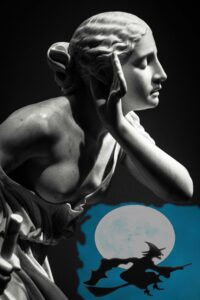
Her milk always let down when the news was bad.
So many centuries had passed–and she was an ancient, hobbled shadow of her once exalted self–yet it still let down. The more horrifying the tragic news, the more copious the flow. If the horror was the result of greed or hubris, as it so often was in the long history of humankind, baleful nourishment flooded, almost enough for the world entire. But The Mother never used it all, even though her shriveled, sagging dugs pained her throughout the year. The bottles she filled annually numbered twelve times twelve, one lot for each lunar cycle. The milk was thick and liver colored, and it blackened as it cured.

In mid-December, dark of the moon, Ulrike, the last of the Clan Mother attendants, shuffled in with a dozen bottles for the last expressing of the year. She was almost as old and withered as The Mother. Her arthritic hands struggled to clasp the vessels to her chest. One escaped her grasp, slipped to the floor, pinged off the stone hearth, and shattered. “Oh, Mother Holle, I’m so sorry,” Ulrike bleated.
The Mother, who had been dozing by the fire, snapped to attention at the sound of that name. Mother Holle was the label of her shame, of her demotion by men to a caricature in fairy tale and legend. Her face, which resembled the last apple lost in a dark corner of a root cellar, creased with scowling furrows. Her dark eyes narrowed and beaded in on her ancient attendant.
Ulrike squeezed the remaining bottles close to her body and carefully lowered them to the table next to The Mother. Then she fell to her knees and groveled on the flagstone floor until her mistress lightly tapped her shoulder and bid her rise.
“It’s not your fault.” The Mother made a sign of blessing and waved her away. “Fetch another. It need not be clean. Not this year.”
Ulrike’s eyes misted with gratitude as she swept up the broken glass and backed out of the room. She hadn’t been afraid, not really. The Mother was compassionate with those who still honored her.
Ulrike returned with the twelfth bottle, clouded and grimy. The shrunken goddess opened her robe, took the vessel in one hand, a breast in the other. The pendulous sac felt like it was filled with stones. A stab of pain shot from her ribs to her nipple as she squeezed, but as umber clots squirted into the container, the discomfort eased. She could concentrate on thoughts and images that would suitably render the milk bitter enough for this year’s 144 chosen babes.
But first, she reflected on those glorious centuries when everyone venerated her as The Mother. She closed her eyes and smiled as her heart throbbed with the mutual love that had so long sustained her. Those were the generations when she walked, lovely and voluptuous, among her people, the very earth springing to life wherever she stepped. Her milk fell as honeyed rain and nourished the fields. When refugees fled war and famine and terror, she could even release it over them as small, sweetened loaves. The people loved her, lavished gifts on her altars and sang her praises. These blessed memories would add to her milk a sweetness the babes would immediately crave, even after it was replaced with the bile of resentment. She filled each bottle one-quarter full, then cleared her mind so she could concentrate on her grievances.
She’d been replaced. The male gods came with their priests. First, they pushed her aside; they crowded her out. They gave her a narrow corner where she could still receive obeisance and offerings. This was the time of the Clan Mothers, who shared her wisdom with other women, openly at first. But then came the priests who violated her altars and destroyed her images until the only places left for her were the dark forests and lonely peaks. The teachings of the Clan Mothers became secret and privileged. That did not stop her enemies from rooting out her acolytes, rounding them up for burning. The Mother let down the milk of mercy to douse the flames. But the priests piled on more fuel and more fuel until her adherents were reduced to silence and ash.
They mocked her with her new name, Old Mother Holle. She became patroness of the homey crafts. They ascribed to her new stories meant to frighten disobedient children.
When she visited her holy sites, she found altars overturned, choked with briars. Clubs had smashed her own images, the smiling mouths now homes for spiders that mocked her with their weaving. Her life-giving milk was no longer wanted. Even the starving hordes no longer asked for her boon. The Mother had always offered sustenance without question to anyone in need. Now, when the people begged their gods for aid, the deities put conditions on their benefices. “Does your god have the proper name? Have you worked for it?” they asked through their priests. “Have you worked hard enough? Have you shared your worldly goods with the priests?”
The goddess became Old Mother Holle. Her robes decayed. Her hair grew snarled and dirty, and her visage took on the damaged, lopsided look of her ruined idols. The spurned milk soured in her breasts until she stank of it. But no one noticed. When she walked among people, they did not seem to notice her, even as she left a trail of blackened footprints through their villages and fields.
It was Mother Holle, not the great maternal figure, who finally retired to the deepest, darkest woods she could find, accompanied by a trio of Clan Mothers who still venerated her. As Mother Holle, she discovered her new purpose.
For many years, her Clan Mothers went out into the world for her and brought news of the greatest miseries across the world. Her breasts ached to relieve the suffering. If she attempted to reenter the world of men, villagers pelted her with stones and called her “witch” and “hag.” The crone eventually surmised that if the needy could not turn away, she could save them. Night after night, Mother Holle traveled the world with her attendants, visiting one impoverished, plague-stricken or war-ravaged village after another. She laid her crooked hands on the foreheads of children who slept with empty bellies and blessed all of them into new forms. They became seedlings that she planted around her cottage. She made the skies rain with her milk, and the saplings quickly grew into tall and sturdy trees. They crowded around the house, shutting out the sunlight, rendering the forest darker still. And although the trees wanted for nothing, they swayed and moaned throughout the night as if crying out in anguish.
The old enchantress thought the children might be grieving for their lost families. It took her a year, but she returned to each village and turned the children’s parents into grackles, stuffed them in a great sack and released them at her cottage to keep the trees company. But the birds flitted among the branches, screeching and squawking with rage. They never seemed to sleep. They dashed against the shutters and tore apart the thatched roof with their beaks. They flocked and attacked the Clan Mothers whenever they went outside. Enraged at their rejection, Mother Holle retreated with her helpmates to a new home even deeper in the woods.
After a few days, her anger subsided. She flew and spread wide her ever loving arms over the children’s grove. Her cloak unfurled, spreading out like winter clouds. Milk fell like snow showers over the wood to feed the trees. But her milk had turned dark and foul smelling, snow transmuted to ash. The trees bowed and twisted away, shunning the old goddess. The grackles swarmed and streamed up into the sky, right into Mother Holle’s face. They beat her with their wings and pecked at her eyes. She shrieked, and her cloak became black thunderheads. Lightning split the trunks and sparked a conflagration that spiraled into the black sky. The grackles circled the fire storm, screaming for their burning children until, overcome by heat and smoke, they plummeted, wings aflame, into the pyre.
The blaze was so intense that the people of the village miles away had seen it illuminating the night sky. Several of them arrived the next morning to inspect the scorched forest. The villagers marveled at the destruction, how the flames had died out after burning a vast but perfect circle in the woods, leaving the rest of the forest unscathed. They pointed at the twisted, blackened trees, bowed by the torturing fire, the heaps of scorched birds, and babbled with fearful wonder. Mother Holle watched from the shadows and knew she had lost all hope of securing their love and loyalty.
“Who’s that?” cried one of the men, and he pointed to an old woman, bent with sorrow, shuffling into the woods.
“Witch! Sorceress! Crone!” the people cried. They flung stones and gave chase, but the old goddess rose into the air like a great carrion bird and escaped.
Now she was worse than unwanted. She was reviled. She was truly the noxious witch of legend, hurtling through the skies on a spinning staff or broom. She heard the mocking tales told before the hearths where she was no longer honored, the words rising up the chimneys like scalding embers. The Clan Mothers could no longer soothe her.
Mother Holle spent years writhing in impotent rage. One day, a woodcutter came into her forest, not with an ax on his shoulder but with two small children in tow. They could not have been more than four years old. She heard the lies he told the boy and girl, and they sent pain slicing through her breasts. Her milk immediately let down and leaked onto the ground.
Mother Holle waited and listened as the woodcutter strode through the brush and disappeared, as even birdsong faded into silence, and dusk filled the woods with shadows. The children sobbed in hunger and fear. They were so young they did not even know enough to gather the berries that were within easy reach. She went to them, brought them to her house and folded them into her bosom. At first, the babes shrank from her breasts, but the initial sweetness fixed a craving in them. They pulled away after a few minutes of nursing. “Oh, it’s bad. It tastes bitter,” said the girl. Yet both children latched onto the teats again and suckled as if they could never be filled.
By the next morning, and over the next several days, the children demanded to be fed. At first, they begged timidly for sustenance. But they soon began to shriek like little woodland imps, their faces twisted with black fury. As she nursed them, Mother Holle smiled in a way that caused Ulrike to take a step back and ask, “What are you planning?”
“My return,” the old goddess replied.
Weeks later, she guided the little ones back to their home village on Market Day. Sure enough, the woodcutter stood in the market among his friends, regaling them with bawdy jokes. The hooded crone pushed the children forward, then quickly retreated to a dark corner. The little ones ran to their father, not with tears of relief but with howls of rage. As the children told their story, the villagers realized what the man had done and corralled him in a circle of pointing fingers. He sputtered excuses, but his children only screamed louder. The constable took him to the stocks. Mother Holle shuffled away, satisfied with the performance of the recovered babes.
After the woodcutter was released, he was forced to take back his children and care for them, supervised by the village elders. His life became a familial hell. Mother Holle knew because she visited the young ones in the night as they slept, suckling them well beyond the age when either would normally accept the teat. They grew in malice and cruelty, beating and starving their father when he grew too old to defend himself. They spread vice and sorrow everywhere they went, to their spouses, offspring, and neighbors.
Halfway through filling the bottles, The Mother pondered how much her fortunes had changed after the woodcutter’s children reached adulthood. She finally had a target for her fury and a way to upend the order of things. She began to travel from town to town, country to country. She followed human tragedy and discord, selected a child or two to suckle, and watched them grow up to spread more horror, more despair. Long ago, her milk always let down when the needy begged for her mercy. Now this new vile nourishment rained when the wicked cried out in exultation. She became The Mother once again, a terrible inverse of her old self, and she had a new plan for the world.
She topped off the twelfth bottle and handed it to Ulrike. The attendant fastened a leather nipple to each with sinew. Then, cradling two bottles at a time, Ulrike shuffled back and forth to the still room. A small brazier would be kept there to heat the room and speed the curing process, for only two weeks remained until the dying of the old year, until that night when all things in all the worlds are possible.
The attendant returned to help The Mother to her bed. Soft cotton plugs were fixed in both ears so she could rest. These days, the news, most of it terrible, floated on the very air itself. It was convenient, but her milk would never stop flowing if she did not plug up her ears for three out of four weeks each month.
Although that horrifying perpetual drone was discomforting, it helped expand her reach. From the days when the crackle of the first telegraphs snaked through the air, The Mother followed the messages to infants already marked by sorrow and fear and nursed them so they would become adults who would spread her poison. She prided herself that there were few atrocities over the past two-and-a-half centuries in which her babes had not had a hand. By listening to the tidings that rode the winds, she could select the 144 infants whose families and circumstances were most likely to augment the bitterness of her black milk.
Three days before the new year, Ulrike raised The Mother from her bed. Liqueurs, honey, fruits, and charred meat were laid out on the table to strengthen them both after the labors of the year. They feasted at great length; then the work of the last night began.
Ulrike carefully swaddled each of the 144 bottles of dusky milk to protect them from breakage over the long black hours. Both crones cloaked themselves and shouldered a great sack. The Mother could be anywhere on the globe she wished, although she was slower than she used to be. With Ulrike’s help, however, they would nurse each of the dozen dozen chosen ones as the old year died. They would do it all in one night. Then, after a long slumber, they would rise in the new year to begin The Mother’s labors once again.
Want another gripping story by Christine Lajewski? Read “The Indignities” in Horrific Scribes March 2025.
| SPECIAL EXHIBIT THREE: Return to “The Cattle That Came Back“ | Return to the “Order of Attractions“ |