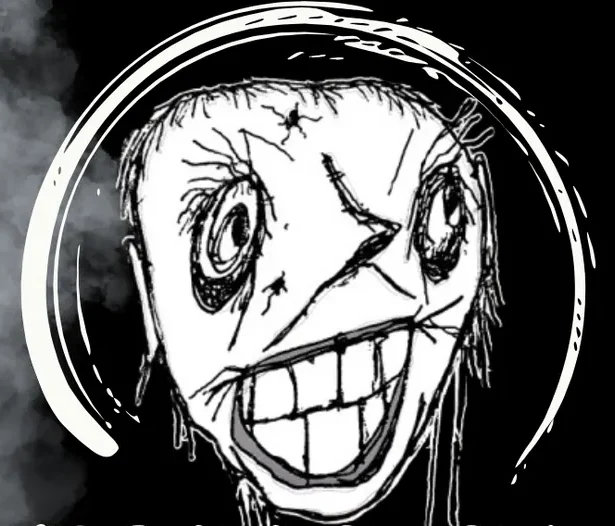
Introduction and Guide: Pests and Puppetmasters
by L. Andrew Cooper and H.J. Dutton
with Jack Conway, editorial assistant
and Silas the Scribble Man, dewormer

Welcome all to Pests and Puppetmasters, the fourth Exhibit from the Horrific Scribes archive of dark fiction and (some) poetry.
Nearly every culture has spun tales about entities that drain their victims in body and spirit. For millennia, astral parasites, such as the Pishacha of Hindu myth and the Dybbuks of Jewish folklore, have embodied cultural anxieties. These tales frequently feature loss of control, loss of sanity, loss of identity, and loss of humanity.
Perhaps the primal fear of personal invasion lies at the root of our morbid fascination with the parasite. The body and the mind are our most intimate possessions. If even those are forfeit, what do we truly have control over?
No surprise, then, that parasites have become a tried-and-true feature in the horror genre. From Bram Stoker’s Dracula (1897) to the recently concluded first season of Alien: Earth, this particular form of antagonist has seen hundreds of unique manifestations throughout literature. Stories about parasites have recently fallen into the category of body horror, a subgenre that entails bodily transformation and degradation. Not all parasites in horror, however, fit into that category. The collective imagination has twisted the image of the parasite into something much more diverse.
The following Exhibit showcases that diversity. While some of its antagonists drain their hosts on a physical level, others do so on a mental or spiritual level. Some parasitize the body, whereas others invade the home or reality at large. Some are insidious in their feeding habits; others play the role of external predator, using promises and facades to lure in their prey. All share one thing in common: be it blood or sanity, they will take something from you.
GALLERY ONE: BARNACLES
“The Rites of Harry Leitner” by Sydney Sackett. Harry Leitner can’t shake his reputation for being the best exorcist in the business, nor can he get rid of his calling: again and again he faces demons that seem to fear his approach. Horrific Scribes usually wouldn’t take much interest in an exorcist story because the subgenre is riddled with repetition, but here what’s scary departs significantly from the William Peter Blatty mold. The truths clinging to Harry Leitner are as unusual as they are chilling.
“Christmas Angel” by Jon McGoran. Christmas Day is almost over, and an old woman packs away the remnants of her festive day with a young girl, sad to watch the minutes pass toward midnight. The passing of time becomes intense, too intense, and the atmosphere becomes heavy with dread that seems realized when the girl demands that the old woman tell a story that has clung to her, shaping her destiny since she was young. Holidays involve memories we cherish and memories we wish we could forget. When is remembering pestilent? Can a memory be a parasite?
“Mama Bear” by Joseph Hirsch. This tale also involves an older woman haunted by a memory in a way that may or may not be supernatural. Both stories play with the question; you’ll have to read to determine whether and what they decide. The barnacle in “Mama Bear” is, in any case, far more aggressive, taking the form of a teddy bear that torments the woman with reminders of her dead junkie son. This one is like the grim outcome of telling an evil doll story with the flair of Requiem for a Dream (2000). The bear isn’t the only barnacle. Dependency–and not just drug addiction–can be monstrous.
GALLERY TWO: LEECHES
“Swimmer” by Steven Mathes. Considering the creature alone, “Swimmer” is the most traditional parasite story in the Exhibit, as it features a wormy little thing that gets inside a human host and alters the human’s behavior. In the traditional tale, however, the parasite usually seeks world domination or something equally unfriendly. Mathes’s creature, by contrast, turns out to be far from traditional and harkens back, with a lighter touch, to Hirsch’s reflections on addiction and dependency. The swimmer is mostly interested in finding great food and true love. Nothing wrong with that, now, is there?
“Worryeater” by K. Thompson. In an insightful, sympathetic, but still scary reflection on obsessive-compulsive disorder, “Worryeater” presents a woman struggling with a monster that emerges from a clock to consume, as the title suggests, her anxieties, particularly her worries related to often violent intrusive thoughts. This particular leech is so perfectly suited to the character that it takes on a universal quality, the transcendent stranger, the cosmic confessor, to whose appetites we surrender ourselves in the hope of receiving relief from the weight of our imperfections.
“The Flesh Factory” by Leonardo J. Lamanna. This sojourn into very dark dystopian sci-fi takes leeching, literal parasitism, to a horrifying extreme in a world where humans are farmed for their parts to go to rich people who want them, where humans are kept alive and regenerated by their masters so they can be harvested again and again. That’s only the set-up. The story is even darker, but it does offer a snicker or two as it frames your up-close view of the void.
“The Basement” by Andrew Welsh-Huggins. A fine mate for “The Flesh Factory,” this story takes a far more upbeat look at parasitic exploitation when a young man comes for dinner with his girlfriend’s parents and must face the unknown when he’s sent to the basement to fix a power outage. Welsh-Huggins uses perspective to great advantage. This story is the first in the Exhibit to normalize the leech’s point of view, the point of view of a leech society.
“And Then There Were Ten Billion” by Jon Clendaniel. This one is like “Swimmer” in that the creature’s aim isn’t necessarily evil, and it’s like “The Basement” in that it takes the creature’s perspective–and all the creature wants is a hug! Unfortunately, what constitutes a “hug” depends on cultural context, and the creature’s hugs aren’t so compatible with humans. More, but also a parody of one of the ultimate parasite movies, Alien (1979).
GALLERY THREE: TRICKSTERS
“Before I Grew Nettled Skin” by Abby Nicole Yee. This guide has no interest in sorting out this poem’s interlaced layers of eroticism and trauma, in which the speaker both feeds and is fed upon, but the speaker does lure men to the their destruction, tricking them with the sweetness of poison berries and, that failing, tearing them with nettled skin. The trickster preys on the infatuation (which in part means the surrender to stupidity) born of desire. À propos, consider resonance with “Goblin Market” by Christina Rossetti.
“Flowers” by John Leahy. In a historical maritime adventure that descends quickly into horror, seafarers encounter creatures similar to mythical sirens, who also prey on the infatuation of desire, beautiful women who lure the unwary sailors to deadly islands. The story features multiple tricksters as it becomes more and more fantastic, and it uses a narrative frame to demonstrate why tricksters keep on tricking people even after their tricks have been revealed. “Before I Grew Nettled Skin” might be about devious beauty used for self-defense. In “Flowers,” beauty is a predator.
“Family of Four” by H.J. Dutton. This story is here by mistake. It’s a perfectly happy story about a family that takes in a stray dog. Well, a little darkness might creep in because it focuses on a father raising his two children on his own, and he feels the vacancy. Part of him thinks maybe the dog could help fill that vacancy and make them a family of four again, but he is slow to trust. The world is full of tricksters. But maybe the lure of family connection is strong enough to overcome bitterness and distrust.
“It Hungers” by John Davis. The “it” of this story is, at least at first, a shapeless, black thing the very existence of which, when two adolescent boys discover it, causes psychological harm… but its psychological, and ultimately physical, trickery runs deeper. “It Hungers” might also fit in the next gallery, but since, to feed its appetites, it does indulge a bit in the classic trickster art of shapeshifting, it stands here, reaching out.
GALLERY FOUR: CONTROLLERS
“Remy de Montfort of Dubcon Palace” by E.J. LeRoy. We start with the most egregious form of parasitism involving puppet mastery that one human visits on another, slavery. A young man makes a daring escape from a sugar plantation in 1686 Barbados and finds the conditions of his captivity, and the obstacles to his freedom, are more horrific than he ever imagined.
“All My Angry Selves” by David Corse. If “Christmas Angel” asks questions about whether memories can be parasites, “All My Angry Selves” asks whether who we’ve been in the past can control us… literally. Ash is getting a very physical visit from her past selves, and they have agendas and instructions she might be forced to follow. Would your past selves be your allies or your enemies?
“A Promising Void: The Memo-morphosis” by Dimitry Partsi. The promise of undefined employment draws people into a cycle of identity erasure and conformity. Kafkaesque absurdity makes faceless corporatism the parasitic puppetmaster, recalling the broad social implications of the leeches in “The Flesh Factory” and “The Basement.” At the same time, the distorted humor anticipates the funhouse effects of the next tale….
“Dental Hygiene” by Steve Toase. Routines are mechanisms of control. Every step in a sequence must occur for the sequence to follow the proper course. If one thing goes wrong–if, for example, the postal van drives up the street the wrong way–everything that follows may be out of control. Other controllers, hidden away, may try to substitute. But to what sorts of death and destruction might they lead? Even the control of a toothbrush can have deadly consequences.
“Chrysalis” by Emmie Christie. The stars are darkening. Oxygen is running out. Whatever controls the universe seems to be ending all life. But maybe understanding control requires another change of perspective along with a new understanding of life.
“When I Come Back” by Shawn Montgomery. This tale of abuse and long-sought revenge takes place on two timelines, one covering years of the narrator’s childhood and the other in his present, and once again, the past is a parasite, one of the story’s many. In the past, a bully feeds on the suffering he causes through his sadistic manipulation of other boys. In the present, the narrator, one of the bully’s victims, manipulates the former bully into a situation where he might confront the horrors spawned by his parasitism. Who will be the puppet and who the master? What is the price of control? This story is extreme horror, very likely to disturb, so approach its representations of physical parasitism, sexual parasitism, and emotional parasitism with caution.
| EXHIBIT FOUR: Return to the Order of Attractions | ENTER Gallery One: Barnacles and read the first attraction, “The Rites of Harry Leitner“ |