The Look on Your Face
by Joseph Hirsch
Horrific Scribes Extremity Rating:
L.T. at Key Pawn had mercy on Bridgette, letting her use the bathroom even though it wasn’t technically for customers. She thanked him, shot him a smile, then struggled through the curtain and into the stuffy backroom and from there to the toilet. After locating the dangling beaded chain in the dark, she tugged and the unshaded lightbulb came on. Quickly, she dropped the toilet seat and sat, taking the test from the box before removing the little stick and fitting it with the strip. She peed and waited.
A blue cross appeared in the test window. “Shit!” She pulled her underwear back up, then her pink vinyl microskirt, before storming out of the bathroom and back through the curtain.
In the store, L.T. was at the counter, gut pressed against a glass case filled with handguns displayed on a red velvet blanket. On the customer’s side stood a stocky bald man in a camo green wifebeater with a razor-bump rash on the back of his neck. He was pointing at a
hammerless Taurus, pressing his finger against the glass and leaving smudges. “How much is that one?”
L.T. didn’t hear him. He was too busy watching Bridgette, drawn to her by the clack of her stilettos on the store floor. “You okay, Bridge?”
With a wave with her free hand, she mouthed the words “Thank you” before pushing her way outside and into the dark.
She turned left, toward her current beat. Slowly she became aware of a car drifting along behind her, tires crawling across asphalt, crunching broken glass beneath their treads.
She rounded the corner at the florist’s, and the car turned with her. Finally—sick of it, sick of everything—she spun on her heels and stood ready to swing her purse or reach for the mace. “What do you want, asshole?!” She punctuated her cry by throwing the pregnancy test stick at the car’s tinted front passenger window, not realizing she’d kept the thing in-hand until after she’d chucked it.
The stick bounced off the window, clattered to the curb, and hit the gutter.
The front passenger window rolled down, and leather cringed as the driver leaned over, stuck his head out onto the street. He had a thick, bushy mustache that fit his angular face, made him look like a seasoned detective or retired pro quarterback. He also wore gold-framed shades despite it being nighttime, probably because whoever he chauffeured liked to keep near the Strip where the neon ensured an uninterrupted flow of burning light.
Slowly, he reached out a leather-gloved hand and waved Bridgette closer.
“Huh-uh,” she said, letting her gaze rove to the back of the stretch job. “Who you got in there, anyway? Howard Hughes?”
The man smirked, probably as close as he could get to smiling. “Howard Hughes is dead.”
“Yeah, but he had his head cut off and frozen so he can come back to life once the doctors figure out that deep-freezing technology.”
The driver shook his head. “You’re thinking of Walt Disney.”
“Alright,” Bridgette said, already bored of the man. “Who’s back there then? Harry Reid?”
“No one’s back there,” the man said. “My boss is waiting at his hotel. He wants you to come there to meet him.”
Bridgette swung her purse around, unzipped it, reached inside. “Outcall’s more expensive. Especially if he wants overnight.” Her fingers found the soft pack of smokes nestled against her rubber troll doll with the shock of green hair. She pulled a cigarette out of the pack and stuck it between her lips.
The chauffeur’s gloved hand disappeared inside the tinted limo, and it reemerged filled with a stack of hundreds. The cash was fastened with a golden money clip. The gold looked real.
“Come on,” he said, getting out of the limo on the front passenger side. “I’ll let you ride up front with me.”
“Huh-uh.” Bridgette shook her head. “If I ride in a limo I’m doing it in style, like a VIP.”
“Suit yourself.” The chauffeur rushed to the back passenger door, pulled it open, and waved with his free hand, bidding her enter. “Your carriage awaits.”
She slid into the plush confines of the car, sitting while rummaging around in her purse for her Zippo. The ride’s interior was all lacquered burlwood and rich-smelling brown leather, sort of like a human-sized humidor. It was perfect, exuding its own golden glow, giving her a sense that her net worth was increasing with every second simply spent here.
“All settled?” the driver asked, standing directly outside the car, hand on the door.
Bridgette nodded, then she opened her mouth to mention the money he’d flashed. The chauffeur, however, stifled her request before she could get it out, tossing her the clipped stack of bills.
“Thank you.” The bundle landed on the hem of her microskirt, near a widening run in her fishnets.
“It’s ten large,” the chauffeur said. “Feel free to count it. You get another ten after you make my boss happy.”
She sensed the eyes behind the shades roving toward the still-unlit cigarette in her mouth. “You can smoke that here,” he said, “but you’re done smoking once we get to his suite. The man’s deathly sick.”
“Fair enough.”
The driver closed her door, retraced his steps around the right side of the car. He stopped once near the front passenger side, glanced down at the cracked concrete, searching for whatever she’d thrown at him. Finding it there, he reached down, picked it up in his gloved palm. Squinting, a little closer at the discarded plastic thingy, he smiled and shook his head before retaking his place behind the wheel.

They took Paradise and hooked right onto Desert Inn, past the convention center that looked like a giant flying saucer landed in the desert. The tinted divider between front and backseat remained up until they reached the hotel, at which point it slowly came down.
The chauffeur had removed his cap at some point during the drive, revealing a headful of curly black hair that undercut his drill sergeant aura. He was kind of cute, but something told Bridgette his boss, her client for the night, was not. That—despite this being the most money she’d ever earned for a trick by far—it would not come easy.
She braced, remaining silent as he pulled around to the valet’s stand where two men in burgundy short coats waited. She took a few last shallow drags of her smoke, then exhaled.
The chauffeur got out, donning his cap again. He walked around to the rear, opened Bridgette’s door for her, and stood back. “Madame…”
Bridgette ditched her smoke, ground it out beneath her high heel. Then she followed the driver through gold-gilded doors into the hotel, both of them walking across the marble-floored lobby, past the elevator to a special, keycard-access model. They rode up in silence in the jewel box of a lift, and at last a chime sounded and the elevator stopped.
The door opened onto a large space with a dark and open floorplan. The chauffeur reached over to the brushed steel panel, pulled the button for the emergency stop. He looked at Bridgette and in a hushed voice, said, “Wait here. I want to talk to him for a minute.”
Bridgette nodded, heart trip-hammering hard in her chest. She hadn’t expected to go directly from the lobby via express lift to the penthouse, and it was jarring. She had been around money before, but not this kind of money.
She stared out into the darkness.
Across the hall with its staggered Greek columns topped by chiseled busts sat a man in a red silk kimono, slumped in shadow before a long table. He was in a highbacked chair with a large silver platter before him. The table was strangely bare except for the tray and a white linen cloth, no silverware, no glasses, the only ornamentation red candles in crystal holders, guttering in the gloam.
The driver strode across the long hall and over to the table. He said something to the old man, and the old man giggled, his wheezy squeezebox of a broken laugh echoing across the vastness. Then the two appeared to shake hands quickly.
After that the chauffeur stood back up straight, turned toward Bridgette, and shouted, “He says, ‘Come Forward!’”
The old man lifted his right hand, more bone than flesh. “Come!”
The voice was surprisingly strong, at odds with his air of frailty.
Bridgett took one last deep breath, left the elevator and began walking down the hall, heels resounding like rifle reports in the stillness.
“The artwork!” the old man cried out. “Do you like it?”
Without stopping, Bridgette looked left and right, at the paintings in gold-gilded frames hanging on otherwise naked walls.
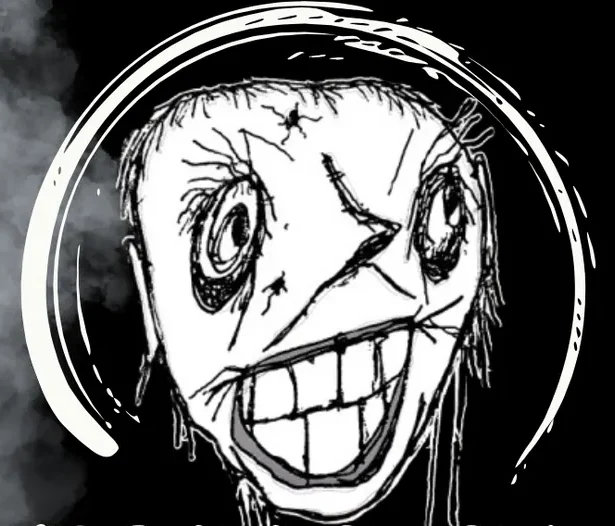
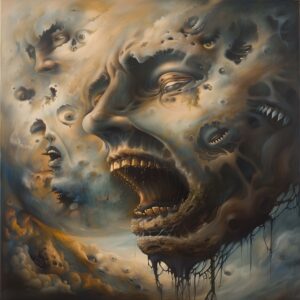
Some of the artworks were beyond her, abstract to the point of meaninglessness, smeared amorphous color blobs resembling wax globules bouncing around in a lava lamp. Others were more realistic—inasmuch as they featured subjects from this world—faces with a slightly misshapen quality, pallid and slightly stunned. The artist, whoever they were, had failed to capture something in each face, or rather had exaggerated an inner quality by bringing it out in the expressions. Each subject appeared frozen in shock, stiff as if having received the worst news of their life, told some ultimate and terrible truth right before the portraiture session commenced. One among them was a man with a close-shaved head, mouth a wide astonished O. It reminded her of that famous painting of the man with a lightbulb-shaped skull shrieking on a bridge, the sky behind him a swirl of mad and collapsing color. Only the man in this painting was much larger than that one, and his hands were not clasped to his cheeks. Another canvas featured a small man—frail and seated—resembling the old gnomish fellow at the table down to the red silk sleeping kimono.
“They’re nice,” Bridgette said, feeling stupid, feeling as if more were demanded of her, that—like a sommelier—she should be bluffing, bullshitting with big words.
The old man, however, merely wheezed and giggled, as pleased with her comment as he might have been with high praise or pithy critique. “Yes,” he said. “Some are originals bought at auction. Others feature my own vain attempts at painting. There’s the self-portrait, which I’m sure you noticed nestled in and among the other ones.”
She nodded, approaching the table. Having gotten closer, she took a better look at the old man. His frailty had not been a mirage or trick of light played on her eyes at a distance. He was indeed wizened, sunken on himself, head slumped between two knifelike shoulder blades resembling wings. His pose—a patient, abiding perch—reminded her of that turkey buzzard she’d seen the other day out by McCarran waiting roadside for a chance at an opossum pancaked to roadkill. This man was undoubtedly waiting for his own death but also appeared to be waiting for the hammer to fall on someone else, maybe some old business rival or estranged family member. Spite alone might have been what kept him going at this point.
Most of his hair was gone, the remaining cobwebby wisps so thin that a hard combing might tear them away. The eyes were sunken deep into time-hollowed orbits, full of a fear so strong it gave them a paralyzed aspect. He might express emotions other than fear—he already had—with laughter, with words—but the eyes would not participate simply because they could not.
He lifted a hand, pointed at the spread on the table. “Please, sit and eat.”
She hadn’t noticed the food from across the room, nor had she smelled it. Even up this close it didn’t exude much aroma. That made sense, though, as it was cold, some kind of pâté—maybe foie gras or another rich person’s variation on basic and better-tasting fare like tuna or chicken salad. The meat was arranged in tightly compacted scoops like ice cream servings, and surrounded by dark, leafy greens and cherry tomatoes. Also arrayed about the meat in a decorative circle were triangular crackers. Thick seasoned flecks of some greenish-black herb—shiny like seaweed wraps—were sprinkled over the meat.
Someone brushed up against her, and Bridgette half-turned to see the chauffeur pulling at the upholstered antique chair, holding out a hand, entreating her sit.
“Please,” the old man said again. “I imagine you spend enough time walking, and your legs are very tired. Moreover, you are hungry.”
“Thank you,” Bridgette muttered, wondering what the plan was, where the catch lay. Twenty grand for dinner—or not even dinner, just an appetizer—with some sad old man?
Inwardly, she shrugged. It took all kinds, and casino whales were an especially eccentric breed. A man who could fade fifty grand a hand on the green baize could certainly spend twenty grand on dinner (or really just an appetizer) with a pretty lady.
She sat and tried to put it out of mind. And once seated, she reached for a cracker, lifted a silver spoon from its place on the tray, and larded some meat onto it.
Footfalls echoed behind her, and she turned to watch the chauffeur leave, trade this darkened chamber for another.
When she turned back around, the old man’s eyes were on her. His stare lingered, not in a leching way, but like an artist committing the details of a still-life subject to heart before beginning.
“You know,” he said, his words lessening the tension caused by his gaze, but only just so. “You can’t really appreciate what money can do unless you have it for yourself.”
“I certainly know what the lack of money can do.”
The old man laughed, wheezing again like a broken accordion before breaking out in hacking coughs.
Bridgette ceased pushing the cracker overloaded with cold meat toward her mouth, asked, “You okay?”
He waved a hand, coughed several times, and, upon recovering, whispered, “Fine,” before gasping out, “Eat, eat.” He struggled then for a big breath, one large enough to aid him in saying whatever it was she sensed he really wanted to say. After he had sufficient wind, he began.
“Expressionism.” He let the single word hang in the air.
Bridgette took a bite, and he continued.
“It never made much sense to me as a movement. That a specific name need be given to something so patently obvious.” He sneered, said, “‘Interior subjective states rendered objectively, or at least in an exterior fashion.’” He shook his head, clearly not in agreement with the words quoted. “I have come to find that any interior state, if sufficiently intense, cannot help but break out into the world. For instance, a man who is terrified enough will show fear on his face. Or, if you prefer a rosier example, consider someone in the throes of sexual ecstasy. This interior state usually registers itself in an open-mouthed moan, eyes closed, perhaps clenched, as if the pleasure were so intense it verged on pain.”
Bridgette had only half heard him, busy as she was getting the cracker down. She had not anticipated it being such a chore, but the thing was rich, consisting as it did of a medley of several different flavors she’d never liked. Someone with a more sophisticated palate (like one of the chefs downstairs) would be necessary to parse every ingredient, but she detected anise, black licorice, and Kalamata olives. Each alone could have triggered her gag reflex, but combined they were simply so vile they left her stunned.
The old man looked on, seemingly offended by her disgust. “It’s an acquired taste,” he said.
Bridgette nodded politely, swallowed once hard. It was not her first introduction to the strange culinary habits of the rich. Once before she’d eaten Beluga caviar (also on a cracker) that looked like tar bubbles and tasted like soap drenched in salty brine. “It…” Bridgette faltered, settled on, “It’s very rich.”
The old man nodded, not so much at her words as in agreement with some thought percolating in his mind. And after shifting some in his squeaking chair, he said, “I’m sure you’ve heard the term ‘affluenza.’ A delightful portmanteau that perfectly describes the latitude the rich are allowed and how corrupting said-latitude can be.”
Bridgette nodded. “Like when some spoiled brat kills somebody with his sportscar he got for his sixteenth birthday and gets off with a slap on the wrist. But that’s not something you need to be rich to understand.”
“Indeed,” the man said. “I don’t imagine it is. I imagine, in fact that the rich with their especially perverse peccadillos have also given you a general aversion to men of my class.”
She shrugged, not because she didn’t want to offend him but because it wasn’t true, at least not in her experience. “I’ve seen johns who drive old beat-up Hondas ask for the weirdest crap you can imagine, and I’ve been picked up in Rolls Royces by guys who want it pretty vanilla.”
“‘Vanilla.’” The term applied to something besides literal food flavoring amused him, and he giggled, the giggle counterpointed by the squeak of metal in need of oiling. Then he pushed free of the table and rolled along, navigating his wheelchair over toward her side of things.
Bridgette turned slightly to face him, neck stiff, feeling awkward with him this close, doing her best to ignore the shock of this latest disclosure: a tartan plaid was spread over his lap and beneath that were the truncated vestiges of proper limbs. The stumps had been wrapped in neoprene liners, swaddled so as not to spot with blood like the limbs of many amputees she knew from the street.
“I’m sorry,” she said.
“I’m not,” he replied. “Not, at least, about the cancer.” At the mention of the unmentionable c-word, he glanced down at the phantom legs.
Bridgette shook her head. “They usually don’t cut your legs off for that.”
“No,” he allowed. “Usually they do not, but mine was a special case. The cancer had spread to an artery, and they thought it prudent to go ahead with the operation. The thinking was that amputation would cause less exhaustion and require fewer trips to the hospital than chemotherapy. And since I am rather sedentary at this point, anyway, I didn’t object.” His gaze roved back to the paintings on the walls. “And this way I don’t have an excuse not to work, since, confined to my chair like this, I pretty much have nothing else to do besides paint.”
Bridgette had not enjoyed seeing the paintings the first time, but out of politeness and as an excuse to look away from the stubs, she turned to stare with him again. Once more she was faced with the amoebae resembling dangerous bacteria under a microscope, the haunted fear-filled faces drained of color. Especially disconcerting was the bald shrieker, who, she now realized, was an uncanny twin to the chauffeur, sans cap and cute curly hair.
It wasn’t just the change in attire or hairstyle, though, that had made it initially hard to recognize him in the painting. It was that look on his face, so different from the confident one he’d worn all night thus far. In the picture he was slump-shouldered and without swagger, also lacking his natural flush of blood in the cheeks so he looked like a mime in clown white.
“Forgive me,” the old man said, “for not answering your question. Or rather, for answering it in stages, in a roundabout manner.”
“It’s alright,” Bridgette said, turning back to study the myriad wrinkles in his brow. It made her self-conscious about her own eventual ageing, but that beat engaging with the eyes or stumps.
“I have not only enough money to buy my way out of most any situation. I have the money to pay men to violate their oaths, destroy their own hard-won, hard-earned credibility in the span of moments.” The old man lifted his right hand, pressed thumb and middle finger together to give a brittle snap. “Oh, to outward appearances my corruptees still appear to be respectable members of the community, with their burnished bona fides and their chairs and titles.”
“It’s Vegas,” Bridgette said, shrugging again, still not surprised by anything the man had said. “It’s been corrupt since the Mafia built the place.”
The old man nodded, appearing impressed with her conclusions, her candor. No doubt he didn’t get much of that from his corruptees, as his own coinage had it. “But there are gradations of corruption. The corruption of one’s office is different from a corruption so total that it warps the Imago Dei that supposedly dwells in every man. For instance, there is a difference between paying a policeman to ignore a trunkful of cocaine and paying a doctor to return my own necrotic, tumorous limbs to me after a surgery is completed.”
Bridgette coughed, stuttered, throat burning, stomach swimming with bile that threatened to come up. “I’m sorry?”
Footfalls sounded behind her then, the soles of patent leather shoes slapping the Vitruvian marble with a concussive force. It was the chauffeur, returned from the darkness.
“The limbs,” the old man said, and he placed his frail arms on either wheel of his chair, reversing course until once again on his side of the table.
Ignoring the terror written in her features, he said, “Usually they either incinerate them or keep them for pathological analysis. This time—and through complicated channels that need not concern you—they were transferred to my personal chef. He has not prepared them in toto, slow roasting them like leg of lamb, but rather shred their meat into tiny flakes in a painstaking process.” The man lifted his arms, pantomimed an act something like rubbing a stiff wedge of parmesan vigorously against a grater. “These many bits of me were then freeze-dried, cured for keeping and flavored to mask the scent of decay. Then the bits are scattered as a seasoning onto servings of this dish, which I serve to my special guests on occasion. And that,” he said, pointing at the remaining meat on the plate, “is the finest duck liver mousse money can buy, by the way.”
Bridgette burped, grunted, held the edge of the table to keep the world from spinning off its axis.
Quickly the chauffeur maneuvered himself behind his employer, lifted a small black gun, aimed it at her, pulled the trigger. After a flash, she winced, flinched, terror of death temporarily overcoming her nausea.
Slowly, after the blinking tracers cleared from her eyes, Bridgette found herself staring at the two men again.
The chauffeur waved the polaroid ejected from the camera back and forth until its milky fog cleared.
“Ah,” the old man said, hand trembling as it reached up to receive the picture. Once he had it clenched in his fingers, he flicked it a couple of times. “You know, that look, that expression of shock… it is, I imagine, much like the one worn on my own face when my doctors told me my condition. Sadly, though, I will never know for sure, as I did not have the forethought to take a photo of myself then. I was too stunned for the thought even to occur to me, and of course I lacked a camera at the time.”
He continued caressing the corners of the photo, stroked them. “Now that I have this for a reference point, though, it will ensure accuracy of feeling in the painting I do of you. Soon your portrait will hang among all the others in the gallery, the fidelity of your fear assured, that look of betrayal we all wear in that moment when it finally dawns on us.” He paused, as if waiting for her to thank him for the honor or to enquire about the specific nature of the it in question.
Bridgette, however, was too busy dry heaving, gagging, hunched over the table. But after gagging several more times, she mastered the rising gorge, her only bile now reserved for the old man.
She faced him again, lips drawn tight in a scowl, trying to will him across that final threshold, into death, with her stare alone.
Unfazed, the old man said, “You are now free to leave. Roy will be happy to drive you wherever you need to go, should you want a ride. I don’t think I must tell you that divulging the nature of my project to the world at large will not redound to your advantage. That not only will no one believe your story, but that word will surely reach me from whatever precinct you visit. And that after committing your folly, your body will join the innumerable other plots already decorating the Mojave desert. Moreover, whether you consented or not, you are now in point of fact a cannibal, and I would think you would not want to broadcast that to the world.”
Bridgette finally found the strength to shove off from the table and stood in one clumsy motion that sent the wingback antique chair clattering to the marble floor.
She turned toward the elevator, began wobbling forward, unsteadily on her heels, the path ahead appearing to lengthen rather than shorten as she moved.
She needed to get this taste out of her mouth, and toward that end she reached into her purse for a cigarette. Fumbling around the stack of bills, she found another stack now nestled next to the first. And like the first, this one was also fastened by a golden clip.
Old Roy was a sly one. While sneaking up behind her, he’d apparently used a magician’s deftness to pay her what was promised.
Beneath the twenty grand, she found her soft pack, pulled a smoke free, stuck it in the corner of her mouth, made her way to the elevator car.
In the elevator, she pulled the Zippo from her purse, hit the strike wheel. But her hand was trembling too hard, and only a wan shower of sparks resulted.
“You should not smoke, dear lady!” the old man admonished. “It can cause cancer! And I don’t think your baby would much appreciate it, either!”
For a final time, she looked over at the old man.
He held something aloft in the dark, a small and flimsy object.
The pregnancy test stick, the same one she had chucked at the limo’s window, which Roy must have picked up when bending down to the curb.
Her rage for the men—both of them, all of them—gave strength to her hands, and when she next struck the wheel, flame spouted to light the cigarette.
Immediately she took a deep drag, chambering the smoke into her nicotine-starved lungs. With her free hand, she pulled out the elevator’s emergency stop, pressed the ‘L’ button, waited.
The door closed, and she took another drag, becoming conscious only after inhaling that the smoke might reach the seed growing inside her. The thing that had already been fed with the flesh she had unknowingly fed her own body. The thing that, if allowed to reach term, would one day grow to have a face of its own.

Want another gripping story by Joseph Hirsch? Read “Red in Tooth” in Horrific Scribes, June 2025, “Mama Bear” in Horrific Scribes, August 2025, and “Teufelsrad” in Horrific Scribes, February 2026.