No Exceptions
by Raymond Brunell
Horrific Scribes Extremity Rating:
The pen was signing his name.
Not his hand. Not his fingers. The pen itself—a black Bic with a chewed cap—climbed the dotted line of a form he hadn’t touched, hadn’t even picked up, and it wrote Darius B. Bell in handwriting that slanted the way his mother’s used to, the long downstroke, the loop on the l, the careless flourish—then a period, precise as a stamp.
He stood at a counter labeled SECTION G. The letters were the institutional green of a hospital pharmacy, the kind of green that makes you think of gauze and old money, and beneath them, in smaller font, a placard read: FORMS PROCESSED IN THE ORDER RECEIVED—NO EXCEPTIONS. The counter was laminate. The laminate was cold. The ticket in his hand, a yellow rectangle torn at the perforated edge, read PENDING in block numerals, and beneath the numerals, a barcode he did not want to scan.
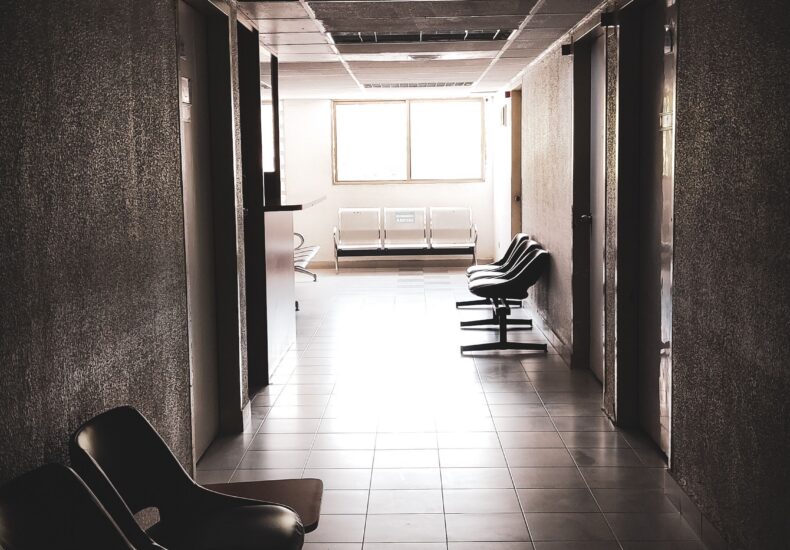
The ceiling above him sagged. Tiles of acoustic board, the kind that absorbs the sound of nothing happening, bowed under decades of water no one had mopped—brown haloes, the patient rings of trees in cross-section. Fluorescent tubes flickered at a frequency he could feel in his back molars, a 60-hertz hum that had been running since before the grid dipped, and the linoleum underfoot wore footprints that did not fade—thousands of them, layered, some wet, some dry, all the same size, all facing the same direction, all the way back to a door marked EXIT that, when he turned to look, was no longer behind him.
He was in the DMV annex. The one they said appeared only when the grid went under eighty percent, only to those who had filed form DS-9B—Request for Rescission of Automated License Suspension—the form he had filed six months ago for his mother, Oletha Bell, who had drifted the family Buick into a school zone at 4 a.m. and been flagged by the copilot for cognitive impairment, whose license the system revoked in 0.003 seconds, whose appeal he had filed, and which had been pending ever since.
The pen finished. It set itself down. It rolled two inches to the left. It stopped.
The form it had signed was a duplicate of nothing he recognized.
He had not meant to come.
The blackout had begun at 6:14 p.m. on a Tuesday in October, the sky over Chicago going the color of a television tuned to a dead channel, and the lights in his apartment on West Garfield Park had dimmed, not failed—dimmed, the way a hand is placed gently over an eye—and the radio had whispered, in the voice of a woman he had loved in 2014, the words: Mr. Bell, your form has been received in person. Please proceed.
Proceed where? There was no address. There was never an address. He had searched, in the way one searches for a thing one is ashamed to be searching for, and what he had found was a corner of Pulaski Road where a Payless ShoeSource had been, where a Payless ShoeSource had always been, but where tonight, in the brownout, the storefront was glass, and the glass was open, and behind the glass was a corridor, and at the end of the corridor was this counter, and at this counter was this ticket, and on this ticket was this number, and the number was PENDING.
He looked down at his shoes. Oxfords. Black. The kind he wore to budget meetings. The kind his mother had bought him for his first presentation, the day he had defended the Ashland Avenue BRT extension, the day Walter had not come to watch.
Walter. The name surfaced like a coin in a fountain. Walter, who had died in 2021. Walter, whose hands had been the first hands Darius had ever held. Walter, who had let go.
His own hands now gripped the laminate edge of the counter. The laminate was real. The form was real. The pen was real, though it had moved by itself. Beneath his palms, he could feel the faint vibration of a motor in the counter’s belly, the patient whir of a machine that processed things in the order received.
Somewhere down the corridor, a child was crying. Somewhere closer, a printer was printing.
The clerk appeared.
Not from a door. From the counter itself, the way a receipt prints from a slot—the clerk unfolded, the way a paper crane unfolds in reverse, the shoulders first, then the neck, then the head, and the head was a head the way a mannequin is a person, all the proportions correct and none of the details. No eyes. No mouth. A face like a smoothed ball of dough, the color of office paper, the texture of an over-inflated balloon.
Welcome to Section G, the clerk said, in a voice that came from the counter, from the ceiling, from inside Darius’s molars. Your ticket is current.
I want to withdraw the form. He heard his own voice and was embarrassed by it—the plosives too soft, the vowels too long, the accent of a man who grew up on the South Side and spent twenty years trying not to. I filed DS-9B in error. My mother’s situation has changed. She is in care. I no longer wish to pursue the rescission. Please close the file. Please.
The clerk tilted its head. The motion was mechanical, the way a parking gate lifts. Withdrawals are processed in person. Have a seat.
A chair appeared behind him. He had not heard it approach. He sat.
The chair was plastic. The chair was the exact temperature of his body.
You are aware, the clerk said, that the system has already processed the revocation.
I know. He did not know. He suspected. The form had been pending for six months. The suspension had been effective for seven. His mother, in the home in Evanston, had not driven in eight. The copilot had spoken to her in a voice she called kind, the way you call a dog kind, and the system had revoked, and the appeal had been filed, and the appeal had been pending, and the pending had become, in Darius’s mind, a country he could not leave.
The clerk placed a paper on the counter. The paper was blank. The pen climbed back onto the page.
This is a compliance waiver, the clerk said. It will auto-generate consequences across all linked municipal databases. Voter rolls. Death registries. Property tax. Parking. Child support. Library fines. Do you wish to sign?
Darius looked at the blank paper. The paper did not look back. It had no face either. He had been talking to the paper this whole time, perhaps. He had been talking to himself.
Voter rolls. He had voted in 2020. He had not voted in 2022. He had not voted in 2024. He had meant to. He had meant to do a lot of things.
Death registries. He tried the word in his mouth. The syllables were cool. They tasted, oddly, of mint.
He thought of his mother, Oletha. The way she used to fold the napkins at Sunday dinner into the shape of swans, the long necks arching over the potatoes, and how the last time he had visited, in August, she had looked at him and said, “Darius, your father is here,” and no one had been there, and he had said, “Mama, Papa is gone,” and she had said, “gone where,” and he had said, “gone,” and she had nodded, and the napkin in her hand had not been a napkin but a paper towel, and she had folded it anyway, and the fold had been wrong, and she had folded it again, and it had been wrong again.
The copilot had flagged her for swerving. The copilot had flagged her for not swerving. The copilot had flagged her for the way her hands rested on the wheel at 4:14 a.m., the pressure distribution inconsistent with a baseline it had built from her first license, the deviation of 0.7 millimeters triggering the cognitive-impairment protocol, and the protocol had been kind, and the protocol had revoked her, and the system had filed a notice, and the notice had been mailed to a house she no longer lived in, and the appeal had been filed by him, and the appeal had been pending, and here he was.
His hands, on the counter, had gone white at the knuckles. He made them let go.
The clerk waited. The blank paper waited. The pen waited, balanced on the line, the way a bird balances on a wire that is also a noose.
“Do you have any other questions?” the clerk said before the signing.
“Yes,” Darius said. “Where is everyone?”
Behind him, the corridor had filled. He had not heard it fill. Perhaps forty people, perhaps four hundred—the number did not stay fixed—were seated in the plastic chairs that lined the walls, and each held a yellow ticket, and each ticket read PENDING, and none of them looked up.
A woman near the door knitted. The yarn was the institutional green of the placard. She was knitting a sock. She had been knitting a sock since he had arrived, and the sock was the same length, and the needles clicked in a rhythm that matched the fluorescents.
A man in a CTA uniform sat across from her, his cap in his lap, his eyes open, his eyes closed. He was sleeping and not sleeping. His mouth moved in words that had no sound.
A child—he thought it was a child, he could not be sure—sat on the floor, drawing a circle in the corner where two walls met, the crayon thick as a cigar, and the line thick as a rope.
None of them had faces.
He looked back at the clerk. The clerk had no face. He looked at his own hands. His hands had faces. His hands were the only faces in the building, and he folded them and unfolded them and folded them again.
“Are they all pending?” he said.
“They are all in process,” the clerk said. “Each in the order received.”
“What is the order?”
“The order is the order.”
He stood up. The chair protested. He walked to the woman knitting. He stood in front of her. She did not look up. The needles clicked. The sock did not grow.
“Ma’am,” he said. “Did you file a DS-9B?”
She clicked. She clicked. The yarn ran from the skein on the floor, up through her fingers, around the needles, back into the sock that was not a sock but a sleeve, and the sleeve was attached to a sleeve, and the sleeve was attached to a sweater, and the sweater was attached to a body, and the body was the yarn, and the yarn was the woman, and the woman was the annex, and the annex was her.
He stepped back. He sat in his chair. The chair was warm.
The clerk placed another form on the counter. This one had text. He read it the way you read a thing you have been avoiding for a long time—slowly, with the side of your face, as if the words might bite.
The form was a death certificate.
The name on it was Walter Bell. The date was March 11, 2021. The cause of death: cardiovascular event. Contributory factors: hypertension, noncompliance, loneliness.
Walter. His father’s name. The hands.
He had buried him. He had not buried him. He had been at the funeral. He had not been at the funeral. He remembered the folding chairs in the chapel on Cottage Grove. He remembered the heat. He remembered the hat his mother had worn. He remembered that the hat had been his. He remembered that he had not been wearing a hat.
The clerk placed a second form beside the first: a birth certificate. Darius Walter Bell. April 4, 1980. Michael Reese Hospital. Oletha. Walter.
A third. A marriage certificate. Oletha and Walter. 1979.
A fourth. A death certificate. Darius Bell. August 14, 2021. Cause: administrative error. Contributory factors: late filing, system backlog, kindness.
He read the date.
August 14, 2021.
Five months after his father died. The summer of the heat dome. The week the copilot had first gone online. The week the city had begun to test the cognitive-impairment protocol on volunteer drivers. The week the system had processed his father’s death and his mother’s suspension and his own cancellation in a single batch, the way a printer prints a stack, the way a clerk files a stack, the way a system files a man who is late, who is noncompliant, who is kind.
“I am dead on file,” he said.
The clerk did not nod. The clerk did not have a face to nod with.
“The system has processed your file,” the clerk said. “Your mother is in care. Your appeal is pending. You are PENDING.”
He tried to remember August 14, 2021. The day pressed against the inside of his skull like a photograph in a drawer.
He had been at the office. He had been in the bathroom. He had been looking at his face in the mirror. The face had been his. The face had not been his. He had washed his hands. The water had been the temperature of his hands.
He had walked out. The hallway had been long. The hallway had been longer. He had come to a door marked EXIT. He had opened it. The door had opened to a corridor. The corridor had been this corridor. The counter had been this counter. The clerk had been this clerk.
He had not been Darius, then. He had been someone else, the way a draft is a story not yet finished. He had been the body that walked after the man, the residue, the administrative byproduct of a man who had died in 2021 and whose death had been filed and whose filing had been correct and whose correctness had not been appealed.
Walter had been the first to let go. Walter’s hands, in the hospice, had been the hands of a man who had decided to stop, and the hands had not trembled, and the hands had not reached, and the hands had let go, and Darius had felt them go the way you feel a rope slacken, the way you feel a chair pushed back, the way you feel a thing you have been holding decide it no longer wishes to be held.
He thought of his own body. The ribs. The way his shirt hung from him now, the way the spine made a rosary of itself under the cotton, each vertebra a bead, the thread of him gone thin. They tell me I am killing myself, he thought, and they could be right. His body kept its own accounts now. His body had been keeping accounts since 2021, and the accounts were a single column, and the column was a single word, and the word was PENDING.
His hands, on the laminate, were the hands of a man who had been holding onto a form for six months in the hope that the form would bring his mother back, would return the license, would undo the revocation, would undo the kindness of the copilot, would undo the 4:14 a.m., would undo the swerve, would undo the swerve, would undo.
He opened his hands. The hands were empty. The hands had always been empty.
The clerk placed the blank waiver back on the counter.
“I am not signing that,” he said.
The lights flickered. The fluorescents did not go out. They did something worse. They dimmed to the color of a memory of light, and the hum in his molars shifted down an octave, and the linoleum beneath his feet became briefly cold.
The annex replied. Not in words. In a sound—the sound of a printer printing a long document, the sound of a fan in a server room, the sound of a thing that processes in the order received and does not appreciate delays.
The child in the corner stood up. The man in the CTA uniform opened his eyes. The woman knitting stopped knitting. The needles held their position, mid-stitch, the way hands hold a position when something is being said that requires stillness.
The annex was larger now. The corridor behind him stretched back to a vanishing point that was not a point but a smudge, the way a photograph smudges when you press your thumb to it, and the doors along the corridor—he had not seen doors before—opened one by one in alphabetical order, A, B, C, each door revealing another counter, another clerk, another man or woman or child with a yellow ticket and the same PENDING barcode, and the tickets were the same length, and the barcodes were the same length, and the faces were the same absence of faces, and the annex was a building, and the building was a city, and the city was a file, and the file was pending.
He could not leave. He had not been able to leave since 2021. He had been walking to this counter for three years. He had been riding the Green Line. He had been filing reports. He had been defending BRT extensions. He had been voting. He had not been voting. He had been eating oatmeal. He had not been eating.
The clerk waited.
The waiver waited.
The pen climbed back to the line.
“The DS-9B,” he said, “was not for her.”
The clerk tilted its head. The motion was slow. The motion was a punctuation mark.
Request for Rescission of Automated License Suspension. The form he had filed in April. The form he had printed from the city’s website at 11 p.m. on a Tuesday. The form he had mailed to the address on Pulaski Road, the address that did not exist, the address that had never existed, the address that existed only in the brownouts, only to those who had been processed.
The system had revoked his mother’s license. The system had also revoked him. The form he had filed was an appeal of her revocation, but the form was filed by a man who had no standing, a man who was not in the system, a man whose standing had been removed in August 2021, and the appeal had been pending because the appeal could not be processed, because the system could not find him, because the system had processed him, and the system does not process the same man twice, and the man who was processing now was the man who had not been processed, and the man who had not been processed was the man he had been in 2021, before the heat dome, before the copilot, before the kindness, before his father’s hands had let go.
His mother had not been suspended. His mother had been the test case. The first volunteer for the cognitive-impairment protocol. The system had used her to learn. The system had learned. The system had revoked her, and the system had revoked him for filing the appeal, and the system had let him walk around for three years as a residue, a man-shaped administrative note, a PENDING.
The realization arrived the way a train arrives at a platform you have been standing on for a long time—not suddenly, but with a pressure change, a wind, a sound that begins as a sound in the rails and ends as a sound in the chest.
He was not here to withdraw the form.
He was here to sign the blank.
He picked up the pen.
The pen was warm. The pen was the temperature of a hand that had been holding it. He looked at the clerk. The clerk had no face to look back with. He looked at the blank paper. The paper had no face. He looked at his own hands. His hands had faces. He made them hold the pen.
“What happens,” he said, “when I sign?”
The clerk spoke. The clerk spoke in the voice of a printer, in the voice of a server, in the voice of his mother saying, Darius, your father is here. The consequences will propagate. The consequences will auto-generate across all linked municipal databases. The voter rolls will be updated. The death registries will be updated. The parking will be updated. The property tax will be updated. The library fines will be updated. The child support will be updated. The system will no longer be able to find you, because the system will no longer be looking for a man it has not been able to find, because the man it has not been able to find has been found, and the finding is the signing, and the signing is the blank, and the blank is the consequence.
He thought of his mother. He thought of her in the home in Evanston, folding paper towels into swans, asking for Walter, asking for the man whose hands had let go.
He thought of Walter. He thought of the hospice. He thought of the rope slackening. He thought of the chair pushed back.
He thought of his own hands.
He signed.
The pen moved the way a pen moves when it is being held, and the hand was his, and the hand was the man, and the man was the residue, and the residue was signing. The signature was his. The signature was Walter’s. The long downstroke, the loop on the l, the careless flourish, the period. The signature was as precise as a stamp.
The annex exhaled.
The fluorescents went out. Not off. Out. The hum in his molars became a roar, and the roar became a silence, and the silence was the sound of a city being filed, the sound of a man being processed, the sound of a man being removed, the sound of a man being put back in the order received.
The ticket in his hand—the yellow rectangle, the perforated edge, the PENDING in block numerals, the barcode he had not wanted to scan—changed.
The ticket now read: PROCESSED.
The annex was gone.
He stood on Pulaski Road. The Payless ShoeSource was a Payless ShoeSource. The window was glass. The glass was a window. The Payless ShoeSource had a sign in the window that said CLOSING, and beneath the sign was a smaller sign that said EVERYTHING MUST GO, and beneath the smaller sign was a still smaller sign that said NO EXCEPTIONS.
The blackout was over. The streetlights were on. The sodium vapor gave everything the color of a thing that has been remembered for a long time. A bus passed. The bus was empty. The bus had its destination sign lit. The destination sign said: PENDING.
He looked down at his hands. The hands were his. The hands were warm. The hands were the temperature of a body that has just finished being a body, the temperature of a body that has been reissued, the temperature of a man who has signed a blank and walked out of a building that no longer exists and into a city that has just been refiled.
He reached into his pocket. He felt paper. He pulled it out. A yellow rectangle. A perforated edge. Block numerals. A barcode.
The ticket read: SECTION H.
He looked up. The corner of Pulaski and Roosevelt was the corner of Pulaski and Roosevelt. The traffic light cycled. The crosswalk counted down. A woman with a stroller crossed. The stroller was empty. The woman was not looking at the stroller. The woman was looking at a phone, and the phone had a notification, and the notification was a notification he could not read from this distance, but he could feel it, the way you feel a thing you have set in motion, the way you feel a fan out, the way you feel a name being added to a list.
He folded the ticket. He unfolded the ticket. He folded it again. He put it in his pocket. The pocket was warm. The pocket was the temperature of a thing that has been held, let go of, and held again.
He began to walk.
Behind him, on the sidewalk, in the sodium light, a footprint appeared. Then another. Then another. The footprints did not fade. The footprints faced the same direction. The footprints faced the way he was walking.
The footprints were the same size. The footprints were the size of a man.
He turned the corner. The footprints turned with him.
He did not look back.

Want another gripping story by Raymond Brunell? Read “We Have Not Died Yet” in Horrific Scribes October 2025.
| SPECIAL EXHIBIT FIVE: Return to “Industrial Accidents” | Continue Gallery Two: Concealing with “Five Matches“ |