Night Flight
by Ryan Broderick
Horrific Scribes Extremity Rating:

Like most of the time they spent together lately, the ride to the airport was quiet. They hadn’t been on good terms for a couple of weeks. She hadn’t wanted him to accept the trip, had argued that he could decline, that his bosses would accept it. He’d disagreed, said that if he turned the offer down, they’d be unlikely to offer him opportunities again, that they’d label him “uncooperative” or “not a team player” or some other corporate term that would persist and cling to him like a bad smell, chaining him permanently to his desk and dissolving any hopes he might have for recognition or promotion.
They’d argued for a couple of days. Once they’d tired of that and realised they had nothing else worth saying, they’d lapsed into a heavy, persistent silence, speaking to one another only when essential.
He wondered what she might be thinking now. Personally, he thought it was a great opportunity, and she would realise the same in a matter of time. He was doing it for the both of them, after all, for their future. She would see that. In time. She had to.
When she pulled into the drop-off lane outside the airport, he stepped out of the car and retrieved his suitcase from the boot. He bent to the rolled-down window on the passenger side to say goodbye, but when he looked at his wife, she seemed for a moment to have disappeared, sort of. Her outline was still there, as were her clothes, but in the spaces where her light pink flesh should have been exposed—her face, her neck, her hands—he saw only shifting dark, like squid ink in water. He blinked, and she was back, properly, seeming how she always seemed. He rubbed his tired eyes, put the brief image of her as some sort of shadow person down to stress and the late hour, and forced a smile.
“I’ll see you in a couple of months,” he said.
“Okay.”
“I love you,” he said.
“Yeah. You, too.”
He stood back from the car, and she pulled quickly away. He watched her go, the orange glow from the streetlights initially lighting her progress, but the lights only went so far, and she was soon lost to him through distance and darkness. He turned and began his way towards the entrance.
I’m doing the right thing, he thought. I’m doing the right thing.

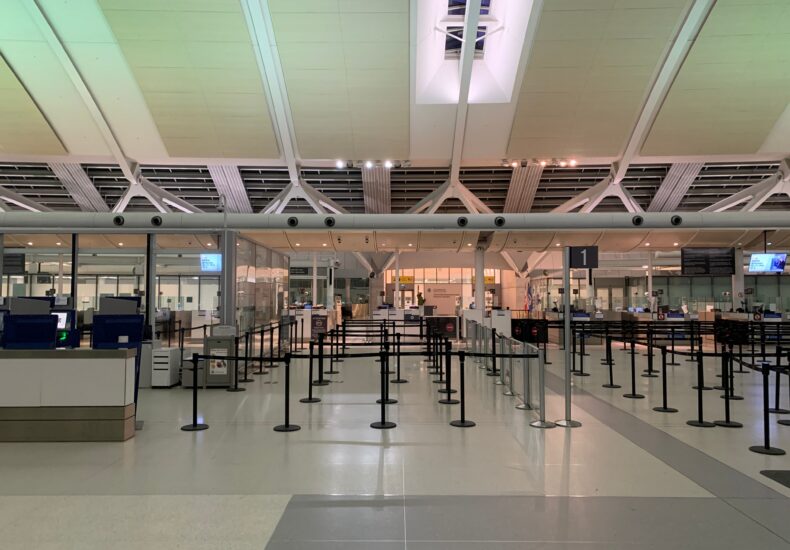
The airport was dead. He hadn’t had a late-night flight in quite some time, but still, he had assumed the place would be hectic with pale-faced and red-eyed travellers. A few people stood around by the check-in desks at the opposite end of the airport, but other than them, he seemed to have the run of the place.
After checking in his bag at the self-service bag drop, he moved towards the escalator that would bring him up towards security. Halfway up the escalator, he had another strange moment as the stairs stuttered, slowed, then lurched violently, making him lose his balance and nearly plummet backwards. He reached desperately for the handrail and held tight to it, breathing deeply and slowly as he tried to regain his composure. He closed his eyes and let out a long exhale as the escalator resumed its usual smooth climb. When he reached the top and stepped back onto steady ground, he turned and examined once more the ground floor of the airport. It was now entirely empty. He had a sudden. strange sense of change, though it was nothing he could quite put his finger on. Maybe it was the quality of the light, which seemed harsher now, or something to do with the usual airport noise—humming machinery and mumbled messages over the PA system and beeping ride-on floor cleaning machines—of which there was none, or at least very little. He chewed his lip, turned away, and tried to ignore the discomfort in his stomach and looseness in his bowels as he made his way towards security.
No one waited in the queue for security, and a large television mounted high on the wall displayed an average wait time of “– minutes.” He frowned up at the television as he passed through the empty queue. Where a person should have stood with a handheld device to scan his boarding pass, there was no one. He stood for a moment, unsure whether to proceed, then continued, his passport clutched in one hand, his phone in the other. As with the queue, not a single soul occupied the bag-check and metal detector portion of security. He scratched at his temple and thought that maybe this was some sort of prank, or maybe he had come on the wrong day and the airport was closed and he really shouldn’t be up here at all, and he might get in a lot of trouble if someone found him here. That sounded about right. He raised his phone to unlock it, intending to verify the date of his flight, but he met only his reflection in the smudged black glass. He tapped the screen with his thumb. Nothing. He held down the power button, planning to turn the damned thing off. No joy there either. It was dead. Typical. He pocketed the phone and decided he’d better turn back and find someone downstairs to tell him what exactly was going on here.
When he turned around, however, the space where he had been was now thronged with people. They all seemed to stare at him, but he couldn’t tell for sure; their faces were featureless, shadowy blanks. At the front of the now busy queue, a shadow person, dressed in the blue uniform of airport security, raised a hand and gestured at him, seemed to urge him forward. He nodded uncertainly, turned back around, and collapsed in a dead faint.
He looked out the window to his right and saw nothing out there, nothing at all. The outside looked as if a great dark blanket had been pulled down over the entire world. No stars, no moon, no little lights from the land that should’ve been visible below. Somehow it didn’t surprise him. He had no memory of boarding the plane, couldn’t remember waking up. He saw his reflection in the window, observed his outline and the darkly scribbled-in space where his face should be. He looked down at himself, at his hands, and saw that they were the same, like he had dipped them into a starless night sky and come away indelibly marked.
He was alone in his row. He shifted in his seat, looked up and down the aisle, and saw that nobody at was on the plane. The plane was silent, as if holding its breath. No engines roared, no air conditioning blew, and he turned his attention back to the window, convinced that the plane must not be in the air at all. He sat back in his seat, closed his eyes, and muttered to himself over and over, “I’m doing the right thing,” though he no longer knew what the words were in reference to nor why he said them.
“Are you all right, sir?”
He spun in his seat, and there, standing in the aisle next to him, was a stewardess. Her outfit was clean and smooth and brightly coloured. The exposed parts of her were nothing but shadow.
“Where am I?”
She didn’t immediately respond, and he got the sense that she was frowning at him, though without any facial features, it was impossible to tell.
“We’re almost there, sir,” she reassured him.
He heard noise behind him, turned again in his seat, and saw that the plane was now full of shadow people like the stewardess, like him. He turned back to the stewardess, and she placed a hand on his shoulder. She gently squeezed. Her touch was bitterly cold.
“Don’t worry, sir. We’ll be landing shortly. Try to relax.”
He nodded, and seeming satisfied, she turned and made her way further down the aisle.
He turned his attention back to the window. He tried to remember where he had come from and found he couldn’t. He tried to remember where he was going, and again, found that he couldn’t. He had left someone behind, he was sure of it, but that felt distant and unimportant now. He relaxed in his seat, and a peaceful feeling washed over him. He gazed out the window, took in all that death-black nothing, all that endless emptiness, and found, strangely, quite a bit of comfort in it.
| SPECIAL EXHIBIT FIVE: Return to Bare and Brittle Brick and Metal | Continue in Gallery One: Contrasting with “The Highline Grace” |