Bread and Body
by Zary Fekete
Horrific Scribes Extremity Rating:
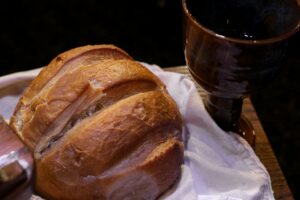
The bread is warm when it reaches her hands.
That is the first thing she notices.
Someone must have baked it that morning. There is a kitchen somewhere in the building. She passed a door marked Fellowship Hall on the way in, heard the faint clatter of pans, the low murmur of voices. It’s a small church. The kind where things are still made by hand.
Still, the bread’s warmth lingers longer than it should.
She turns the piece between her fingers. The surface gives, softer than she expects. When she pulls it apart, it resists. Enough that the two halves hold together for a moment before separating.
A thin strand stretches between them, then breaks.
“The body remembers,” the pastor says from the front. Murmurs of agreement and nods of affirmation throughout the congregation around her.
She brings the bread to her mouth. It tastes of yeast and salt, something metallic beneath it. She swallows, then takes the cup when it is offered.
The wine is darker than she expects.
She drinks.
“Take, eat,” the pastor says. “Take, drink. You are not alone. He is here.”

She had not planned to come back to church. It had been something she simply no longer did. It was a memory of acquaintances left behind. She thought she had left childlike ways behind her.
But the building had been there, the door had been open, and the sign out front had said:
RESTORATION FELLOWSHIP – SUNDAY LITURGY, 10:30
She had sat in the back.
The service had begun as if she had always been there. She had found that comforting.
Afterward, people stand in small clusters, speaking in low voices. No one asks her who she is.
A woman beside her folds the cloth that had covered the table.
“You’re new,” she says.
It is not a question.
“Yes,” she says.
The woman nods. “You came to the table.”
“I did.”
“That’s good.”
She hesitates. “The bread…”
The woman smiles with a small nod.
“It takes getting used to,” she says. “Most people are surprised the first time.”
“It felt…” She stops.
“Real?” the woman suggests.
She considers that. “Yes.”
“That’s the point,” the woman says.
She tells herself she will not go back.
There is nothing in particular to return for. The service had been quiet, yes, and orderly in a way that felt almost careful, but other churches do that. Other places do things with intention.
The bread was unusual.
The language was unusual.
Still, on Sunday morning, she finds herself turning down the same street.
The door is open again.
This time she sits closer to the front.
She tells herself it is so she can hear better. The room carries sound unevenly; some words seem to land directly while others drift and dissolve before reaching her.
The liturgy is the same. The pastor’s voice is measured. Each phrase given time to settle before the next begins.
“We do not come to remember alone,” he says. “We come to be gathered.”
Murmurs and nods.
“We have been taught to think of the body as distant,” he continues. “As something that happened once, far away, and is now safely contained in memory.”
He looks down at the table.
“But a body is not an idea,” he says. “A body does not remain where it was left.”
Her chest tightens.
When the bread comes, she watches more carefully. The loaf is brought forward whole. The pastor rests his hands on either side of it.
For a moment, he does not move.
Then he presses inward. The crust cracks. The sound is soft, but it carries. He pulls the loaf apart.
This time she sees it clearly.
The interior is darker than it should be. Deeper in color, as if the light does not settle properly.
A faint sheen runs along the torn edge.
He lifts one half.
“Take, eat,” he says again.
She does not mean to go forward. But the line forms, and she is already standing, and to sit back down would feel more awkward than to continue.
The woman from before is ahead of her. She receives the bread without hesitation. When it is her turn, the pastor looks directly at her.
“Do not be afraid if you feel it,” he says quietly.
“Feel what?” she asks.
“Communion,” he says.
She takes the bread and puts it in her mouth
The sensation is immediate this time. The metal taste is there again, but something else is with it. Something like expanding pressure but not localized. A spreading awareness, as if her body has briefly become larger than itself.
She swallows.
The room feels tilts. She steadies herself before returning to her pew.
She sits. Across the aisle, a man presses his hand to his side. His face tightens. For a moment, she feels a sharp ache beneath her own ribs.
It fades.
The man exhales, then relaxes.
After the service, she does not linger. She walks quickly to her car, the sensation in her chest still echoing.
“This is not normal,” she says.
She sits with her hands on the steering wheel. She presses her fingers into her side. Nothing. No bruise. No tenderness.
She starts the car.
The following Sunday, she returns. She does not decide to. She simply finds herself there.
The door is open. The room is still.
During the service, a man near the front lifts his sleeve. A scar runs along his forearm. Old. Faded.
As she watches, it lightens… softens, as if it is being drawn away. At the same time, she feels a sharp sting across her own arm.
She looks down.
A thin red line has appeared below her elbow.
She touches it.
It is real.
“No,” she says, under her breath.
The pastor raises the loaf.
“This is not punishment,” he says. “It is participation.”
He breaks the bread. The seam that opens is wet.
There is no other word for it.
Wet.
A dark line runs along the torn edge, catching the light. Several people lean forward.
One woman closes her eyes and smiles.
“We have forgotten what it means to belong,” the pastor says. “We have mistaken isolation for safety.”
He looks directly at her.
“You cannot stand near the body forever and remain untouched,” he says.
Her chest tightens.
When the plate comes to her, she does not move.
The bread rests there. Heavy. Waiting.
She shakes her head. She exhales. Her hands stop trembling.
“This is enough,” she says. “I’ve seen enough.”
She stands and walks out.
Outside, the air feels thin.
She pauses on the steps, one hand on the rail, waiting for the tightness in her chest to settle into something she recognizes. The street is quiet. A car passes, then another. Ordinary sounds, spaced at ordinary intervals.
Everything behaves as it should.
She walks to her car.
Back home, the house is quiet. Not still in the way the church had been… held, contained, attentive.
Empty quiet.
Suddenly she is in her car again, not remembering how she got there. Desperate to be back. She tries to push thoughts away, but all she sees in her mind is the wet crack in the bread.
The drive back is shorter than she remembers. Or perhaps she is moving faster. She does not check. The building comes into view before she is ready for it.
The door is closed now.
The sign still reads: RESTORATION FELLOWSHIP
The windows are dark. She approaches and opens the door. The handle turns easily.
Inside is dark. No lights. No voices. No movement.
She steps inside. The air is different now.
Heavier.
Full.
“Hello?” she says.
The word does not carry far.
It seems to settle just beyond her. No answer. She moves forward.
The sanctuary is empty. Pews in place. Table cleared. The cloth folded neatly at one end.
No bread.
No cup.
She walks forward and stands at the front, looking down at the table. She reaches forward and touches it. The surface is cool.
Still.
She hears a sound. Low. Irregular.
It comes from below.
Off to the side of the pulpit, she sees the basement door. It’s closed. She walks up to it, leans forward, and listens.
The sound is coming from behind it. From below.
A wet, shifting movement. Something pressing.
Something yielding.
Her hand pauses on the handle. For a moment, she thinks of turning back.
She opens it.
The stairs descend into darkness. The sound is clearer now.
Not one sound.
Many. Layered moments. Breaths in and out. Wet and sucking.
A soft, rhythmic tearing.
She begins to descend.
The light from below seems strange. It’s a diffuse glow that does not settle in one place.
She reaches the final step. And stops.
The room is full.
At first, she does not understand what she sees. There are no clear boundaries. No individual shapes she can isolate.
Just mass.
Then her eyes adjust. She sees bodies. She sees one body. Many joined into one.
They have grown into one another. Into openings. Through wounds. Through places where the skin has given way and allowed another body to enter.
Arms disappear into torsos that are not their own. Faces press against shoulders, against backs, against the sides of heads that no longer turn independently. Mouths open and close.
Some praying.
Some breathing.
Some biting.
She takes a step back. She steadies herself against the wall. She looks across the carpet of flesh.
A man she recognizes… third row, left side… lifts what remains of his arm. The hand is intact. The wrist is not. It disappears into the side of another body.
He opens his mouth. And takes his own arm.
Bites and chews. Then swallows. The flesh gives. It stretches between them all.
She cannot move.
“This is not possible,” she says.
A face turns. Slowly. It is carried by the movement of others.
It is the woman who spoke to her. The one who folded the cloth.
“You came back,” she says, her breath deep and moist.
Her voice is not singular. It emerges from several mouths at once.
“What is this?” she asks, her voice thin.
“The body,” the woman says.
A movement ripples through the mass. A shifting inward. A drawing together.
“You feel it,” the woman says.
And she does. It’s a pull. A recognition.
Her hands begin to tremble.
She looks down. The wound lines are back. Dark and raised.
“No,” she says.
The flesh before her shifts. It opens. Like a raw mouth. A wound. It deliberately pulls apart.
“No,” she says again.
The opening widens. It matches her. The length of her torso. The angle of her shoulders. The curve of her arms.
A space where she would fit.
“You don’t have to be afraid,” the woman says.
“I am,” she says.
“So were we.”
The mass breathes. A single, shared intake. The room shifts with it.
She steps forward. Her body trembles.
She takes another step.
The opening responds. The edges soften. The red inside glistens… inviting.
Welcoming.
Her hand reaches out and presses into the wound.
It is warm. She does not pull away.
She closes her eyes.
For a moment, there is only her own body. Her own breath. Her own weight.
Then something answers. From within.
The same pressure she felt at the table.
She exhales.
Her hand presses forward.
The surface gives.
And the body receives her.
Want another gripping story by Zary Fekete? Read “My Father, My Father” in Horrific Scribes December 2025.