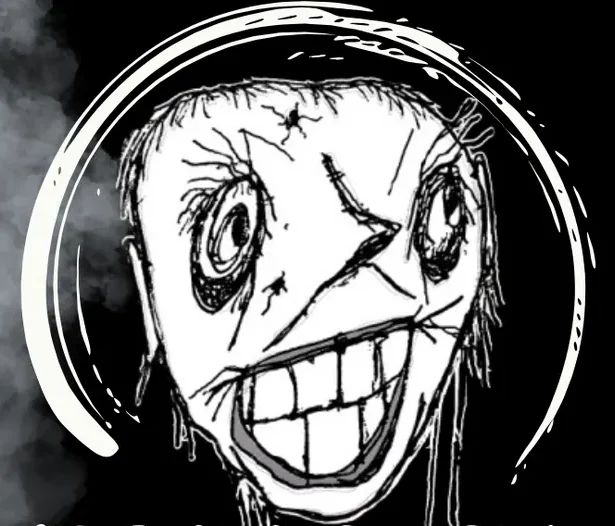
A Cracked Hand-Mirror
by Conor Walsh
Horrific Scribes Extremity Rating:

The first dissection came on our thirteenth birthday.
I tried my utmost to forget it, but to Brett it was a bizarre novelty to be shared over the wine-speckled embers of a dying party. I imagine her audience found it inoffensive, perhaps dull—a misremembered childhood incident, a puffy retelling, something to fill time until the last burnt-out houseguest departed into the night.
Sometimes while spinning the tale, Brett would look over at me as if waiting for me to chime in. I could have—she’d forgotten details, misremembered aspects. But if she wanted to take me on a forced march down memory lane, she could do the navigating herself.
Here’s how it went, time and time again: Brett was excited about a new bicycle from our parents, a present for reaching her teens intact. It was a sleek, silver machine, much too large for her—she could only reach the pedals with the tips of her toes. My gift was a set of pastel pink walkie talkies, which I had to share. That was how it was in our family. Share, always share, even if we did not want what the other had.
We were with a group of neighborhood children, names now forgotten, at the top of the tallest hill in town. There were five bikes for the six of us, but I was content to stand back and frown at the others as they risked their lives.
We played a stupid game, pedaling down the hill as fast as possible even if, should a car suddenly appear, we would never be able to get out of the way in time. Brett told me in confidence that her new bike would take her faster than any others before, so fast she would be able to leave herself behind, become pure speed and break into the beyond. She always omitted that detail. If it was so embarrassing, why bother recounting the story at all?
At the bottom of the hill the street veered hard to the left, a brick wall curtaining it. That curve was the obstacle separating us from mach speed. No matter how quickly we started, we’d inevitably lose our nerve halfway down and brake, taking the turn at the bottom with the sheepish awareness that when death looked us in the eye, we blinked. But when Brett’s silver bike passed the halfway point, whistling like a ghost, she didn’t even slow.
The others were silent. I knew they thought what I thought: Brett was going to slam into the wall at the hill’s base and shatter. But we were mistaken—somehow, as the road leveled out, she bent and took the bottom turn at full speed, smoothly, with the casual grace she had in all things. That grace was one of the few qualities we did not share.
Here Brett would skip to the end of the story. According to her, she was aware of the wind tearing at her hair one moment, and the next she was sitting beside her bike, completely unscathed. The bike itself, she would only ever say, was “a wreck”. The event had been an exciting, if foolish, brush with death. Foolish was the word for it. If she’d been seriously injured, I would have been the one punished.
Brett always left out the most important part of the incident.
When the rest of us caught up to her, she was seated on the sidewalk, yes, but I would hardly call her unscathed. She shook. Her fingers were vice-grips around her bike’s handlebars—and those handlebars were the only part of the bike intact.
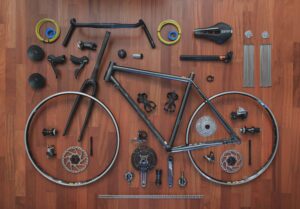
The rest of it lay in small pieces, disassembled down to the screws, meticulously placed in the road at her feet in neat rows arranged by size, the frame, the brakes, the bike wheel tubes removed from their casings, individual gears set one after the other like metal matryoshkas.
We stood in a circle around her, afraid to get too close. I heard a noise so soft that none of the others seemed to hear it. I turned toward a whisper on the wind, the voice of someone vanishing. If I ever interjected with that detail, Brett’s bracing little story would have ended on a much darker note.
But I just smiled and nodded along with her other listeners. It made sense to be fascinated with one bizarre incident in an otherwise ordinary life. Prom queen, excellent college, steady job. I saw her less after she graduated, then not at all once I joined the workforce. Some part of me felt guilty at how easily we were parted. At least I wasn’t expected to share any more.
For a while we called each other yearly on Christmas, but even that custom faded. A year ago, our parents were killed—a car accident—and I planned the dual funeral without even thinking to consult her. She was there, of course, a pale face in a sea of black suits and dresses. Shame she hadn’t called to offer her assistance.
Yesterday was the anniversary of our parents’ deaths. For a moment in my workday I paused and thought—just for a moment—about checking in on my sister to see how she was doing. Imagine my surprise when I came home to find a message on my answering machine from Brett’s area code.
It was Brett’s work. She hadn’t been to the office in a week, hadn’t responded to phone calls or emails, and her manager was becoming concerned. I was still listed as her third emergency contact.
At the end of the message her manager paused, silent so long I thought she’d forgotten to disconnect the call. But finally, she spoke. She said they’d gone into Brett’s office, intending to search it, and had found every piece of furniture disassembled down to the screws. There had been a storm the night prior, and maintenance crews were still locating pieces of her car.

Brett lived in a two-story home at the edge of town. I’d never visited, and now that I finally saw it, I wasn’t impressed. It was a dingy brick-and-mortar structure half-overcome with dead brush, a chain-link fence around the yard like a metal noose. On a six-digit salary, an interior designer should have lived in something flashier than this bad memory from last century.
She was single, too—but at least she owned her place. At least she wasn’t being pushed into the street by her boyfriend’s bric-a-brac. At least success followed every step she took. It fled me no matter what I did.
I knocked twice and waited. Silence. I knocked again, then began to pound the door with both hands in staccato arrhythmia. Nothing irritated Brett more than a constant, off-beat racket—if she was alive, she’d come to the door.
A minute passed. My knuckles stung. I decided to break in.
Shrouded in the dead brush around the corner was a dust-stained window. I picked up a broken branch, squared my shoulders, and swung as hard as I could. The glass exploded into pieces.
No screams echoed from within. No alarms blared. The silence was off-putting. I used the stick to clear away the remaining window shards, then clambered into the dark. Had Brett ever talked about buying a gun? Hopefully not, for my sake—and hers.
I blinked, eyes adjusting to the stifling dark. Brett’s living room looked cut from a furniture catalogue, if the photographer had failed to assemble every third entry. The leather armchair across from me was a Montague, which came close in value to the car Harris and I co-owned. Next to it lay a pile of very expensive couch parts. Springs, stuffing, rolls of fabric, bolts and screws. Buttons from a television remote in neat rows on the floor in front of it, beside the case. In the kitchenette a broken pile of metal and glass plates detracted greatly from the neat faux-Americana cabinets.
Something shifted in the center of the room. I turned. Cross-legged and bent nearly to the floor was my sister, an old Persian rug around her shoulders like a mad queen’s robe. Her face was gaunt. Her hands were interlocked, squeezing a weather-beaten stuffed lobster that Mom had helped me pick out for her seventh birthday. She smiled crookedly down at the floor, showing her teeth, a dead tell that it was forced. She’d always hated her smile.
I looked at her, not sure what to say. I couldn’t remember if our last exchange had been cordial, but I doubted it.
“When was the last time you ate?” I managed.
Brett lifted the stuffed lobster, using it to part the curtain of long blonde hair from her face. It fell right back again when she lowered the plush toy. Whenever her hair got this long, she’d complain that it was getting in her nose and making her sneeze.
“I’m okay,” she said. “Really.”
I went into the kitchen and opened empty cabinets until I found a crumpled box of macaroni with noodles shaped like cartoon characters. In the living room Brett began to rock slowly, her one visible eye burning into me. When I turned the sink handle, she spasmed like she’d been shocked. When I touched the stove, she shouted.
“NO! NO NO NO! STOP!”
I did. Neither of us spoke for a long time. A dog barked in the distance. Something, a squirrel maybe, skittered on the roof.
“I’m really—I’ve been under some stress at work, okay?” Brett said. “I—lost the last client we had. They got me another, but I can’t afford to lose him, and I think I might. It’s just been—it’s been a lot.”
I gestured toward the remains of her couch. “Taking apart your own furniture isn’t what I’d call a healthy coping mechanism. Someone might see that and think you’ve gone totally insane.”
Brett stared back at the floor. “I don’t know when that happened. I don’t remember. But it’s just a—it’s just a little setback. I’m okay. Really.”
“If your job’s wearing on you so much, quit.”
That made her look up. “Evelyn, I know you’re trying to help me, but I need to ask you to leave.”
Dust motes curled in the shaft of light from the window I’d broken. I tried to swallow my irritation. This was worse than dealing with a child.
“Yeah, now that you mention it, everything here seems fine,” I said. “Nobody here seems like they’re suffering a hysterical breakdown. I know plenty of people who start breaking shit, leaving the pieces for others to find, then say they don’t remember doing it. Probably just an iron deficiency.”
“You don’t think I can hack it.” Her hair swaddled her face, walling me off. “You don’t think I can support myself.”
“I can’t say you’re really proving me wrong, can I?”
Her knuckles went white, crushing the stuffed lobster. Cotton pushed through a wound in its side. “Get out of my house. You broke in. I’ll tell the police.”
I’d pushed her too far—but her disdain made my guts boil. “Fine. If you want me to go, I’ll go. Give me a call when you’re ready to act like an adult.”
I left the way I came in. Brett was silent, but I felt like she wanted to say something.
Outside, rays of sunshine slashed at me. As I hopped off the window frame something darted out of the brush and scampered over the fence. When I looked into the weed-choked yard beyond, I saw nothing.
“Shouldn’t have left her alone. She’ll probably kill herself.” Harris had a pair of tweezers in one hand and a figurine of a disemboweled soldier in the other. For the past three months he had been building a diorama of the Battle of Iotensia, some small-scale conflict in Italy during the Second World War, on our kitchen table. He was aiming to take part in an amateur modeler’s contest. First prize was three hundred dollars, which would recoup about a quarter of what he had spent on paints and models. If he won. Which he wouldn’t.
“Brett’s tougher than she looks,” I said. “She always made a lot of noise whenever a boy dumped her or she got a B+ instead of an A. But… something felt different this time.”
“Uh-huh.” Harris angled the soldier into a small gap between two beige-uniformed men cowering in a trench.
“I want to help her, but I just get so… pissed off whenever we talk. It feels like she already knows what I’m going to say, so there’s no point in me saying it. Which begs the question— if she already knows what advice I’m going to give her, why the hell doesn’t she follow it?”
I took mail out of the slot beneath our doorway. Junk. Better than overdue bills. “I just don’t know what happened,” I said. “We always used to hang out. We went to the same places, ate the same things—we even fell in love with the same boys, though it never worked out for me. I always got the feeling she was everyone’s favorite even though she barely tried. But sometimes I wonder if the two of us were meant to spend so much time apart.” I shredded the junk mail into the recycling bin. “For her sake, I mean.”
“It’s better this way. She’s not a serious person.” Harris put a dollop of superglue on the underside of a pillbug tank. His giant mitts exaggerated its miniscule size. “You were using her as a crutch. She probably resents you for it.”
“Hard to say what she feels about anything.”
Harris grunted, then went silent for a long time as he made infinitesimally small movements amid the bloody, tiny battle with his tweezers. Finally, he stood back, scowling down at the battle, a godly commander finding his detachment wanting. “Heard some noises below the floorboards earlier,” he said. “Probably rats.”
“Did you call management?”
With an irritated mumble, he gestured at his diorama as if it served as an explanation of negligence. Looking at him, I suddenly couldn’t recall how we’d met. As if Harris had sprung up one day in my home, a pasty, man-shaped fungus.
Looking down, I noticed my shirtsleeve was sticky with black blood. I’d cut it earlier coming through Brett’s window. Exhaustion overcame me. “I’m going to bed,” I announced. Harris didn’t give me the decency of a grunt.
Two hours later, I lay awake. Sleep refused to sweep me away. I’d forgotten to dress my wound, and it stung in intervals like a reminder of some long-neglected task. In the cloying warmth of our bedroom, I listened for the sounds of rats beneath the floorboards but only heard Harris’s phlegmy breathing. Sometimes I thought about leaving him, but never very hard.
A single electric note lit up the night in a staccato burst, then ceased.
“Whuh?”
“The phone,” I said, sliding out and into the dark, each step sluggish and reluctant. I feared what I already knew.
On the blue glass display of our landline, Brett’s number flashed like a distress beacon.
The grey rays seemed reluctant to touch on Brett’s lightless home, making it illusory, a suggestion of a house. A leering moon dangled overhead, nailed dead in the sky.
The front door had fallen over the front step, creating an unsteady seesaw I had to ride to enter. On the inside it wasn’t darker than the sky had been that morning, yet I felt I was peering into solid black. If I stepped inside, I would be met with force.
I stepped inside anyway, slowed only by mounting dread.
As my eyes adjusted, each new thing I saw revealed more of how far Brett’s “issue” had progressed. There wasn’t much left of the kitchenette: a single hanging cabinet stood on the far wall, black dust stains around it the only signs of its siblings. The television had been dissected, along with all of the chairs and light fixtures in the living room. Not even a scrap remained of her expensive Montague armchair.
A hallway branched from the living room, leading to a mercifully intact staircase. “Brett?” I called. No response came from above.
The staircase led into an attic-turned-bedroom, smaller than the kitchenette but just as desecrated. Only the bed hadn’t been reduced to neatly organized pieces. Atop it a comforter, patterned with pastel yellow and pink ducks, shook over a huddled shape.
I walked forward, and a board squealed, and the shaking stopped. I opened my mouth to speak, and the comforter spoke first.
“Do you remember—when we were little girls, my favorite toy? The singing frog?”
I ran my tongue along my teeth. “No.”
“The bike wasn’t the first disassembly. I woke up the day after our seventh birthday and it was dissected—or, in pieces like it had never been built in the first place. I got so mad I hit you. I thought you did it.”
“You never hit me. You were always a model sister.”
“Well, I was wrong,” she said, ignoring me. “I know you didn’t do it—because it happened to you, too. Your doll that wet itself. Disassembled, too.”
“Why are you saying it like that?” I blurted out. “It wasn’t ‘disassembled’—it fell apart. You’re trying to blame bad luck on—”
Brett lifted her blanket to stare at me. The eye that looked out from the black was bloodstained, wild. “It was taken apart.”
“What are you saying?”
“I knew nobody would ever believe me. I never talked about it. I wanted to see if you had seen it, too. That day on the bike.” She was sitting up now, shaking worse than before, her skin a swaddling blanket, her eyes staring out of a vanishing face. She was something out of a bad dream. Not my sister. Nothing like this could happen to my perfect sister. “I turned the corner on that hill, and something darted out and under my bike. I thought it was an animal. Then I wasn’t moving any more, and my bike was in pieces, and I saw it clearly. Just for a moment.”
Brett stopped, nearly hyperventilating, and I thought she was about to pass out. But then her chin swung toward the ceiling, showing the thin line of her throat. “Listen! Do you hear that?”
I detected the faintest sound, the tap-tap of an animal walking on the roof, like I’d heard that morning.
“No,” I lied.
“But—”
“I don’t know what’s happening to you, but you’re pretending like you’re sick, and I know you aren’t sick. And that fucking story—what the hell are you on about? Maybe something strange happened, maybe it didn’t, but you’re obsessed! Breaking your furniture now and blaming it on whatever you’re blaming it on—”
“You think I’m lying? You think I’m doing this for attention?”
I felt myself recoil, retaliate, a machine dispensing a response to a stimulus. “All I think is that, if I lived in a house this nice, I wouldn’t tear it apart.”
“I’m not the one…!” she started, trailing off, her eyes on the ceiling. Then she sighed a slow, deep sigh, seeming to deflate beneath the blanket. She was wearing a ratty tank top, and between it and her bony shoulders she looked like a newborn bird on the narrow footing between life and death. “I don’t want to argue,” she whispered.
“Then don’t. Start going back to work, stop with all this woe-is-me psycho bullshit. Learn to be a serious person.” I folded my arms. “You ask me, I think you’re just lonely. If you had more people in your life you wouldn’t have to keep bothering your sister.”
Brett didn’t look at me. “Can you… can you stay the night?”
I blinked. Suddenly my heart, set against her bullshit, faltered. Maybe I did want to be near her. Maybe I did want us to be close, to have someone other than Harris. But then things would be like they were before, and I would be everyone’s second choice again.
I looked away. “If I’m not home by 11, Harris gives me hell. Sorry.”
She leaned forward, her hair swallowing her shoulders and neck. Sheets of gold, floating independent of a body. “I don’t like that man.”
“Who does?” I turned away. “You’ve lived here a long time. You’ll be fine.”
Brett pulled the blanket up over her face, returning to how she’d been when I found her. Except now she did not shake.
In the morning her house was gone.
Not even a fragment of drywall was left, only a solid square of bare, cracked concrete. I called the police, and the deputy on the other end laughed so hard at my story that I hung up and decided not to call again.
The morning was cold and dreary, and a steady rain fell, but I still picked through the bushes for any sign of Brett. Even though I knew it was pointless. When I finally parted from the bushes, a dirt mound stood where the home’s foundation had been moments beforehand. I decided to go home.
I called Brett’s office as I biked—Harris had taken the car into town for one of his weekly war enthusiast meetings. Brett’s manager picked up, telling me that Brett had been in that morning only long enough to resign. I thanked her and asked her to call me if she heard from Brett again.
Between the place where Brett’s house had been and our apartment stood a tall hill, ringed on either side by unkempt brush the city had abandoned its halfhearted attempts to tame. I dismounted and began to arduously walk my bike up the incline.
Brett and I had taken a path like this to school every day when we were little. We’d ride tandem on our one bike as we took the serpentine path to school, then we’d take turns pushing it on the way back.
Why had the two of us stopped talking? It must have been around the time Brett took her interior design job, around the time I met Harris. He’d disliked her immediately, but I’d never paid much heed to his opinion on anything. Yet I’d chosen him over her. Somehow, I neededhim. But not as a friend. Certainly not as a lover.
Then what?
I slipped and fell hard, flinging my arms out in time to scrape both palms bloody against the wet asphalt. I was confused—and then realization sank into me like a knife.
My bike’s handlebars lay like a silver bridge from the asphalt to the curb. Everything else was in pieces on the sidewalk.
Something stirred in the brush, and I caught—or imagined I caught—the barest glimpse of it amid the grey leaves. Sallow skin torn and scarred in a hundred different places. A dozen joints. More fingers than I could see.
Without even blinking I lost sight of it. Like it was never there.
But the memory of it was embossed on my mind, and that memory ran like paint in water and touched other memories. That invisible hand. I railed against it, tried to force myself to forget. But the gap in the bushes matched other gaps all around me—the wide empty spots between homes, the too-large spaces between broken fence slats, the dark hollows in the spouts of rain gutters, echoing with unseen movement.
I left the pieces of the bike where they lay and half-stumbled, half-ran the rest of the way home, keeping to the dirt near the sidewalk, other people’s lawns, once leaving the road completely to stumble through a nest of dead branches that clawed at my jeans and my jacket. I imagined the road turning to slag underneath me, swallowing me up. The sidewalk splitting apart, leaving me to fall into the bowels of the earth. Even after I left the brush, I could feel hands tugging at my ankles. I walked for a long time.
When I finally made it to our apartment, a parcel waited at the front door. It had a tag on it: “From – Brett.” How she had found her way in without the building collapsing I couldn’t even begin to speculate.
I came in and left the front door open, the diluted grey sunlight casting a sickly hue over the familiarity of the living room. Out of the corner of my eye, I noticed Harris’s war diorama had caved in on the kitchen table, like a sinkhole had opened amidst the trenches.
I placed the box on the floor and opened it. Its contents were unintelligible at first. A plastic arm, a tiny, hairless, eyeless head, pieces of fabric, milky white tubes, all yellowed with age. And then I remembered. This was my doll.
Brett had been gone at a sleepover for two days, and I came downstairs, and suddenly everything, the whole living room, was in pieces—all of our toys, the television, the couch. Even the window had become a pane of solid, unbroken glass on the floor. I curled into a ball and sat on the carpet, rocking and crying, not noticing when Mom and Dad entered to stare, in shocked silence, at the absolute ruin their child had wrought. Then they grounded me for two months, and the incident was forgotten.
It had all been compacted, shoved into the back of my head, buried in the murky half-remembered dream-state of childhood. But it had been real. The invisible hands had been there long enough to tear a hole in my life. I could see the ghastly arms stretching into everything I’d ever known. Noises in the dark, present and not present, things moving that others would say hadn’t moved, an overactive imagination fed by the not-quite-literal. It had been there every day, even after I moved in with Harris, Harris with his massive body, with his thousand hateful quirks that occupied my moments at home. I did not love him, and I could not live without him. Without his shadow over everything, I would have no choice but to see the naked, impossible reality of the situation.
Brett had seen it. Instead of helping, I had tried to stay blind. And now it was impossible.
I shut the door and crossed the room to sit in the corner in the dark. In the cold silence of late morning I listened to my own shaky breathing, to the pops and cracks and small hands digging, twisting, prising nails out of floorboards. What else, I wondered, had I forgotten? What else in my life had fallen apart without my noticing? Had Mom and Dad really died in an accident, or had they… or had they…
The front door flew open, and an indistinct grey silhouette loomed in the doorway in a silver halo. Harris asked why I was sitting in the dark like an idiot. He asked if I’d been to see my sister again. He said she was a drain on my sense of self-worth, a parasite—a disease. He didn’t seem to notice that I was already infected, that the infection was spreading around him, above him, beneath him.
He caught sight of his ruined diorama and jerked as if stabbed. His voice grew loud, and then quiet, and then he didn’t speak, though his lips continued to move like an actor on a silent television. He began to slouch, still silently speaking. And I watched as gnarled hands reached into the light, entwining with the wispy hair on either side of his head. A single deft jerk preceded a dull squelch as bones slid from their sockets. A flurry of movement followed.
When I opened my eyes, Harris was reduced to his composite parts—arms, legs, fingers, heart, liver, both his eyes, arranged neatly beginning in the kitchen and ending in the front doorway. With him gone, nothing would keep me from disassembling everything else. Nothing would keep the walls from falling to pieces.
I felt the hands upon me. I heard the same whisper I’d heard so long ago, that day on the hill, a voice older than any I had ever heard. And I heard again what I had forgotten, all those years ago.
“When next I speak, you will have no ears to hear.”