
Five Stories About the Urban Underground
by H.J. Dutton
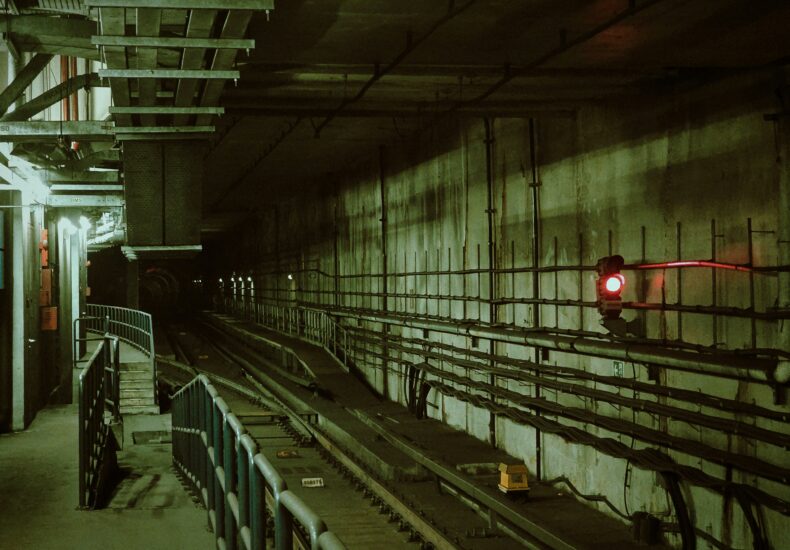
Few places can fill the mind with unease like the subway. The slick tiled halls, the platforms of cold concrete, the tracks crawling with rats, and the black abysses of the tunnels–and don’t forget the sounds and smells, the drips, the groans, the putrescent garbage and… what on Earth smells like that anyway?
Every aspect of the world below the city streets feels designed to upset the human brain. Sewers are much like subways, if not even more frightening. These underworlds make perfect settings for horror stories, but the horror genre uses them relatively rarely.

They’re not entirely absent, of course. Cult horror film fave C.H.U.D. (1984), Stephen King’s epic novel IT (1986), Clive Barker’s short story “The Midnight Meat Train” (1986), its 2008 film adaptation, creature feature Mimic (1997), grim sci-fi film Dark City (1998), and the fan favorite “Storm Drain” short film segment of V/H/S/94 (2021) are only a few examples of how subterranean settings have evoked terror in horror fiction. Still, compared to the bulk of fiction in the genre, these settings–and cities in general–are scarce. Why?
Horror scholar L. Andrew Cooper suggests that Stephen King and his contemporaries may partly be to blame. Throughout his 60-year career, King has predominantly explored the small-town American landscape, a tendency influenced by his having lived in suburban Maine most of his life. These settings were, and still are, populated en masse by the white middle class, a demographic who quickly became King’s primary reader base. His rapid, unprecedented success after the release of Carrie in 1974 effectively determined the trajectory of the horror genre. Budding authors active during King’s heyday or coming off his heels sought to emulate him, deliberately or subconsciously, creating a surge of small-town and suburban horror that quickly became the status quo.
A related factor, Cooper adds, is racism. As white Americans departed the cities in droves post-WWII, a phenomenon known as “white flight” that peaked in the 1970s, urban landscapes became associated with African Americans and other minority groups. Publishers, in response to King’s surge in popularity and their target demographic’s disdain for the “urban,” sought more white horror authors writing about white anxieties and white settings. Thus, as the suburbs became associated with white America, the suburbs became the standard of horror. This sociopolitical trend still shapes the horror genre today.

“A Subway Named Möbius” – A.J. Deutsch (1950)

Number 86, a tram on the Boston subway line, goes missing. Nobody can figure out how. Yet stranger is how the subway system’s power lines remain active, as if the missing train is still present somewhere. While technically not horror, spare details imbue this classic sci-fi story with a unique and heavy sense of unease.
“The Underground People” – Rosemary Timperley (1955)
An anonymous narrator recounts her trips up and down the London Underground. In these accounts, the narrator describes the dozens of commuters she shares the trams with each day, all of whom have increasingly decrepit features. More grounded than the others on this list, this story offers a simple yet bleak meditation on the dehumanizing nature of modern work life.
“Children of the Kingdom” – TED Klein (1980)

Set in the bleak landscape of 1970s NYC, a man helps his elderly father-in-law move into an apartment complex. However, during his stay, the 1977 blackout takes place. This very real event resulted in mass looting and over 4,000 arrests. In this story, the city’s inhabitants have much more to worry about than petty crime, however, as something beneath the city streets begins to stir. Klein is a master of dramatic irony, a talent you will see on full display here.
“Tunnels” – Philip Haldeman (2010)

Told from the perspective of a child, this story follows a family as it moves from apartment complex to apartment complex, seemingly on the run from something beneath the soil. This story does what all great Lovecraftian fiction does: it hints at something much bigger and much worse beyond the present narrative.
“Coup de Grace” – Sophia Ajram (2024)

Vicken, a young man in Montreal, rides the subway to the Saint Lawrence River where he plans to commit suicide. Things take a turn for the worse when, upon disembarking, Vicken discovers the station is much bigger than should be possible. The novella is a superb exercise in metaphor that balances liminal, surrealist horror with grounded character struggles.