
Splatterpunk, de Sade, and the Infinite Set Piece
by L. Andrew Cooper
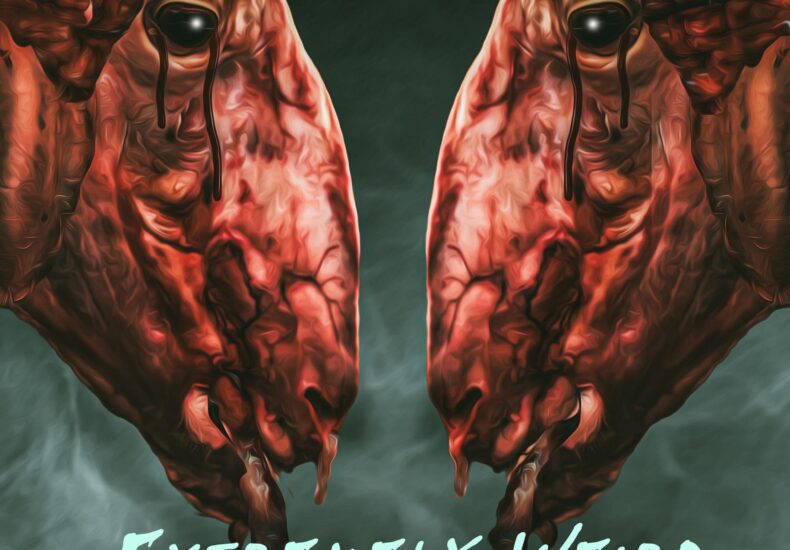
This article is my second bit of content created in support of Extremely Weird Splatter, the first anthology from Horrific Scribblings that’s paying its contributing short fiction authors professional rates. To pull it off, though, we’re crowdfunding, so please visit us, follow us, and consider backing us at
https://www.indiegogo.com/en/projects/horrific-scribblings/extremely-weird-splatter
The IndieGoGo site has information about submissions, too; we’re open until May 15.
Anyway, for my first bit of EWS-related content, I made a video in which I talk about how the stories in the book fuse the splattery with the weird. I go on to talk about a concern with human insignificance in the cosmic scheme, so-called “cosmic horror,” as a feature central to weird fiction since the tradition’s beginnings in the late nineteenth century, a tradition informed by philosophy and science that toppled humanity’s assumptions about its place in the universe. A major threat of weird fiction is the threat of THE VOID, meaninglessness, nihilism.
In the video, I make a quick jump to tie the weird’s voidy concerns with the inherent voidiness of splatter, nihilism intrinsic in reducing humans to meatbags that end up splattered on a wall.
The ancestor of human-reducing contemporary splatter fiction–people generally date Splatterpunk to the 1980s, perhaps due to the term’s coinage by David J. Schow in 1986–is the Marquis de Sade, whose major works The 120 Days of Sodom, Justine, and Juliette were written and published in the 1780s and 1790s (except for The 120 Days of Sodom, which Wikipedia says was first published in 1899, long after Sade’s years of intermittent imprisonment during which he did much writing, also long after his death in 1814).
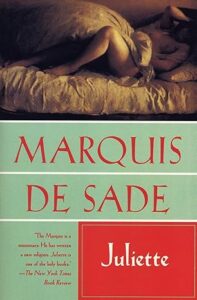
When most people think of Sade and Sadism, they think of kinky, perhaps rough sex, but Sade’s major works are undeniably mixtures of sex and splatter. With the exception of acts involving technology unavailable in his time, Sade does not leave any form of human violation, sexual or otherwise, unexplored. His libertine characters live for transgression, so they try out the possibilities systematically. Rape, murder, incest, all kinds of religious stuff… necrophilia, coprophagia… that’s the shit-eating you might have heard about… there’s a lot of that…

Sade’s thoroughness required a lot of text, and as a result, his works are very looooooooong. Assuming you get the later version of Justine that has all the naughty bits, you won’t find an edition of one of the works I’ve mentioned that doesn’t run hundreds and hundreds of pages. Thinkers such as Roland Barthes and Michel Foucault have discussed the voidiness not only in the splattering of humanity and human values that Sade wrote about in the shadow of a French Revolution that did away with social and religious structures relied on to give life meaning for centuries, but also the emptying of language Sade accomplished through his exhaustiveness. Meaning and even the ability to mean get lost in the Sadean void.
Instead of describing how Sadean tendencies lived on through serialized and underground stories of the nineteenth and early twentieth centuries–which I’m confident I could do with a little extra work–I’m going to talk about the structures of the three novels by Sade I’ve mentioned, take a detour through cinema, then stop at splatterpunk.
The novel as a literary artform pretty much came into existence around the beginning of the eighteenth century, and early types of novels related to news stories, letter exchanges (the “epistolary” form), and wandering journeys/quests similar to the earlier “romance” form (the “picaresque”). All these forms tended to be episodic, chronicling events intentionally digressive or otherwise (by today’s standards) loosely related to the central narrative concerns. Though the novel was changing at the end of the century, Sade needed episodic forms to accomodate his systematic depictions of otherwise loosely related transgressive acts, and his forms are as systematic as his content. The 120 Days of Sodom takes the form of a storytelling contest, recalling cultural touchstones The Decameron and The Canterbury Tales, and the later novels Justine and Juliette are picaresque journeys that mock mainstream eighteenth-century novels, which are often fixated on proving that virtuous behavior gets rewarded, with plotlines inversely reflected in Sade’s subtitles The Misfortunes of Virtue / Good Conduct Well-Chastised and Vice Amply Rewarded. He needed episodic forms for his novels, so he took on classic structures and subverted their traditional moral uses. He used these structures to… splatter them. The episodic structures are what allow his works to show life’s pointlessness. As in so many eighteenth-century novels, the episodes in Sade’s masterworks go on and on and on, wandering through horrors until transgression fails to shock. You’re left void of feeling. Numb.
Filmmaker Pier Paolo Pasolini understood that episodic structure is central to Sadean effects. In his Trilogy of Life, he explores episodes in adaptations of The Decameron (1971) and The Canterbury Tales (1972). For the first and only film completed in his Trilogy of Death, he adapted The 120 Days of Sodom as Salo (1975), continuing in the same episodic vein, perhaps in a different direction, contrasting his earlier (ambivalent) celebrations of life with depictions of rape, pedophilia, mutilation, murder, and, yes, coprophagia.
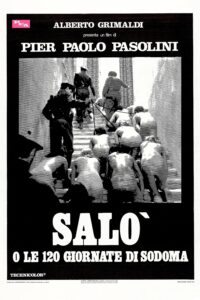
A film couldn’t reasonably be as exhaustive as Sade and still qualify as a screen-able feature film, but just as Sade had recourse to existing eighteenth-century forms when he needed episodic structures for splatter, Pasolini had recourse to a film form currently booming in Italy thanks to the international success of Dario Argento‘s The Bird with the Crystal Plumage (1970) and the wave of imitators that followed it: the giallo. The giallo is a murder-mystery that uses often disjointed storylines to weave together elaborate and gruesome scenes, or “set pieces,” in which an unseen killer violently dispatches a victim, typically with sexual overtones. Usually cited as a forerunner of the American slasher film, the giallo‘s violent set pieces are tamer but comparable to Sadean/sadistic episodes, and Salo takes such set pieces to their almost unthinkable limits as their violence escalates to a symphonic, soul-crushing finish. The film combines the eighteenth-century emphasis on episodes with twentieth-century technological and formal innovation, all in the name of splatter.
I asked Monica J. O’ Rourke, an inspirational, founding figure in splatterpunk, about Sade’s influence:
“Yes, de Sade inspired [my short story] “An Experiment in Human Nature,” and he also greatly influenced the novel [Suffer the Flesh]. I was a huge fan of his work, initially because of the shocking extremism that I couldn’t believe had been published, but then after seeing movies such as Marat/Sade and Quills, I saw his work in a very different perspective. However, I despised Salò, or the 120 Days of Sodom. It was unbearably painful to watch….”
O’Rourke’s Suffer the Flesh involves a hidden compound with many rooms, each room containing a horror to be discovered, so the setting helps the novel accommodate diverse episodes of extreme horror, but it also contains the episodes, makes the novel finite and manageable, and allows more development of an overarching narrative.

Splatterpunk novels–frequently, novellas–are often quite short, seeking to shock and then stop before shocks lose their sting, before numbness sets in or becomes, as Salo did even for someone as extreme as O’Rourke, “unbelievably painful.” Nevertheless, their episodic emphases often make splatterpunk novels and novellas, like slasher movies, ripe for sequels: Kristopher Triana, Stuart Bray, Dan Shrader, and Jason Nickey (the last of whom is in Extremely Weird Splatter) are only a few splatterpunk authors who have written follow-ups to some of their most successful titles.
Though splatterpunk works aren’t individually as exhaustive as Sade’s, the impact of Sade is his collected works’ exhaustion of the possibilities for human depravity. I personally can’t imagine reading all of his shit, but I’ve read enough to know that it hollows you out. Splatterpunk, as a body of literature, strives for the same phenomenon, each splattery tale exploring one or more episodes, a new way or ways to transgress acceptable limits, breaking down those limits so you’re left adrift in the cosmos with nothing to hold on to. Even if a splattery tale makes you laugh–as several stories–the one by Christine Morgan, maybe–in Extremely Weird Splatter are likely to do–you’re laughing as you get closer to the void.
Maybe we’ll help you have fun while you’re there. Help us get you there!
https://www.indiegogo.com/en/projects/horrific-scribblings/extremely-weird-splatter