The Teeth Remember
by Nenad Mitrović
Horrific Scribes Extremity Rating:
The engine was already running when I realized I’d forgotten to lock the drawer with the molds, but it didn’t really bother me. In the basement of the Institute of Forensic Medicine in Deligradska Street, few people would know what to do with plaster casts of other people’s teeth. People fear bones in general, but teeth disturb them on a deeper level. Fragments of jaw are too personal, too close to something that once spoke.
Have you ever seen the skull of a child in the mixed-dentition stage, seven to ten years old? Such skulls are crowded with teeth, three, sometimes four rows pressing beneath the bone, waiting their turn to emerge. They sometimes appear in medical collections. I have one myself. The sight reminds me of human temperaments: impatience, ambition, the quiet pressure of things not yet visible.
Belgrade that morning lay buried beneath smog. I drove toward the edge of the city and the highway leading east. The mountains rose abruptly, jagged ridges lifting from the earth like the teeth of Cadmus.
The call had come only a few hours earlier, while I was still in the morgue. The phone rang as I photographed the lower jaw of an unidentified man. The camera was set to macro. Under the lamp the teeth shone faintly, their crowns and old amalgam fillings catching the light. Each tooth carried its own history—tiny fractures in the enamel, faint grinding marks left by years and habits.
People believe teeth are merely tools for chewing, one of their smaller misconceptions. Teeth can be ornaments. Teeth can be weapons.
In truth, dentition is as individual as a fingerprint. Spacing, angles of eruption, fractures in enamel, old fillings, crowns, all of it forms a map of a life. No two people carry the same pattern of wear. In my profession, that fact is invaluable.
Identification begins with molds. Silicone captures everything: edges of incisors, irregularities in molars, the architecture of a bite. Then come photographs from multiple angles, comparisons with dental records, X-rays, surgical histories.
Slow work. Precise.
Exactly the kind I prefer.
Teeth are patient. When flesh decays, and skin disappears, when even bone begins to crumble, teeth endure, small fortresses standing in the ruins of meat and blood.
That’s why I listen to them.
Teeth can speak, you know.
A joke, of course. Yet in the muffled silence of the morgue, one sometimes imagines hearing whispers.
I lifted the receiver with my left hand, tweezers still in my right.
The voice on the line was police—rough, tired.
“Doctor, we’ve got something strange.”
I hear that sentence far too often. “Where?”
“Eastern Serbia. A mountain above a village. We found… parts of jaws buried in the ground.”
“How many?”
A pause. “Several.”
“A body?”
“No.”
“Bones?”
“No. Just jaws.”
I set the tweezers down and looked again at the jaw beneath the lamp. The teeth stared back with dull indifference.
“Don’t touch them,” I said.
“What?”
“Don’t remove them from the soil. Don’t wash them. Don’t bag them.”
I heard voices murmuring in the background. The morgue was cold when I hung up. Ventilation hummed softly overhead. I packed my equipment—brushes, tweezers, evidence bags, camera, lamp—with the slow, ritual care the work required.
Now I was halfway there.
The east lay hidden beneath low clouds, and the mountains ahead formed a dark row of teeth along the horizon.

Asphalt became a cracked ribbon climbing the hills. Forest pressed in from both sides. I followed the GPS and still took several wrong turns. Something in my mind resisted the idea that people lived here. From time to time, I passed collapsed barns and abandoned houses jutting from the hills like rotten teeth in a diseased jaw.
The village appeared suddenly through fog: a handful of houses, an old well, an abandoned bus stop. A police jeep waited beside a small shop.
Two policemen stood nearby. One young, fidgety. The other older, from Belgrade, with the eyes of a man who had seen things he preferred not to explain. We had worked together before.
“I kept the locals away. Everything’s exactly as we found it.”
“Good.”
We drove farther uphill until the road disappeared entirely. The jeep’s tires ground over soil and wet leaves. Finally, we stopped in a clearing. The grass was trampled. Mushrooms grew in a circle.
“To be honest,” the younger officer said, “locals wouldn’t step foot here.”
“Yet someone did,” I replied.
They looked puzzled.
“The one who left the jaws.”
The younger officer pointed. “There.”
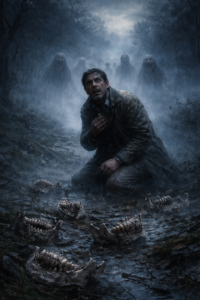
I walked toward the spot. Then I saw them. Jaws. Scattered across the ground, half-buried as if planted. Some protruded slightly above the soil, others lay almost exposed.
No bones. No skulls. Only jaws.
For a moment I simply stood there, letting the wind pass over the clearing. It carried a cold that reached the bone.
“Do you think they’re—” the young policeman began.
I knelt and opened my bag. Brush. Tweezers. Gloves. The ritual began. I brushed soil from the first jaw. The bristles passed across enamel like invisible paint. Sometimes I wonder how my work differs from archaeology. Archaeologists dig up the past. I dig up death. The difference is only time.
The first jaw came free with a soft tearing sound. I placed it beneath the lamp. Something was wrong. The teeth looked almost normal—incisors, canines, molars.
Almost.
One canine was too long. Another bent at an angle human jaws rarely permit. The molars were sharp, as if meant for tearing flesh rather than grinding food.
“Well, doctor?” the inspector asked. “Are they human?”
Instead of answering, I lifted a magnifying lens to the enamel. I saw the scratches. Tiny lines etched into the surface. At first, they resembled erosion, marks left by water or stone. But they formed patterns. Intentional ones? Under magnification they resembled letters.
Or symbols.
I photographed each tooth. The flash lit the clearing like cold lightning.
“They’re human,” I said finally.
The policemen exchanged uneasy looks. “A mass grave?” one muttered. “But where are the bodies?”
I continued photographing. The longer I examined them, the stronger the unease grew. The teeth were not merely irregular. They were incorrectly arranged, as if these jaws belonged to mouths that had never been entirely human. By the time I finished, the sun had sunk behind the hills.
Thirteen.
Seven upper jaws. Six lower. Thirteen different people. I could not yet prove they were victims. But instinct told me so. Someone had done this.
We packed the jaws into evidence bags and left the clearing behind us. The forest closed again around the place as if nothing had happened.
We returned to the village at dusk.
The inn was a small, aging building with a wooden terrace whose boards groaned underfoot. Inside it smelled of damp wood, rakija, and hand-rolled tobacco. The innkeeper was a thin man with a gray beard and hands that looked capable of crushing stone.
He showed me a room upstairs. “Nothing special,” he said. “But it will do.”
The room contained a bed, a table, and a narrow wardrobe. Enough.
I set my bag on the table and reached for my wallet. As I opened the bag, the zipper snagged. The bag tipped, and something slipped out, scattering across the floor with a dry clatter.
The necklace.
The innkeeper froze. For several seconds he stared at it without speaking. Then he slowly crossed himself.
“What do you want with that?” he said. “You shouldn’t carry such things.”
I picked up the necklace and wiped it with a handkerchief. “Just an old piece of jewelry.”
He shook his head. “That’s no jewelry. Women used to make things like that.”
“I know,” I said. “Milk teeth. A talisman against curses.”
“No,” he replied quietly. “Witches.” The word lingered in the air. “From the teeth of dead children.”
I smiled. “I don’t believe in witches.”
“No one does,” he said, turning toward the door, “until it begins.”
He left without another word.
“Begins what?” I called after him. “You forgot the towels.”
No answer.
I put the necklace back into the case.
Years earlier I had found it in a monastery while working nearby. I am not a religious man, but the object fascinated me. It felt connected to my work, so I kept it. Since then, it had traveled with me everywhere.
The shower produced only lukewarm water, enough to wash away the smell of soil and forest. I stood beneath it for several minutes, letting the warmth loosen the tension in my shoulders.
Then I heard it. A faint sound from the room. Something delicate. Like porcelain touching porcelain. I knew immediately what it was.
I dried myself quickly and stepped back into the room.
The necklace lay on the table. The teeth had been removed from it. They were arranged carefully across the wood. In the shape of a smile. Someone had entered my room.
Someone… or something.
I reassembled the necklace and put it back in the case. Uneasy.
The innkeeper sat at a table cutting an apple with a small knife.
“Someone was in my room,” I said.
He looked up. “No one was.”
“The teeth were taken off the necklace.”
“There’s no one here,” he replied. “No other guests.”
We watched each other for several seconds. His eyes were calm, empty. There was no point continuing. “All right,” I said. “Then I must be mistaken. The teeth climbed off the string themselves.”
“That’s devilry for you.”
I said nothing. Tomorrow I would leave this place. I took the key and returned upstairs, locking the door twice. If something truly wanted to reach me, locks would not matter.
Sleep would not come.
The storm arrived shortly after midnight. Wind descended from the mountains and struck the house in heavy gusts. Rain followed, rattling the windows. The building groaned like something alive beneath the weight of the storm. Lightning flashed across the sky, leaving blue ghosts on my vision. Thunder rolled across the hills.
After a while I heard another sound. Not outside. Inside the room. A faint clicking.
I lay still, listening.
Wind. Rain. Wood swelling in damp air. Nothing else.
Pareidolia, I told myself. The mind searching for patterns where none exist. But when I sat up, the sound returned. Porcelain touching bone. Soft. Irregular.
I turned toward the table.
The jaws lay motionless in their evidence bags. Yet the feeling remained. As if they were speaking.
Ridiculous. Dangerous.
I rose and switched on the lamp. Yellow light spread across the table. Thirteen jaws lay inside their bags. I placed them back into my equipment case. Then I glanced toward the window.
Rain fell in slanted sheets. Fog glowed faintly in the darkness. The road beyond the inn was barely visible. Something stood in the middle of it. A figure. Motionless. Rain passed through it like smoke.
At first, I assumed it was one of the villagers. Then I realized it had stood there far too long. Too still. I tried to see a face. There was none. Only a dark outline cut from the night. My chest tightened.
I should have ignored it.
Instead, I pulled on my jacket and stepped outside.
The door creaked open, and the wind rushed in like an animal. Rain struck my face. At night, everything feels different. Sounds sharpen. Thoughts shift. Night is when irrational fear finds the softest place in the human mind.
The figure still stood on the road. Now it seemed closer.
“Hey!” I shouted.
No response.
I began walking toward it, each step sinking into mud. The wind tore the hood from my head. Halfway there I stopped. The figure moved. It was a man. But he was not walking. He glided through the rain.
Now I saw something terribly wrong. The shape was human, yet the edges of his body wavered as if dissolving into the darkness around him. “Who are you?” I asked. “What are you doing here?”
The figure stopped a few steps away. Rain fell through him.
When he spoke, his voice sounded like dry bones touching. “Teeth remember.” I could not move. “Teeth know.” My throat tightened. “Read them,” he said softly. The wind tore away part of his words, but the last reached me clearly. “They will tell you.”
I blinked. The figure was gone. The road lay empty. Only rain and fog remained. For several seconds I stood there, trying to understand what I had seen.
Hallucination. Stress. A change of environment. Those were the explanations I had been trained to use. When I returned to my room, I opened the equipment case in panic. The jaws lay exactly where I had left them. Silent. Still.
Yet as I removed my wet jacket, I heard it again.
The faint clicking. A quiet porcelain whisper.
They knew.
Morning came slowly, as if the sun struggled to be born. The rain had stopped, yet dampness clung to everything. The village looked pale and ancient, like a photograph left too long in water.
I sat at the table in my room. The jaws lay arranged before me, each on its own sheet of paper. The lamp hung low above them, casting a bluish light that revealed every fracture in the enamel.
Work began as it always did. Photographs first. The macro lens captured every scratch. Afterward I transferred the images to my laptop and began enlarging them. At first, they seemed random, like marks left by soil, stone, perhaps a blade or dental instrument.
But the larger the images became, the less random they looked. The lines took direction. Angles. Intent. The first letter appeared slowly, almost shyly. Then another appeared. And another.
I removed my glasses and leaned back in the chair. For several minutes I simply stared at the screen. Routine had governed my work for years. Now routine had abandoned me. Gradually I began arranging the teeth like fragments of a larger puzzle.
An incisor from one jaw. A canine from another. A molar from a third. Fragments of sentences emerged. My pulse quickened.
Not complete sentences—only broken thoughts. “Don’t…” “…don’t know…” “…please… how…” “…into the dark…”
A weight settled in my stomach. These were not the words of a killer. They were the final thoughts of victims. Fear. Pain. Confusion. The last impulses of a mind confronting its own extinction.
I rubbed my eyes and forced my thoughts toward something rational. Perhaps a psychopath carving messages into bone. Some ritual.
Then I reached a jaw unlike the others. An upper jaw. The cuts were deeper. Cleaner. I enlarged the photograph and adjusted the contrast. The letters sharpened. When I assembled them, a single sentence appeared. My hands began to tremble.
DO NOT OPEN YOUR MOUTH.
I stared at the screen for several minutes. Why would a killer write such a message? Who was it meant for? The victim? Or the person who would eventually find it?
Then I noticed something I had overlooked.
I picked up one of the jaws and followed the path of a scratch across the enamel. The line ran deeper than the surface. Far deeper. I traced it inward. And suddenly I understood. The scratches had not been carved from outside. They had begun inside the tooth. The damage was deeper within the pulp than on the enamel itself, as if the force that had made it had come from within the root.
I slowly placed the jaw back on the table. The realization left me dizzy.
How could it be?
Teeth are not living like muscle or skin. Yet inside them lies pulp—tissue filled with nerves and blood vessels. If something had grown there…
“No,” I whispered. “That makes no sense.”
But the thought would not leave. If the marks came from inside the teeth, they had not been carved by a killer. They had been made by the victims. Or by something inside them. A colder thought followed.
Teeth are not guardians of life. They are ornaments on the face of death.
A small laugh escaped my throat before I could stop it. I covered my mouth. Perhaps I was losing my mind. People like to believe something survives death. I never have. I am an atheist, a man of science. To me death has always meant finality. Yet as I looked at those jaws, I felt that certainty slipping away. The room seemed suddenly too small.
I stood and went outside.
The village was awake now. A single street lined with old houses of mud and wood, a few newer brick buildings, and the occasional concrete structure that felt strangely out of place. Several villagers stood outside the shop, smoking. Their faces were weathered, their skin dry. What struck me most were their smiles.
Or rather the absence of them.
One old man had only two teeth left. Another had none. A third possessed a jaw that resembled a collapsed fence. A young woman emerged from the shop carrying a bag. When she saw me looking, she quickly covered her mouth with her hand. Only then did the thought occur to me.
Almost no one in this village had healthy teeth.
The unease returned. Coincidence? Or something connected to the jaws buried on the mountain?
I approached one of the men. “Have you seen another outsider?” I asked. “A police inspector from Belgrade.”
“The one in the suit?” the old man said. “He left this morning.”
“Left? For Belgrade?”
He shrugged. “How should I know?” Then he smiled. There is something unsettling about the way human mouths—narrow wounds in the face—can open into a smile. “You’re the tooth doctor, aren’t you?” he asked.
The others turned toward me. For a moment I felt as if the entire village were staring. I walked away quickly and called the inspector. He answered after the third ring.
“Doctor. I’m on the road.”
“We need to talk.”
“Later.”
“There are messages carved into the jaws.”
Silence.
“Do your job,” he finally said. “Come back when you’re finished.”
The line went dead. Someone else might have thought him busy. I had another impression. He was afraid.
That night the dream came. Or something like a dream. At first, only a sound. Clicking. Soft. Persistent. Like spoons rattling in a drawer.
I opened my eyes. The room was dark. The bags on the table were open. The jaws lay outside them, arranged in a circle. Teeth touching teeth. Click. Click. Click.
“Enough,” I whispered, retrieving my case.
Something seized my leg. I was dragged from the bed and slammed onto the floor. The door burst open. Fog poured into the hallway. I clawed at the floorboards as something dragged me down the stairs and out into the yard.
Mud swallowed my hands as I struggled to stand. Something clamped onto my leg. I felt teeth. I swung my case wildly. The zipper burst open, and instruments scattered across the ground. The scalpel flashed in the moonlight.
I slashed blindly. Something recoiled. The fog parted. Figures emerged from it—one, then another, then dozens. They rose from the earth like soldiers grown from dragon’s teeth.
I recognized them.
The innkeeper. The young policeman. The inspector. The villagers.
But they were no longer human.
Their jaws gaped impossibly wide. Teeth had grown long and hooked. Blood seeped from their gums. Their bodies were pale and half transparent.
Moonlight shone through them. And inside their mouths, things moved. Like worms in glass.
“You read them,” a voice whispered from everywhere. “Teeth remember.” “Teeth know.” One of them lunged at me. Its mouth opened wider than my face. I smelled rot.
I slashed.
The wound released only fog. Teeth sank into my leg. I screamed. Through the chaos I saw the girl from the shop standing apart from the others. For a moment her mouth remained closed. Then she smiled. Her teeth were longer than the rest. White. Terrible. Like old bone in desert sand. My hand struck something in the mud.
The necklace. The talisman!
I clenched it in my fist. Everything vanished. The fog. The creatures. The clicking teeth.
All of it.
I woke with a gasp. The lamp still burned. The jaws lay quietly inside their bags. For several seconds I did not know where I was. Then I felt the cold. The sheets were wet. I was a frightened child inside the body of a grown man. Worse, on my leg was a wound. Deep. Two semicircles. Indentations. Dentition.
The inspector proved wiser than I was. He left in time. I stayed one more morning, packed the jaws, and returned to Belgrade. The case was never solved. The victims were not identified. Before long the clearing vanished again beneath grass.
Not long afterward I resigned from the Institute. I no longer work among the dead. I no longer wish to look at skulls with their rows of teeth—those smiles that last forever. Teeth still speak. But I no longer listen. I kept the necklace. I carry it with me always. To remind me.
And to protect me.
Want another gripping story by Nenad Mitrović? Read “An Advertisement” in Horrific Scribes October 2025.