
Eight Stories About Liminal Spaces
by H.J. Dutton and Reese Hurd
In 2019, a user on 4chan posted an eerie photo of what seemed like an empty office or retail space referred to as “The Backrooms.”
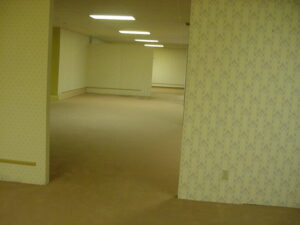
The post states that this space is not of our world but an alternate dimension, categorized by the stench of old carpets, mono-yellow walls, and the high-frequency buzz of fluorescent lights above. The post also warns against the act of accidentally falling between the cracks of our reality and into The Backrooms, which is referred to as “no clipping.” The area of The Backrooms consists of a terrifying 600,000,000 square miles of completely empty space, a vastness that appears to be void of all life at first glance. But you are not alone. A deadly, unidentified creature lurks within these segmented rooms, and you simply can’t hide from it. Viewers of the post were immediately plagued by the horrifying possibility of ending up in The Backrooms, as you are essentially guaranteed a descent into insanity and an agonizingly slow death. The most effective aspect of this phenomenon lies within the uncanniness of the space. It is reminiscent of your reality, yet you instinctively feel that something is off. The concept of The Backrooms has gained increasing popularity as it has appeared in many indie horror games since the early 2020s.
What The Backrooms post described has come to be known as a “liminal space.” This use of the term does not refer to its figurative definition, a transitional state between two more defined states of being; it refers to literal, physical spaces. A liminal space is often a setting devoid of life. No humans present, sometimes nothing animate of any kind. Though natural settings such as forests can be classified as liminal, the most popular liminal spaces are manmade. They are spaces typically populated by a large number of people that are now empty. Some examples include streets, supermarkets, indoor swimming pools, Home Depots, and dead malls.
Liminal spaces have exploded in popularity online, so much so that the liminal space has become an acknowledged niche in art, photography, and fiction. Part of the appeal is the wide range of emotions these settings can evoke through their minimalist aesthetic (peace, sadness, longing). The most widespread reaction to these spaces, though, is dread. It’s no surprise, really. Psychologically, empty spaces unnerve us on a fundamental level. They evoke fear of wandering “out of bounds,” so to speak, of straying too far from the village. Whatever this place is, our herd isn’t present there and might not belong there. And that can only mean danger. It’s no wonder, then, why the history of the horror genre is brimming with examples of the liminal space.
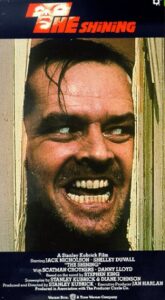
Classic horror films provide great images of liminality. Stanley Kubrick’s The Shining (1980) offers a reputable example. Kubrick’s use of space within the Overlook Hotel emphasizes the “in-between.” The Torrance family is neither entirely removed from nor included in regular society. Jack is driven into madness as he is surrounded by nothing but empty space and winding, endless hallways. The hotel also acts as a liminal space between the living and the dead.
An older use of liminal space appears in Charlotte Perkins Gilman’s novella The Yellow Wallpaper (1892). A woman treated as mentally ill is imprisoned in a room, and both she and the room deteriorate as her husband withholds her freedom and access to the outside world. She begins to see other women in the wallpaper whom she believes she must rescue. The room with the yellow wallpaper is neither dream nor reality.

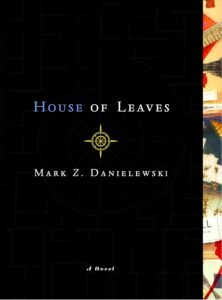
Mark Z. Danielewski’s novel House of Leaves (2000) explores liminality through the concept of domestic space. The novel tackles the nature of enclosure as it includes a house that appears quite small but feels much bigger on the inside. The house transforms into a labyrinth, effectively creating a warped version of a familiar space.
David Lynch’s Twin Peaks (1989 – 1991, 2017) includes one of the most famous uses of liminality within “The Black Lodge.” With its iconic chevron floor and red curtains, the lodge becomes a space between dream and reality. When inside, characters are neither dead nor alive. It also exists on a plane in which two versions of the self can exist at the same time.

Kyle MacLachlan and Sheryl Lee in a still from Twin Peaks. Photo: Suzanne Tenner/SHOWTIME
A brilliant use of liminal space appears in the very recent 2024 horror hit The Substance. Directed by Coralie Fargeat, the film follows Elizabeth Sparkle, an actress struggling with her appearance as she ages out of zeitgeist and begins to lose her sense of purpose. In a desperate attempt to remain relevant, she undergoes a medical procedure that creates a younger and improved version of herself. She must divide her time evenly between her current and younger self. When she first begins this procedure in her bathroom, the audience is exposed to its blank, factory white walls. It is not a medical facility, but it is not home. Her bathroom acts as a space of transformation and the state of being in between her two selves.
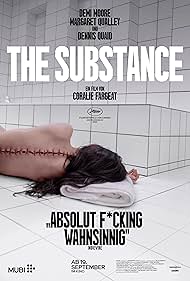
As the following list demonstrates further, liminality in horror has a long history. If recent successes like The Substance are any indication, it probably has a long future as well.


“The Inn” – Guy de Maupassant (1886)
This is quintessential psychological horror, and just one of Maupassant’s masterful contributions to the subgenre. In the wake of a snowstorm, two hiking guides find themselves trapped in an inn on the Swiss mountains. When one of the men disappears, the other is left with only the inn’s creaking floors and empty halls for company, a state of isolation that inevitably drives him to insanity.
“The Red Room” – HG Wells (1896)
An unnamed skeptical narrator spends a night at the infamous Lorraine Castle, specifically in a chamber known only to the old caretakers as “the red room.” In his attempts to quench his own paranoia, he lights the room’s set of candles, which repeatedly go out despite the lack of a draft. Wells’s resolution to this tale is masterful in its ambiguity.
“Treading the Maze” – Lisa Tuttle (1981)

During a vacation, a young couple stays at a guesthouse in Glastonbury, one built near an ancient turf maze. The husband becomes strangely transfixed with the maze and insists on trying to reach its center, an action that foreshadows this story’s tragic conclusion. Tuttle is at the height of her emotional versatility here, a power she’s honed to perfection over her 50+ year career.
“Report on an Unidentified Space Station” – JG Ballard (1982)

When a group of interstellar travelers stop at a derelict space station, they discover that the structure is bigger on the inside than on the outside. Only upon exploring its ever-branching innards does the full, cosmic scope of the structure’s size become apparent. The escalation is beautifully divulged to the reader through Ballard’s distinct minimalist style.
“Carnation, Lily, Lily, Rose” – Kelly Link (2001)

Named after John Singer’s iconic painting, this story follows a man directly after his death. He details his navigation of the strange purgatory he’s found himself trapped in, and more than that his futile attempts to recall whatever misdeeds have condemned him to such an afterlife. Kelly Link showcases here her ability to walk the tightrope between black humor and abject horror, a style that lends her work its unique surrealist mood.
“Past Reno” – Brian Evenson (2014)

After the death of his estranged father, Bernt makes a road trip to Utah to collect his share of the meager inheritance. Things take a turn as the desert landscape outside the window subtly warps into an uncanny nightmare. This story is a perfect demonstration of Evenson at his strongest; his talent for unnerving you in as few words as possible is on full display.
“What is Lost, What is Given Away” – John Langan (2016)
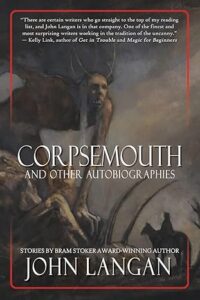
A man attends a school reunion and comes into contact with a professor who served jail time over a custody disagreement. His estranged wife and in-laws have taken his son and disappeared. He has a strange plan to get his boy back–but first, he needs his old student to help him out of a pinch. For all its absurdity, this story’s resolution hits like a truck. Langan has honed these last-minute gut punches to perfection throughout his prolific literary career.
“It’s All the Same Road in the End” – Brian Hodge (2016)

Driven by seething curiosity, two brothers embark on a lonely road trip into the depth of the American heartland. They’re searching for answers regarding what became of their grandfathers, a mystery which has haunted their family for decades. What begins as a Lynchian goose chase evolves into a prelude to Lovecraftian apocalypse. Nobody does cosmic horror quite like Hodge. His ability to paint the bleakest image of the cosmos with as few crumbs as possible is unmatched.