EXTREMELY WEIRD SPLATTER Written in Its Authors’ Guts: Group Interviews, Part Three
by L. Andrew Cooper
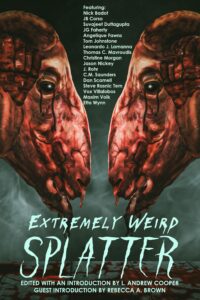
As I put together the table of contents for the forthcoming anthology Extremely Weird Splatter, I asked authors to answer three basic questions about why they and their stories fit with a project aiming to fuse extreme horror and splatterpunk with weird fiction. Not entirely randomly, I’ve sorted responses into three groups.
Extremely Weird Splatter: Contents

Nick Badot, “The Copper Merchant”
JB Corso, “Scenarios”
Suvajeet Duttagupta, “The Weight of the Dark”
JG Faherty, “The Fishhook Prophecy”
Angelique Fawns, “Highway to Hell Fan”
Tom Johnstone. “Debbie Does Delos...?”
Leonardo J. Lamanna, “How to Build a Meat Radio”
Thomas C Mavroudis, “Adoration of Evil”
Christine Morgan, “What They Deserve”
Jason Nickey, “Portal”
J. Rohr, “A Parent Sacrifices”
Steve Rasnic Tem, “Dermis”
C.M. Saunders, “On the Fringes”
Dan Scamell, “MySkin EverFlesh”
Vox Villalobos, “Soup”
Maxim Volk, “My Love, Like Moss, Envelops You”
Etta Wynn, “The Architect of the Soft Circuit”
Interview Group Three
GROUP MEMBERS: Nick Badot, Suvajeet Duttagupta, C.M. Saunders, Dan Scamell, Vox Villalobos
By the way, I totally stole this “roundtable” format from author Sean Taylor, who does neat stuff all the time on his site Bad Girls, Good Guys, and Two-Fisted Action.
What aspect of your biography is most relevant to Extremely Weird Splatter?
Nick Badot: I’ve written quite a lot of weird speculative fiction and horror. And some of it’s even gotten published! I don’t generally include this in my bio, but I received an autism diagnosis as an adult which, aside from explaining my recent obsession with Assyriology, has made me return to the theme of the other” a lot, which I think is perfect fodder for the genre. I also grew up in rural Ireland near an old-growth forest called “Devil’s Glen”—so I think there’re some suitably melancholic omens from my childhood to point to the kind of fiction I would write.

Suvajeet Duttagupta: Over the last few years, I’ve been actively writing stories, and I enjoy incorporating Eldritch horror but with a twist in them. I’ve always called my writing as “weird little stories, looking for the readers who enjoy the weird.” While I spent most of my 20s watching splatter movies, I never really considered writing, nor envisioned creating a body of work that falls in that genre specifically, so when I saw the call for EWS I did want to attempt something different from my usual style.

C.M. Saunders: I don’t put it in my bio, but about ten years ago I was living in London, a very expensive city, and I got fired from my job. I needed money fast, so I signed up for a medical drug trial. The kind where they lock you away for two weeks and test experimental drugs on you to see if you die. Looking back, that was a bit reckless. It could have gone all kinds of wrong. But happily, I didn’t die and ended up with a good story.
Dan Scamell: I’ve always enjoyed the weirdness of things like Eraserhead, Tim & Eric Awesome Show, Tetsuo: The Iron Man. Mix that with an appreciation for deathmatch wrestling, and you get a pretty good primer for Extremely Weird Splatter.
Vox Villalobos: The aspect of my biography that is most relevant to Extremely Weird Splatter is that I’ve always been drawn to transgressive stories, particularly those that are profound, layered, and/or shed light on harsh truths and brutal realities.
Which of your previous (or forthcoming, or planned) works makes you most qualified to participate in a project that fuses splatter with the weird?
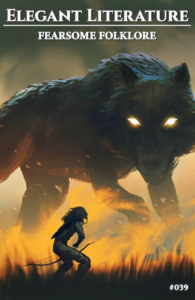
Nick Badot: Probably a short story called “The Fetch,” first published in Elegant Literature #39 and set to be reprinted in the Poisoned Folk Tales anthology edited by A.C Hessenauer. I have amassed a good few weird/horror publications over the past few years, but I think this is the one that best brings the two together. Like this story, it also incorporates folklore/mythology and uses a historical setting.
Suvajeet Duttagupta: Back in 2012, I got back to writing after almost a decade (since middle school), thanks to a Twitter mutual sharing daily prompts and collating the 55 word stories everyone would share. There was a two-part (55 word story) I wrote, which might be one of the earliest stories that could be considered splatter or at least shows sparks for it, if I ever decide to write a longer piece. Apart from this, there are a few recent body horror stories that are currently looking for a home, and a handful of WIPs (“The Joy of Cannibalism” is one of them) that got me in the path to let the story be extreme because the story needs it and not because I must shoehorn it for the shock value.
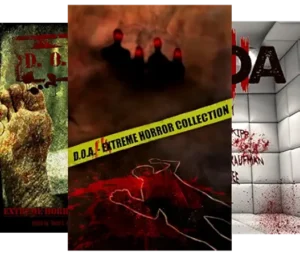
C.M. Saunders: For me, splatter and the weird go together like strawberries and ice cream. One often comes with the other. Over the years I have cultivated quite a strong bond with several publishers in the genre including Blood Bound Books, who have published several of my stories in their DOA series of anthologies (including “Subject #270374,“ which, incidentally, is about an out of work journalist who agrees to do an experimental drug trial in London…)
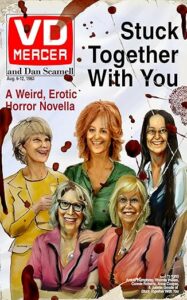
Dan Scamell: My novella Stuck Together With You probably fits the weird-splatter mold best, having the cast of a Golden Girls style show summoning a demon (whose extra finger ends up jammed in a man’s brain where it speaks telepathically to him), elderly sex scenes and a fiend whose flesh is in a constant state of burnt putrescence. Mostly it’s a love story.
Vox Villalobos: I’d say my short story, “It’s Time You Atoned for Your Sins,” which was published in Issue 4 of the online fiction web-zine Carnage House in 2024. It’s a visceral story inspired by medical malpractice and the discrimination against sex workers.
Without giving away ANYTHING—what about your story for Extremely Weird Splatter is most transgressive?
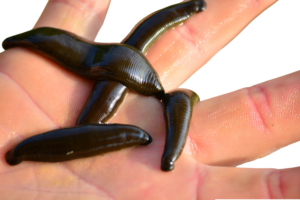
Nick Badot: I talked before about my relationship with the theme of the “other,” and I think that’s one theme (among many) where transgressive fiction gets its juice. My story has violence, it has torture, it has far too many leeches, but I don’t think any of these things pack a punch without trying to address something. When people are “othered,” they can feel like their existence/baseline behaviour is transgressing against something, breaking some kind of unspoken rule, or generally isolating them from society—it’s a rather unpleasant feeling, and finding ways to overcome it can be empowering. That’s what’s at the core here, I think.
Suvajeet Duttagupta: This is a very interesting question and not something I had running in the back of my mind. When I started outlining my story, my simple premise was about a world where the shadows of every creature are infected with a monster that feeds on their guilt, and when the guilt hits the critical mass, they are activated. While I never put a thought to making my story transgressive, I did want to slowly build on the horror of their situation before it culminates to something big.
C.M. Saunders: The MC [main character] has a checkered past, which is hinted at rather than explicitly explained, but he is trying his best to put it behind him and fit into one of the little boxes society insists on putting us all in. Unfortunately, he keeps being drawn to the darker, more self-destructive patterns that blight his life and with that invariably comes a lot of collateral damage.
Dan Scamell: “MySkin EverFlesh” takes an unpleasant and darkly humorous look at male-ego and dating dynamics, while also being debatably sex-positive.
Vox Villalobos: The most transgressive aspect of my story is its portrayal of the normalization of violence, cruelty, and dehumanization.