The Nightway
by Rodney P. Bertholet
Horrific Scribes Extremity Rating:

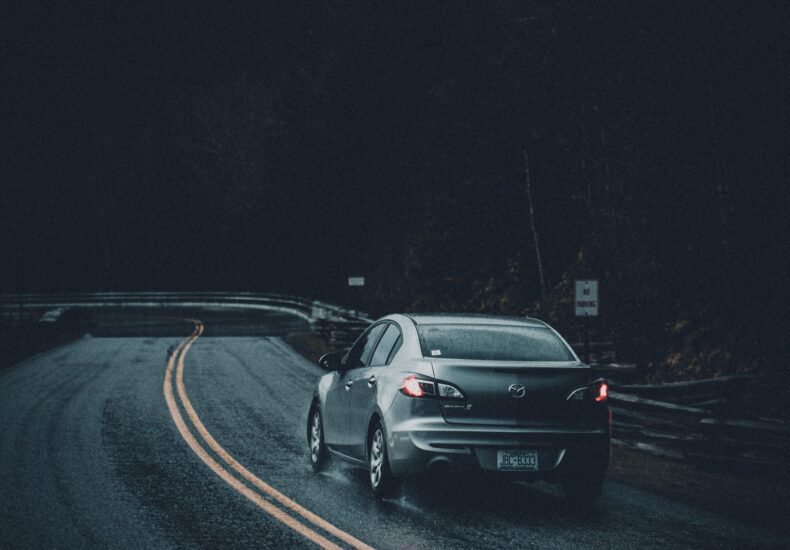
The sun hovered low as Christy navigated the twisting road into the foothills, one hand on the wheel, the other curled tight around her phone. Along the far ridgeline, a carmine stain clung to the peaks—deeper than the usual pink of sunset.
“You promised we’d do this together,” she heard Robby saying over the speakers. The distant hue gathered and thinned in slow pulses.
Christy winced, her attention returning to the conversation. He wasn’t wrong. She had promised—back when uprooting her life had felt like a bold step forward, not the sacrifice it felt like now.
“I’m not saying no,” she said, breath fogging the glass. “I just need more time to think about it. My work—”
“People move all the time,” he retorted. “For once—”
“Are they the ones left alone to fit in?” she snapped, then winced.
She heard him inhale, the way he did when he was about to give in. She hated that sound.
“Christy,” he said carefully, “I want us on the same page before the wedding.”
Her stomach tightened. There it was again. The timeline. She bit her lip in restraint. “I know,” she replied, “but I can’t give you an answer tonight.”
Static. His slow release of breath. “Choose me, Christy. Just this once.”
“I’ll call you later,” she murmured, sliding her thumb over the hang-up icon.
The call dropped. Silence rushed in, startling in its relief. The familiar guilt followed. Her old friend. Her shadow.
She exhaled. No. She wasn’t avoiding. She was taking space.
Up ahead, a green sign glowed through the deepening dusk. Exit 23. Ridgeback Pass. Scenic Detour.
Her blinker clicked before she could reconsider. The car drifted into the exit. “Just a longer way home,” she murmured. The knot in her chest loosened, and she blew out a sigh. The red stain on the crest vanished behind towering pines. She rolled her tight shoulders, grimacing, and drove on, deeper into the mountains. Toward Ridgeback Pass.

The road snaked through resinous evergreens. Dusk had gathered in the foothills. Her fuel indicator was slanting downward when a neon sign shone out from the forest ahead.
The gas station appeared forgotten by time. Weed-cracked concrete. A rusted canopy. Buzzing lights. Wind whispering through the pumps.
She was startled by the rasping chatter of crows, a black ripple of sound that pulled her gaze skyward. They packed the power line like charred ornaments. But the service line descending to the store’s pole remained bare. Not one crow touched it.
Unease pinched her brow. She pulled on her jacket and hurried up to the store.
The bell chimed sharply as she entered. The little store smelled of old oil and a sweetness she couldn’t place—synthetic and medicinal. The warmth was stifling. A gray-haired man sat behind the counter, posture ramrod straight, eyes fixed on a small TV. Only when the bell’s echo died did he turn.
His smile came late, as if dredged up from deep memory. “Evenin’.”
“Evening.” She set her keys on the counter with a clatter. “Fifty on pump one.”
He barely looked up. “You driving up the Pass?”
“Yeah. Why?”
His eyes flickered like a TV blip. “Do what you want,” he grinned, staring. “Road’s been quiet.”
“Um, okay. Thanks.” She turned away.
Her attention snagged on a sun-bleached poster on the counter next to the till. Missing. A young man, maybe in his twenties. Charles… the rest of the name had worn away. The date was gone. The image was nearly obliterated, save for stiff shoulders, a narrow face, and proud cheekbones.
“This sure has been around a long time…” she muttered, eyes flicking to the shopkeeper. When she glanced back at the poster, a shiver ran along her spine. Her laugh faltered, thin and nervous. Silence loomed.
He took the poster and folded it once, grinning. “Time. That’s what we’re given. But it’s nothing we keep.” He scooped the money off the counter, gesturing. “Pump one ready.”
She reached for her keys, but her hand brushed only the empty counter.
Her keys hung on a wall hook by the door, dangling beside several other sets with plain rings, beaded rings—one with a plastic charm. Arranged too neatly. Categorized.
Her fingers curled around her keys. Skin prickling, she pulled them free and pushed outside.
The door slammed behind her, and the crows shrieked as if they’d been waiting. A frenzy of wings beat the air above, twisting and tumbling in tight spirals. Not one went farther than the power line, as if it were an invisible barrier, a threshold.
Christy stood frozen in awe. A cold finger brushed her cheek. She turned sharply. Nothing. Only fog flirting with the edges of the lot.
Rattled, she grabbed the fuel nozzle and leaned in to start the pump. As she straightened, the driver-side window caught her reflection. She gasped. Reflected in the glass, a little girl stood behind her. Bare feet. White dress. Hair still, despite the steady wind.
Christy spun. The lot was empty. No white dress. No child. Only the steady pulsing of the neon sign and the crows fluttering in the twilight air.
Her nerves twitched. She forced herself through the motions of fueling, every second stretched taut enough to snap. When the pump finally clicked off, she dove into the car, locked the doors and blasted the heat. The rumble of the engine was comforting. Her skin still prickled. Guilt could wait. Later was a problem for later. She drove.
She allowed one glance at the store as she pulled away. Through the window, the interior looked deserted. Dim. Vacant.
Twilight collapsed into a blunt black, the sky stippled with too many stars like fractures in a surface under strain. Christy wound deeper into the mountain pass. No towns. No headlights behind her. Fog slid beneath her tires like a cold tongue.
“No service,” she sighed. No phone call. Regret haunted her. Robby. She needed him now, after that awful store and the crows… that horrible shopkeeper… the girl. Was it real? Did that happen? She shuddered and flicked on the radio to warm over the shame and dread.
A gentle wash of folk music filled the cabin, soothing and familiar. Then it stuttered, fuzzed, and dissolved into a long, needling burst of static.
She tapped the console. “Come on.”
The static shifted into a pattern, ebbing, then lilted, almost speech-like. She reached to change the band.
A thin voice dragged across the static, like a fingernail drawn through a dark pool.
“Christy…”
She jerked upright. “No. Nope. Nope.” She slapped off the radio. Silence returned, marked with only her breath, the engine and the wind.
Suddenly, her lights illuminated a crash scene. A blue van stretched over a guardrail, dangling above the black abyss beyond. It was gone in an instant.
“Oh my God,” she blurted, glancing back. She’d seen something else. A torso and legs sprawled beneath the van, bent at impossible angles.
She pulled to the shoulder, hazard lights blinking into obscuring mist. Her hands shook, and a chill settled into her marrow, but instinct pressed her forward. The surreality of the moment hit. Shame over Robby. The conversation she’d been avoiding. The truth, just out of reach. She skirted it, trapped in the weight of what she’d done.
“You don’t have to get out,” she muttered.
What good would it do? She should drive away. Call the authorities and leave, as she had before. Her hand hovered over the shifter.
What if someone was still alive under there?
Christy forced herself out of the car. The air was earthy, tinged with pine and a distant rotten and metallic stench. She stepped toward the guardrail, boots crunching on loose gravel.
“Hello?” she called, voice trembling. “Can anyone hear me?”
Nothing. The fog swallowed the world. Her car looked distant, unreal—headlights haloed like moon dogs. She circled the van and crouched to look beneath it.
No legs. A shaky breath escaped her. Relief. Thin but real.
Behind her, a scrape. A slow drag. Gravel bounced and rattled.
She spun. “Hello?”
A slender figure stepped out from behind the van, tall, limbs bending in a way that seemed wrong. Fog curled around his ankles but didn’t touch him.
“At last,” he grinned.
Christy’s mouth went dry. She stepped back, slipping on gravel. “I—are you hurt? I thought—” Her words tangled. “I saw you under the van.”
He glanced over his shoulder at the vehicle as if just noticing it and shrugged. “I’m Phil,” he announced, studying her.
She swallowed. “I… thought you needed help.”
“I do.” His smile widened, twitching. Shadows clawed and curled around him like restless children, tugging at the edges of his shape. He leaned closer, and Christy felt a cold pull at her mind—a subtle tug on her thoughts, churning her memories. “Help me, Christy.”
Her heart hit first. Then she bolted.
Behind her, the air split with a violent hiss through the space she had occupied an instant before. She didn’t look or think. She just ran toward her car’s glow and kept going until her legs burned. Except the glow receded as she approached. Drifted like a mirage—unreachable.
Her ankle rolled on loose rubble, and she cried out, stumbling hard into the guardrail. The frigid metal bit into her palms. She clung to it, gasping, blinking against the rising panic. A sob broke loose. “Oh, please. Help me.”
The forest hummed. Shadows crept upward as though the darkness itself were climbing the trees.
Headlights.
Twin shafts penetrated the darkness, flitting between tree trunks. An unknown car weaved along the serpentine highway.
Pale fingers crept up Christy’s spine. She felt Phil’s eyes on her from somewhere in the trees.
Forest shadows shifted as the unknown vehicle glided around the final bend. The glare blinded her, but she squinted into it anyway, waving her arms.
The car rumbled to a stop, its brakes squealing.
The moon crept across its grille, a mouth of steel against an abysmal face. Twin beams stabbed out from chrome circlets and pierced the fog swirling about the machine. It was broad and squat, beastlike, purring throatily in the darkness.
Slowly, Christy’s arm fell from the harsh brilliance. “W-wait,” she whispered.
A door catch clicked. The door opened. A boot touched the pavement—polished leather, old but well cared for. Its weight settled as though its owner were measuring the ground. A man stepped out.
Tall. Broad through the shoulders. Military-straight posture despite his age. His jaw was hard-set, expression unreadable in the haze of moonrise. A heavy coat hung from him, dark and timeless. He had a familiarity about him that made her stomach twist. She’d seen him before in a photograph, maybe a newspaper clipping, maybe an encounter she didn’t fully remember.
Christy limped forward. Her voice rasped. “H-help… please… my car, I—there’s someone out there.”
The man looked at her with slow, assessing calm. He nodded, “Get in.”
Relief bowed her. “Thank you—God, thank you.” Back down the road, Phil was nowhere. Nothing but blackness.
The stranger held the door open with an expectant stillness. She hesitated at the threshold. The pit of her stomach went heavy. The interior seemed too deep. The chassis carried a low tremor.
The man’s eyes flicked to her. “In. Let’s go.”
Her instincts were confused, but she felt compelled, so she climbed in. The door shut behind her, snapping like the jaws of a trap. She fought the urge to rip it back open and bolt.
The driver slid into his seat without a sound. He glanced back at her. The engine’s purr was warm. Comforting. Then too warm. Feverish. The seat pressed close against her back like hands.
Christy swallowed hard. “Do you—do you have a phone? My fiancé was on his way—”
“You’ll see him soon,” he replied, as if confirming a sequence.
The trees blurred past, faster than before. Yet the car made no sound of strain.
Her eyes fluttered as a memory slipped sideways in her mind. She remembered talking to her fiancé earlier—Rrr? The sound caught, repeating, like a tongue against a bad tooth. She grabbed her hair and pulled. Robby?
She forced herself upright. “What—what was your name again?”
“You didn’t ask.”
“Oh. Okay. Um… what is your name?”
He shrugged. “I’ve had many names. Bill will do.”
The engine deepened its purr into a low, devouring resonance. A whisper pressed at the base of her skull. Her mother’s face blurred at the edges.
“Stop the car,” she demanded, voice cracking. “I want to get out.”
Bill’s jaw tightened. “You asked for help. I’m helping.”
“No—you’re—I don’t feel right, I need to—”
The window dimmed. The air thickened behind her. Christy whipped around but saw only deepening shadow. “Let me out! Pull over!”
Bill exhaled slowly. “You don’t want to be out there.”
“I’ll take my chances.”
Movement flashed at the window. A bleached form paced the car—knees pumping, smile wide, eyes wet and shining.
Phil.
“This one is mine,” Bill growled.
The car surged forward. Phil vanished into the dark.
Christy’s cheek pressed against the unyielding glass as the trees smeared into the blackness behind them. Her vision went dim around the edges, parts of her lifting away as if selected and removed.
Another bit of herself stripped loose. The world dulled. Old memories surfaced, depleted of feelings.
Bill kept glancing at her, jaw tight, white knuckles around the wheel. “You chose right back there,” he said. “Phil’s no good.”
“Chose… right,” she echoed. What choice?
A faint, effervescent tickle stirred inside her skull, bringing a memory that felt gently placed and not entirely her own. A childhood bedroom. Flashlights under the blanket. Her friends’ faces spectral and breathless in the dark, daring each other to speak into a dark window, calling out to whatever might be listening.
Phil on the hill,
shadow in the sill.
If you want him near,
ask him to appear.
She could almost hear their giggles, floorboards creaking in the hallway outside. None of this made any sense. Who had taught her that rhyme?
She whispered it—barely audible. “Phil on the hill…”
The headlights flickered. “Don’t,” Bill snapped. His voice cracked—fear or anger—she couldn’t tell.
She gritted her teeth. “Shadow in the sill…”
The rear window glass rippled like disturbed water. Bill’s hand gripped her knee hard. “Stop calling him.” Frost crept along the window.
“If you want him near…” The glass darkened with an absence.
Bill slammed a fist on the dashboard. “He can’t come in unless you let him! Do you hear me? Don’t choose him. Choose me!”
Christy’s voice, quiet but certain, finished the rhyme, “…ask him to appear.”
The glass cracked down the center. A face pushed through the fracture—Phil’s face, grainy and underlit, eyes glowing with a dull, furious heat. The window bent inwards.
Bill roared. “You don’t get to have her!”
His hands weren’t hands anymore. Fingers lengthened, yellowed, gripping the wheel like claws. The whole car lurched sideways, tires screaming.
Christy braced herself, looking at neither of them. Instead, she whispered, loudly enough to be heard by both.
“Phil told me something about you,” she said.
Bill’s eyes snapped toward her. Christy remembered the sun-bleached poster on the gas station counter.
“Your name isn’t Bill.” She smiled faintly. “It’s Charles.”
The engine faltered. Bill snarled, glaring at Phil.
“And Bill said,” she continued, “that you’re afraid of him, Phil.”
The window blistered outward as Phil’s form thrashed, half-born. He screamed, “She’s mine!” They turned on each other—two halves of the same dark appetite locked in a territorial frenzy.
The car bucked, dashboard lights pulsing with panic. Windows bulged, seats twisted, her seatbelt slackened. Hunger diverted inward, feeding on confusion instead of her.
The pressure around her mind eased. Her sense of herself sharpened. Now!
She threw her shoulder against the door. It shuddered. She kicked hard. The frame groaned.
Behind her, Bill and Phil tore at each other, their forms overlapped, misaligned.
Another kick. The lock snapped. The door flew open.
Chill air blasted her face as she tumbled out, rolling, scraping her palms raw. The bumper slammed her hip, a flash of impact that drew a grunt of pain. In that instant, the car’s skin wavered like paint sliding off grease. Beneath the chrome was a presence, alive, recoiling from her gaze as if it hated to be seen.
The car convulsed behind her. The headlights twisted inward. Glass thinned into mist. Bill and Phil’s voices collapsed into a single shriek of rage and hunger before imploding into silence. Christy pushed herself upright, panting and shaking. The world held still, as though the trees had paused to take measure of what she had become.
A memory surfaced. Robby at the kitchen counter that morning, one hand wrapped around a chipped mug, the other braced as if steadying himself.
“Just tell me if you’re sure,” he’d said. He hadn’t been angry, which had made it more devastating. The memory wavered at the edges, its warmth tickling her neck, his voice thinning, growing less familiar.
“No,” Christy growled, pressing her fingers into her palms. The ground was rough—biting. The memory held. It hurt. It was hers.
Her life had been a map of distortions. Frost glimmered on the asphalt, catching the pale constellations above. The patterns seemed to align.
Faster than pain, a dense wave washed through her, dragging every nerve out of sync. The asphalt beneath her quivered in rhythm with her pulse. Reality bunched and twisted. She stumbled, bracing against a tree. When the world steadied, the road behind her had collapsed into a confusion of spiralling depth.
Christy groaned and coughed, putting her fingers to her throbbing temples. The air tasted of wet leaves and cold iron. Her memory was a chasm of crumbling fortresses, walls toppling into shadows. But something right before the shift had mattered.
Bill had steadied her mind into a narrow corridor. Phil had blown it apart.
She exhaled, trembling. She was caught between road and tree line, in the place where those forces met.
She heard footsteps. They didn’t approach from the distance. They were just suddenly there.
“Christy.”
Phil.
He seemed to drift in from a point, rendering in stages, until, at last, he stood before her, smiling.
“Hey,” he said. “Big mess, wow.” He chuckled. His tone was light and even a little embarrassed. But his eyes were hollow pits.
Christy recoiled, disgusted by the sight of him.
He tilted his head. “I didn’t hurt you before, did I? I only wanted to see what you would do.”
The trees creaked, leaning further to the left. A low-frequency hum vibrated in the ground.
She clenched her fists, resisting panic. “You tried to feed me to him.”
“It didn’t have to be this way,” he said, shrugging.
A shadow behind him trembled—Bill’s silhouette, caught as if standing behind a flypaper wall, tall and stiff and military-straight. Phil didn’t turn to look, but his expression tightened.
“They’re still fighting,” Phil muttered. He glanced at her shrewdly, hand open. “Alright. We’re leaving. Come.”
“I don’t think so.” Christy grimaced, steadying her legs despite the unreliable ground beneath her. The words hung there, unanswered.
The forest drew tight around them. Shadows pulled in opposite directions. A tree groaned. Its height split with a muted crack.
A narrow white fissure forced its way through the dark. Phil’s expression faltered. His open hand remained extended, but wariness flickered behind his eyes.
“That’s not for you,” he whispered.
The fracture widened by degrees, soundless but insistent. It did not glow so much as repel the surrounding dark. Through it was no clear landscape—only a pallid suggestion of depth without distance.
The ground tremored under Christy’s feet. Behind her, the fighting surged again. The trees bowed inward, bark peeling in long strips.
Phil stepped towards her. “Come.” Urgent. Sharp.
Christy backed towards the split, eyes on Phil. “You don’t tell me where I go.”
“You don’t understand what it is,” he said.
“Neither do you.” That, more than anything, seemed to anger him.
The fracture opened another inch. A cool breeze touched her face. She took another step towards it. Behind her a vastness shifted. She didn’t let herself look. Phil shook his head. He whispered to himself; a snicker slipped out. He burst into sudden motion.
She stepped into white light.
She heard Phil’s scream of frustration thin until it snapped like cut wire. The forest lurched again and flipped. She fought to stand as vertigo spun her. Wind roared upward. Trees whipped past. Ground tilted into the sky, then sky into ground.
The light swallowed everything.
Christy hit yielding ground. She fell to one knee, hands sinking into grass—cool, freshly cut, uncannily normal. The scent stunned her. After everything, the smell of summer seemed obscene.
Warm air rolled over her skin. Sunlight filtered through a green canopy above, gold and gentle. Birds sang. Morning? Or pretending?
Memory crashed back all at once. She shuddered, revolted, as a greasy film peeled from her mind, sliding and dripping away.
A little girl stood a few feet away, watching her. Christy had not heard her approach.
Her dress was white, the hem whispering around bare feet that left no impression in the grass. She studied Christy with unblinking owlish eyes.
“Did I make it out?” Christy asked.
The girl tilted her head slightly in quiet regard. “You made it here,” she finally said.
For a moment neither of them spoke, and the birds continued their bright, careless song.
Christy’s skin prickled. “Where is here?”
The girl glanced around as if the place made her uneasy. “Between,” she said. “Places people pass by.”
“Is that like a dream?”
The girl shook her head. “Dreams are from you,” she smiled. “This is not.”
She closed the distance and reached for Christy’s hand. Christy took it with care. It weighed almost nothing, more suggestion than touch, and she felt a brief vertiginous sense of holding onto something that might slip away at any moment.
She let the quiet rebuild her even though the peace felt thin. Then the world faltered. The birdsong repeated. The light dipped and flickered. Tree trunks wavered.
“Why is it doing that?” Christy whispered.
The girl slowed. Her grip tightened. “It’s close.”
Christy’s legs went numb. “Bill? Phil?”
“Those names,” she said, mouth twisting as if from a bad taste. “They pretend to be harmless.”
The ground pulsed once beneath them. The girl watched it vacantly.
“I don’t remember what I was,” she said, “before this.” Something brushed against the edge of Christy’s mind—a hollow ache, followed by a flare of anger already fading. She gasped, reeling.
A deep, soundless pressure rolled through the trees. The sky warped, bowing towards them. The treeline shifted, and the wind went thin.
Christy’s knees weakened. “Is that—?”
“Don’t define it,” she urged. “It notices.”
The figure tilted its head, or what Christy conceived to be a head, and the world stretched as if draining into a well. Panic tightened Christy’s chest. She scanned the clearing for somewhere—anywhere—to run.
The girl stepped close, and her outline flickered. “I can’t stop it,” she said. “But I know what it wants.” Her small fingers tightened against Christy’s. “Stay.”
The air buckled. A mass behind the treeline leaned inward—an outline that didn’t belong to a body. The trees bent toward it as if drawn by gravity. The shape hesitated and then withdrew in a long, grudging fold of warped space. The world snapped back into place like stretched metal.
Christy grabbed the girl’s shoulders. “How do you know—?”
The girl met Christy’s gaze. For a heartbeat her expression went empty, like a mask set down and forgotten. Then she returned—ashen, frightened, stubborn. “I stayed too long once,” she said. Her hand gripped Christy’s. It was even colder, becoming spectral. “You shouldn’t… not like I did.”
Christy nodded, sensing the subtle force holding the thing at bay. The girl’s smile faded as she released her hand, reluctantly pushing Christy away. Christy stepped back, alone, thinking of what she had to do. Light gathered behind her—a doorway waiting. She let herself fall into it. The trees bleached to silhouettes. Gravity tugged at her guts. Cold asphalt pressed under her palms. Night wind caressed her face—her world.
Christy pushed herself upright, shivering, on her knees. The stars above the mountain pass glared like eyes from the blackness. Her breath fogged white in the bitter air.
And the car waited—a dark mass on the road from which even starlight could not escape.
Familiar malevolence pressed at her mind. More patient than the coaxing desperation of Bill or the wild static of Phil. It probed and tested her, nudging her the way the tide nudges a drowning swimmer. It wanted her to look away, to let her new clarity soften. But she didn’t flinch.
Robby, she called to him silently, her head shaking, tears streaming. I can’t pretend anymore. She opened her eyes wider, accepting the pull of vacuum.
A seam split. Light—white, pure, merciless—erupted. It came from inside the shapes, tearing them open. Trees peeled back their skins, giving way to a trembling lattice beneath. The asphalt dissolved, showing the underlying aberration, the thing that had worn this place like a mask.
And the car—
It twisted in her sight, tendrils reaching, melting through a dozen false forms, rifling through faces that no longer fooled.
Christy screamed as something pushed into her mind—whispered suggestions of absolution. The light seared her retinas. Illusions begged for acceptance. Something popped inside her skull, a hot wetness behind her eyes. Tears leaked out, warm and stinging, as the thing’s true shape struggled to fit inside three dimensions—a mouth forming and unfurling—a stuttering geometry that resented observation.
Her legs quivered as she held the dawn’s red sun in her mind. The road seemed to fill with its uncompromising radiance. Shadows thinned, falling away, until the world stood bare. The lie recoiled. Dark veils peeled like sheets of burnt film. The fog at its base boiled away.
A bellowing roar split the night—a truck’s horn, enormous and real. Headlights carved through the trees, brilliant and violent. She staggered as the brass blare washed over her.
An eighteen-wheeler barreled around the bend, its high beams flooding the road with lurid brightness. The red sun in her mind flared, collapsing into a single point of fire. She felt it as much as she saw it. The lie shattered.
The car dissolved around an absence too hideous to name, pulling back from her in a convulsion of bent space. The truck barreled into the chaos, scattering light, shadow and sound in a violent, impossible rhythm. Wind and heat blasted her as the semi thundered by, brakes squealing, the driver screaming words she couldn’t hear over the ringing in her ears.
When the roar faded, when the shards of reality seemed to settle, she couldn’t tell what had been destroyed—or if anything at all had changed. The road stretched empty before her. From the silence came the distant rumble of a diesel engine, the soft sigh of air brakes, and the distant thunk of a door.
Christy stood in the middle of the road, trembling, the world wavering around her. She knew, deep in the bone marrow, that she’d driven the thing back. But not without a trade.
Beyond the pain burning her eyes, she could see faint fractures in the air itself, like hairline cracks in glass. A shadow moved behind one.
The first real hint of dawn touched the sky behind her. She raised her chin, eyes burning, lungs trembling, and collapsed to her knees, blinking into a world that would never fit together the same way again.
“Jesus, ma’am, are you hurt? Can you hear me?”
A human voice. Kind. Alarmed. Real. Hands took her arms, gentle, steady, and lifted her upright.
“I—I can’t see right,” Christy gasped.
“We’ll get you help,” the man said. “Come on. I got you.”
He guided her toward the truck. His presence grounded the collapsing edges of her world. Metal steps clanged under her feet. The cab smelled of old coffee and diesel and someone who lived on the road.
“Easy now,” he murmured as he settled her into the passenger seat. “You’re safe.”
The engine rumbled. The truck turned back onto the highway. Christy looked out the window, at the cracks in the air, seeing them as other roads—paths not taken. They branched and vanished, most of them ending here.
But not every road ended here.
| SPECIAL EXHIBIT FIVE: Return to Whispering Walls and Other Verses | Begin Four: Consuming with “The Soft Interior“ |