
Introduction and Guide for We shouldn’t be here
by L. Andrew Cooper and H.J. Dutton
with Silas the Scribble Man, ephemeral gatekeeper
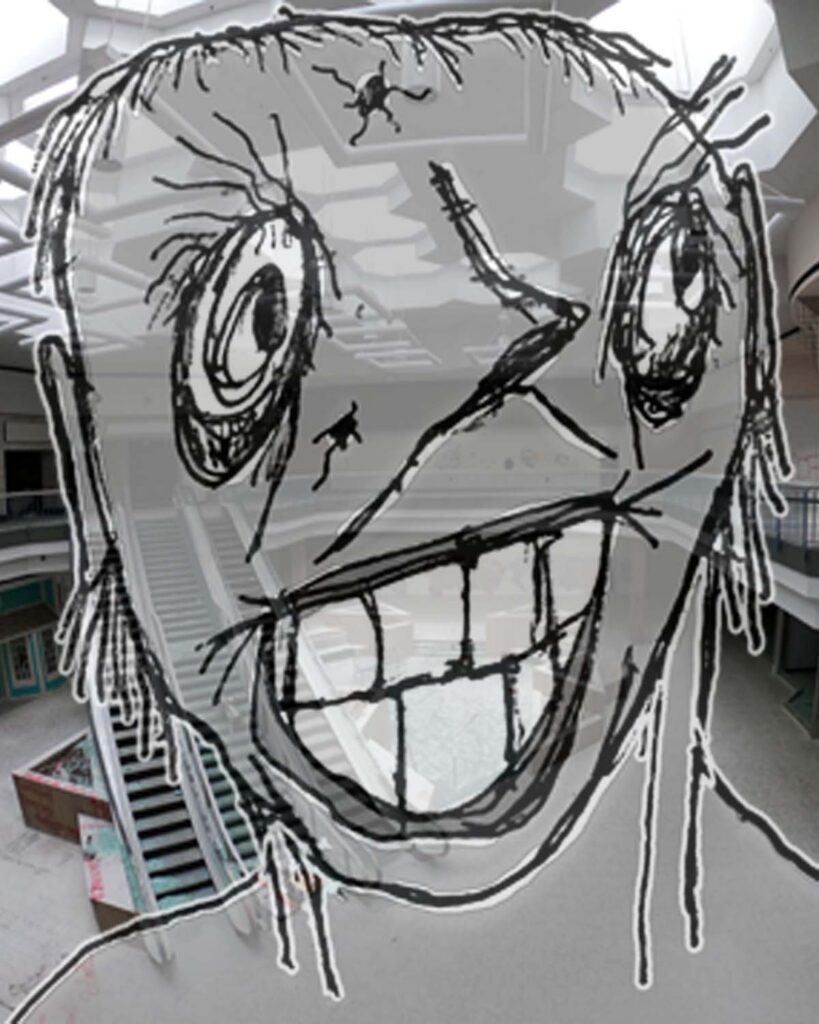
Christy’s skin prickled. “Where is here?”
Rodney P. Bertholet, “The Nightway” (this Exhibit)
The girl glanced around as if the place made her uneasy. “Between,” she said. “Places people pass by.”
“Is that like a dream?”
The girl shook her head. “Dreams are from you,” she smiled. “This is not.”
This Special Exhibit addresses “limits,” the properties of which the adjective “liminal”–as in liminal spaces and liminal horror–describe, from a perspective different from but not unrelated to Exhibit Seven: Testing the Limits. In the previous Exhibit, we looked specifically at the limits of, the boundaries of, representation, or at least socially acceptable representation, and at stories that test and violate those limits in diverse ways.
The limits in question here, and in what people tend to mean by liminal horror, rarely challenge the boundaries of the socially acceptable but might challenge the boundaries of the conceptually possible. The limits of this “liminal” are, at their grandest, lines between can be and can’t be. But they’re all kinds of lines between, between states, between realms: life and death, young and old, past and present, full and empty, remembered and forgotten, present and absent, loved and lost. Et cetera.
Liminal horror imagines these limits as spaces, the boundaries as navigable, transitions to be traversed. Border zones. Twilight is the liminal time between day and night; liminal spaces are, please allow the indulgence, twilight zones. Because the liminal is transitional, being in liminal spaces often means being in flux.
Dangerous flux.
Liminal spaces fill those who trespass inside the limits with dread, an overwhelming feeling: We shouldn’t be here. This place is wrong.
Proceed into Special Exhibit Five, We shouldn’t be here. Something about it… calls to you.
When we planned this Special Exhibit, we knew the film adaptation of liminal horror web classic The Backrooms would come and go from theaters during our open submissions period (we follow such things: H.J. Dutton has an article from February about liminal horror that discusses The Backrooms), but we had no idea how successful the film would be and, at least partially as a result, how overused and confused the terms “liminal horror” and “liminal spaces” would become. We were grateful so many authors sent us good stories, but if all their claims were true, all creepy spaces (preferably haunted) would qualify as “liminal” for “liminal horror” purposes. We do not agree.
Sticking with the sense of “limits” above, we regard liminal spaces as spaces in between, spaces in flux, spaces whose visitors experience transition and instability, usually as a result of having entered where they shouldn’t (whether they meant to or not). The emphasis on transition makes spaces related to travel ideal, spaces about crossing the boundary between here and there, for representing liminal experience: bus stations, train stations, airports. Spaces that have become wrong due to neglect, age, rot, spaces once inhabited, now abandoned, reflecting the passage of time and its transformations: old playgrounds, deserted shopping malls. Spaces that should be full now emptied (emptiness is a common trait of the liminal). The betweenness of liminal spaces makes them not only unstable but ill-defined. Getting lost in liminality is easy. You can disappear in it.
Sometimes, it wants you to disappear in it.
The liminal, so different from our comfortable, defined spaces, menaces us. It often seems malevolent. Conscious. It hungers for us to explore and in doing so to join the undefined.
Our first gallery establishes a baseline with liminal spaces that are Contrasting. Simon MacCulloch’s Bare and Brittle Brick and Metal collects three poems that describe spaces where abandonment and urban decay summon earlier, more vital times that haunt them, as memories or maybe more, creating an atmosphere where past and present both contrast and blur together with a sense of nostalgic loss that is an archetypal emotion for liminal horror (beautifully evoked). Ryan Broderick uses the archetypal (sometimes) abandoned airport to stage a bizarre physical transition into a contrasting, otherworldly realm that corresponds with a psychological transition in his main character’s life. Megan Frank’s “The Highline Grace” gives us a luxury New York apartment building that slides into liminality along with its main character, who doesn’t like the building’s other occupants but becomes distressed as they fade, making his experience of the building, and his own life, altogether different.
The second gallery turns to spaces with liminality that generates horrors through Concealing or concealment. These stories’ liminal spaces still contrast with the stable and defined, but their horror depends on some form of obfuscation. Obscurity. In Julia Rajagopalan’s “Industrial Accidents,” an old warehouse might be covering the site of a much older burial ground, and the warehouse’s current functions as a yoga studio and a veggie market might cover up atrocities that workers experienced there in earlier times… atrocities making themselves known as grotesque reminders appear in hidden spots where they oughtn’t be. Raymond Brunell visits the liminal domain of bureaucracy in “No Exceptions,” reflecting on structures, people, and processes whose purpose seems to be the deferral of clarity and resolution rather than the opposite. The absurdity is surreal and very serious: the emotional stakes of achieving clarity, at arriving at definition after the obfuscating liminal experience, are as human as the liminal horror is dehumanizing. The gallery ends with a story that takes obscurity to its greatest possible extreme: Suvajeet Duttagupta’s “Five Matches” begins with a man in what seems like a vast dark space who doesn’t know who or where he is or how he got there. The dark space that has him, however, conceals his situation’s strange conditions, which he has only the light of five matches to explore.
A limit, a line, a transition between two places: a liminal space might easily be a threshold, an entryway to the realm to which the space transitions from the normal, the transition a literal and/or figurative step through a doorway. The phrase “threshold of revelation” from Tony Kushner’s Angels in America is apt: in a liminal space’s state of flux often come opportunities for discovery, especially self-discovery, inward journeys reflected in the bizarre outward encounters with the liminal. In Margo Pecha’s “More Downstairs →,” the main character might not benefit from what she discovers, but as she gets lost in what might be an infinite bookstore, her mind’s tendencies and perhaps the nature of the universe are revealed. The link between psyche and space is arguably stronger in SJ Townend’s “When One Door Closes,” as the space–a house–edges toward the limits of possibility at the same time as it edges toward a revelation about the main character. The poems in Emmanuel Komen’s Whispering Walls and Other Verses present different spaces with liminal qualities, and they often follow a pattern that proceeds from external description to a mirroring internal revelation. “The Nightway” presents different types of liminal spaces within different types of liminal spaces and could fit elsewhere, but it’s in the Revealing gallery because the strongest throughline is the main character’s internal struggle with her romantic relationship, not the focus while all the supernatural scariness is afoot, but revelation about which is the dividend of the liminal experience.
The final gallery is where the liminal spaces get most malevolent and appear to be actively Consuming their visitors, perhaps even luring them in as prey. To start, however, “malevolent” might be the wrong word for the house in Prince Kumar’s “The Soft Interior.” It seduces… it consumes… perhaps it kills… but it is soft. The encounter with it, so tactile, borders the erotic. The malevolence in H.J. Dutton’s “Darcy’s Docks” appears via indirect suggestion and implication. You don’t really know the abandoned amusement park ride devours children. But it does feel wrong. And the coincidences…. We take a sharp turn with “Red Thread” by J. Nathan, in which the house is definitely bad news, but the problems seem less ghostly than liminal as time and space create horrors through their instability and flux. We conclude with “Fisher of Men,” which makes an entire region of Australia seem liminal but brings us to a specific dreadful lighthouse where something eldritch calls… a liminal tale, classic and unconventional at the same time.
Now for more about the individual tales’ takes on liminal horror…
Gallery One: Contrasting
Bare and Brittle Brick and Metal–Simon MacCulloch
This collection of three poems–“Framed,” “Gingerbread Factory,” and “Sky Dungeon”–showcases exemplary liminal spaces in verse that mixes the nostalgic and melancholy with subtle chills. The author notes that the poems together form “an autobiographical reminiscence on growing up in a down-at-heel North London suburb in the 1960s” focusing on places with “an especially ruinous and forbidding ambience.” The first, “Framed,” presents an abandoned playground made strange by its view from the perspective of a rusting climbing frame “remembering” the children who once climbed on it. The playground, in decay, is haunted by better times and by those who have played there. “Gingerbread Factory” takes the perspective of kids wandering an area marked by similar decay, a swimming pool with dryness and weeds that give it an aura of liminality, raising questions about whether and how much people in such a space become like the space. The final poem, “Sky Dungeon,” looks at a decrepit high-rise building, the height of which might suggest grandiosity but the state of which suggests human insignificance. All three poems show places that aren’t what they once were and are supposed to be. They’re elegiac, haunting, and scary in that they suggest the possible fate of any place, as anywhere, like anyone, can be neglected.
“Night Flight”–Ryan Broderick
Airports and planes are among the ultimate transitional spaces. They’re in the same category as train stations and subways: waiting rooms between point A and point B that exist to be forgotten. And like those other spaces, airports are meant to be busy. We expect traffic, crowds, families, lines, gates crammed full of vacationers. We do not expect silence. In Boderick’s story, a man on a business trip encounters shocking silence and disorienting emptiness after he parts with his wife. The walk to his gate is unnerving enough as is; the flight itself, though, violates the very law of a transitional space in a simple yet haunting way. He doesn’t understand what’s happening, but his trip to the airport is a transition in his marriage and a transformation of who he is–a transformation that the airport and the airplane’s liminality makes horrifyingly literal.
“The Highline Grace”–Megan Frank
In most liminal horror, the characters explore a space that was emptied long before they stumbled upon it. The birth of a liminal space, depicted far less frequently, imbues a story with an equally powerful flavor of dread through the contrast between its bustling start and its desolate end. In Frank’s story, the narrator recounts his numerous trips to and from his rooms in a luxury apartment complex, giving the reader insight into his crippling social anxiety. When people disappear, his desire for isolation is gradually granted, but he was accustomed to, and perhaps actually valued, the company of his neighbors. It’s a somber and disquieting meditation on the power of human presence that cuts to the core of the absences that often make liminal spaces so frightening. Very Twilight Zone in spirit.
Gallery Two: Concealing
“Industrial Accidents”–Julia Rajagopalan
This story begins and ends with family members swapping sensational stories about the old days, setting up reflection on how lore, legends, and beliefs can contribute to a space’s liminality. The main character hears that the old warehouse now used as a space for her yoga classes and a veggie market was built on a graveyard and, when it was a site for factory work, regularly had blood on its floors from severed fingers and other industrial accidents. Unnerved, the main character goes for her class and feels an invisible force interfere with her movements. Later, she finds remnants of industrial accidents hidden in strange–and quite shocking–places. What do these concealed horrors mean? What’s the greater truth–about the town, about social class, about something–concealed behind the mysteries of the building? What might her family know that they’re not telling her?
“No Exceptions”–Raymond Brunell
Few real-life places are more universally despised than a DMV. These branches of bureaucracy are associated with agonizingly long waits, arbitrary rules, and, above all, stress. On top of all these associations lands claustrophobia, strangers, packed shoulder to shoulder, forced to share hours of each other’s company. Brunell’s take on the setting, however, suggests that its crowds could be a comfort, concealing the isolation that, without the heat of closely crammed bodies, would pervade a cold and brutal place. Intent on advancing a pending appeal on behalf of his mother, a man visits a DMV annex known only to appear during blackouts. Inside, an absurd exchange seems designed to be more obfuscating than productive, but his experience in the space connects with his experiences of pain and loss related to his family. The bureaucratic liminal space that marks the mysterious divide between the “official” and the “unofficial” gets mixed up with lines between life and death, holding on and letting go, and the transitional journey that starts with the frustration of bureaucracy plunges into desperation and grief.
“Five Matches”–Suvajeet Duttagupta
In the same vein as Poe’s “The Pit and the Pendulum,” this story begins with a main character in total darkness, a predicament stripped of context. This approach–the near or total masking of space and the character’s reasons for existing in it–steeps the story in intrigue from its first lines. Unlike Poe’s work, Duttagupta’s tale grants the reader no lifeline, and as the hapless narrator navigates his prison, questions only multiply. And unlike the space in Poe’s story, the space in “Five Matches” doesn’t obey the rules of “normal” space: time and other factors are in flux, and as the main character goes through the five matches that are his only sources of light, he must not only map the dimensions of his enclosure but comprehend the new laws of his reality. The escalation of intrigue culminates in a devastating reveal that gestures toward the full scope of the narrator’s nightmarish predicament, a scope that carries the story toward cosmic proportions.
Gallery Three: Revealing
“More Downstairs →”–Margo Pecha
Many of you reading this Exhibit might have spent large chunks of your lives inside libraries and bookstores. They exude an atmosphere few other spaces can replicate, one that grows more poignant the older the building gets. On its slow days, the bookstore’s expectation of silence might make it feel empty even if it’s not. And the further you wander away from the Help desk and into that labyrinth of shelves, the more the serenity the silence creates might give way to unease. The main character of Pecha’s story has experiences that push her beyond the typical unease a person might feel in the shadowy stacks of a sprawling bookstore as the space she’s in gradually reveals its shape. Upon entering what looks like a tiny hole-in-the-wall store, she spots a sign that reads: “More Downstairs →” in bold letters. On the lower floor, she spots yet another sign. Then another. And another. The unfolding space reveals that she’s a little paranoid. Or maybe a lot paranoid. Or maybe someone… or some impossible thing… really is following her….
“When One Door Closes”–SJ Townend
“When One Door Closes” is a Christmas story that dares to address a feeling many have but to which few will confess: that neighbor with a million decorations is freakin’ annoying! Bright lights that glare and flash at all hours, the constant whir of motors running the plastic figurines, gaudy colors filling up all the views… but worse than that is all these doors that won’t behave. Doors on the advent calendar, doors in the house, opening and closing, but maybe following a kind of math. Logic? Reason? Telling him something? His house has become a liminal space, on the line between sense and nonsense, a place where his mind might very well be. “Something feels off.” Offness, wrongness, a feeling hard to describe–a hallmark of the liminal. “His doors might be haunted.” Could be. But maybe his doors are leading him somewhere. Maybe he’s on the threshold of revelation.
Whispering Walls and Other Verses–Emmanuel Komen
The five poems in Whispering Walls and Other Verses weren’t assembled as a collection about liminality, but they could have been. The first, “Whispering Walls,” focuses on a house that calls to people (and thus could fit in the next gallery) but, more importantly, through its liminal position between place and entity reveals to the speaker what he has in common with the structure. Similarly, in “The Thing Beneath My Bed,” the space beneath the bed, at night, spawns monstrosity, but the space raises questions about whether the speaker might be a similar night-creature. “It Crawls at Dusk” mentions liminal time in its title, a time when a creature the monstrosity of which distorts the space around it shows up at your threshold and invites you to transition… presumably into darkness. The first line of “The Hollow Man” refers to “the fields where crows won’t go,” more space distorted by the evil within it, evil that calls you to join you in the space, but even hearing the call reveals your doom. Finally, “The Thing That Wears My Face” refers to the space “beyond the shattered glass / where night is thick and time won’t pass,” referring to a common flux in liminal space that helps the speaker reach self-revelation.
“The Nightway”–Rodney P. Bertholet
If readers shouted at pages like some viewers shout at movie screens, you might do a lot of shouting while reading this story. The main character, Christy, decides to extend her drive by taking the “Scenic Detour” on a mountain road. NO, DON’T! Of course, she doesn’t know she’s in a horror story. She stops at the creepy, run-down gas station. NO! She talks to the guy she thought was an accident victim but now seems unhurt. NO! She accepts a ride from a stranger. ARE YOU KIDDING ME? Tip of the iceberg. The “Scenic Detour” is at the limit between possible and impossible, and Christy’s trip through the borderland–and a borderland within that borderland–threatens both sides of the dividing line. However, the horrific adventure does provide her with a revelation and, if she survives long enough, a chance to realign her values.
Gallery Four: Consuming
“The Soft Interior”–Prince Kumar
This story gets scarier the more you think about it, in part because, on first reading, it might not seem very scary at all. Prince Kumar’s prose is eloquent, even enchanting. As in “No Exceptions,” a dominant emotion here is grief, but while Brunell’s story has a bureaucratic monolith to fill in some fear, Kumar only has the house that the main character Mara’s dead sister has left behind, a house that doesn’t seem very imposing. In fact, the house is inviting, comfortable, so appealing that, as Mara reads her sister’s journals that clearly point to her relationship with the house as the cause of her demise, Mara only wants to get closer to the house, not run from it. She and the house form an intimate bond. Physical. Perhaps erotic. As Kumar writes, they form “a strange and intimate connection that blurs the boundary between comfort and consumption, presence and absence.” The blurring obscures the danger of consumption–the death Mara already knows is the result. And that’s what’s so subtly scary. The space’s liminality is so seductive you might forget to be afraid and thus forgo your own safety.
“Darcy’s Docks”–H.J. Dutton
“Darcy’s Docks” is one of those horror stories that you might read and tell a friend about, then go back to and realize that most of what you told your friend isn’t actually on the story’s pages (kind of like all that gore in the original Texas Chain Saw Massacre, 1974–it’s just not on the screen). The setting is quintessentially liminal, an abandoned amusement park ride, once pristine and populated, now rotting and empty, and it seems from the beginning to be of the consuming variety because its entrance is a “maw” with “teeth,” but if you think the story describes the maw eating the kids who enter, you imagined it. We do get an image of consumption with the animatronics, but do you have concrete images of the animatronics in your mind? The details are impressionistic on the page, perhaps filled in by your own memories of similar places. A large gap exists between what the story tells you happened and what it suggests might have happened. It’s a kind of liminal storytelling, setting up space to be traversed in imagination between concrete detail and suggested (though supernaturally irrational) conclusions. And if your imagination does the suggested work, the results are scary as hell.
“Red Thread”–J. Nathan
The setting as antagonist is one of literature’s oldest motifs, dating back to the Cedar Forest in the Epic of Gilgamesh. In most instances, these villainous and/or oppositional settings represent an indirect or thematic antagonism. The horror genre, however, transforms the purely symbolic setting into a sentient, malicious, and hungry entity. The most iconic modern example is Stephen King’s Overlook Hotel (The Shining, 1977), a sprawling predator that craves the souls of the Torrance family. Close behind are Shirley Jackson’s Hill House in 1959 and Mark Z. Danielewski’s House of Leaves in 2000. J. Nathan’s story exists in the same literary tradition. Three curious women sneak inside their neighborhood’s notorious derelict mansion to do some exploring, only to realize far too late that the house was waiting for such an opportunity for a long, long time. The liminal space’s spatial and temporal flux puts the narrator in a position where she believes she must retrace her path through the house backward in order to escape, and thus the story itself is mostly narrated with events in reverse chronology, an experiment hard to pull off from a writing standpoint that works beautifully with the liminal themes.
“Fisher of Men”–Aaron Beardsell
Beardsell’s “Fisher of Men” is a fitting end for this Exhibit because it is in some ways the story most in touch with liminal horror’s historical roots and in other ways the story least bounded by tradition. It is like other stories here and other liminal horror in general because it has a focus on grief, like “No Exceptions” and “The Soft Interior” but hinted at elsewhere in this Exhibit as well. In “Fisher of Men,” the protagonist has lost a husband. More deeply historical, “Fisher of Men” is a weird tale with a cosmic edge. The “call” of the black lighthouse is like the “call” of Cthulhu in Lovecraft, infecting dreams, more literal than the attraction of liminal spaces in other stories, and the consuming threat that waits there, surrounded by images of tentacle-like rocks reaching out from the lighthouse tower, is a Lovecraftian image. The space of the lighthouse straddles the fantastic and the grounded, appropriately liminal. However, liminality doesn’t begin when the first-person narrator reaches the black lighthouse: they go from lighthouse to lighthouse in Western Australia, and their grief combined with the emptiness of their path makes the entire journey seem liminal, making the space in this story a rare, outdoor and relatively unbounded liminal space. Further, the narrator refers to a lost husband but is ungendered, and Beardsell identifies as “they/them” and uses “LGBTQ” as a keyword for the story, suggesting that queerness, a liminal zone of sexuality, is central to the grief that is, in turn, central to the story’s journey. The weird roots of liminal horror, then, combine with unusual elements and receive fresh direction. This form of horror has many new spaces to traverse and many new ways to traverse them.
| SPECIAL EXHIBIT FIVE: Return to “Order of Attractions“ | Begin Gallery One: Contrasting with Bare and Brittle Brick and Metal |