Four Internet Horror Stories
by H.J. Dutton
Internet horror took its first steps in the early 1990s through epistolary works such as the first of the stories I’ve listed below, “Pickman’s Modem,” and other tales of web correspondence gone awry. These stories often derive their dread from web characteristics like anonymity, breaches of privacy, e-celebrity culture, and the “Wild West” state of early internet social hubs devoid of conventional etiquette and/or restraint. You can roughly separate internet horror into three categories: digital hauntings, offline hauntings discussed digitally, and social horror set in digital hubs.
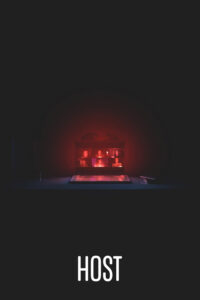
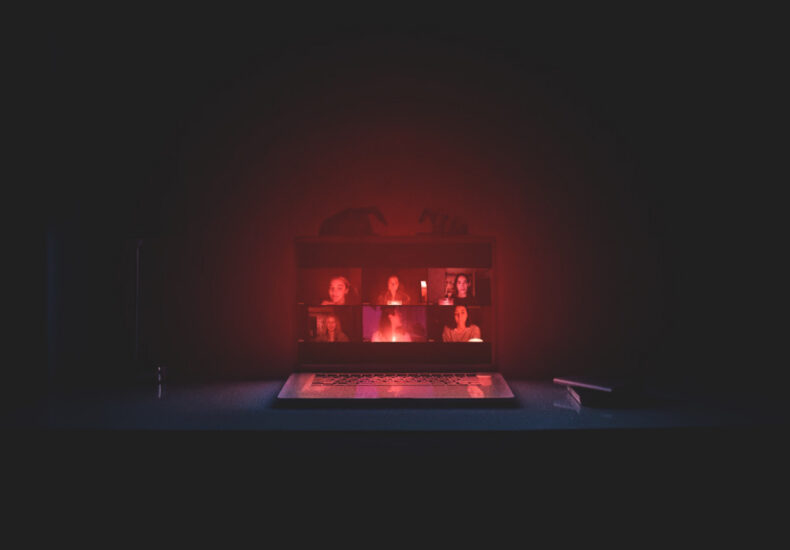
Before we get into the list below, I’ll sort what I think counts as internet horror from what doesn’t count. For a horror story to count as internet horror, it must A) be told primarily through an online format (i.e. news articles, comment sections, message boards, webspages, etc) and/or B) relegate the source(s) of its horror to the online landscape. More importantly, its themes must pertain, in some way, to the internet. Host (2020), for starters, is a very strong example of internet horror, despite its rather traditional haunting, because its themes relate to the online social settings created by the 2020 pandemic and the hysteria they amplified.
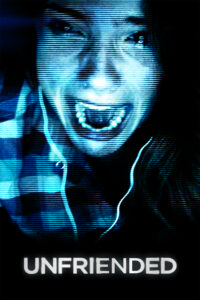
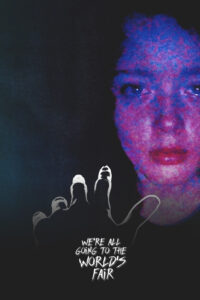
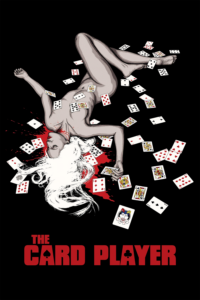
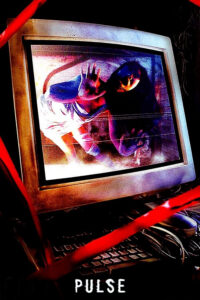
Found footage films such as Unfriended (2014) and We’re All Going to the World’s Fair (2021) are also fantastic examples of internet horror. While the former is remarkably similar to Host, it’s rooted in distinctly different conceptual territory, touching on cyberbullying and digital footprints. The latter example derives its horror from the impact of online socialization on adolescents and the innate dangers that come with performing for an online audience. Other strong examples of internet horror include earlier films such as Dario Argento’s The Card Player (2003), which explores online apathy, and Kiyoshi Kurosawa’s Pulse (2001), a harrowing exploration of social decay in the digital age.
Without further ado, here are four stories that make superb use of the digital landscape.

“Pickman’s Modem” – Lawrence Watt-Evans (1992)
Contemporary retelling of an H.P. Lovecraft classic. On a message board, a user named Henry Pickman documents his purchase of a 2400-baud modem, a device that allowed computers to send and receive data via telephone lines. Things quickly get out of hand when the modem begins rewriting the text of the user’s posts.
“Each Thing I Show You is a Piece of My Death” – Gemma Files (2010)
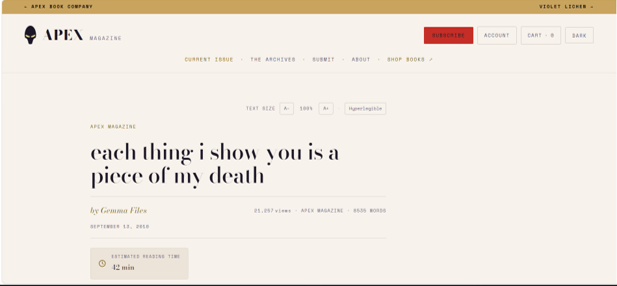
Two avant-garde filmmakers receive a disturbing video file in which a man commits suicide. In the background of the video, one of the two spots a figure who doesn’t look quite human. And the more videos they analyze, the more they start to see him everywhere.
“Things Have Gotten Worse Since We Last Spoke” – Eric LaRocca (2021)
Agnes and Zoe, two lonely lesbian women, meet on a forum and begin exchanging messages. The relationship, at first mundane, gradually spirals into a sadomasochistic nightmare.
“Where Oaken Hearts Do Gather” – Sarah Pinsker (2021)
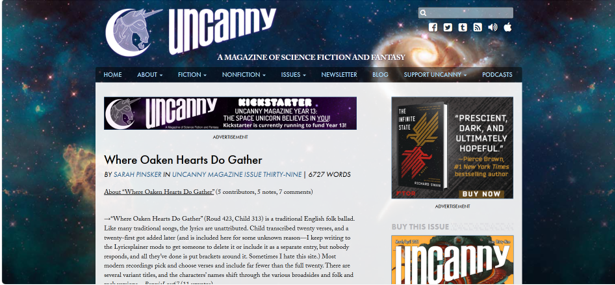
On a crowdsourced lyrics website, a handful of anonymous users analyze and discuss the lines of an English folk ballad that warns of cursed trees. One of the users, a student named Henry Martyn, tracks the song’s origins to an isolated village. From there, things go very, very wrong.
For more digital horrors, read these stories in our archive:

Read Christopher Degni‘s story “Notes from the Dark Web” in Horrific Scribes July 2025.
Description: The hacker b3lph3g0r buys a Dark Web site to offer his shady services to whoever will buy them. But immediately, things don’t go as planned, and even worse: he seems to have angered the wrong person. Piece together the mystery through chat logs, emails, web copy, and more.
Notes from the Dark Web: https://horrificscribblings.com/authors/degni/

Read Michael Hessel-Mial’s poem “Pseudodisplay for Voice and Captive” in Horrific Scribes, February 2026.
Description: Five thousand years from now, a bored spacefarer-artist devised a script for their mock-installation as the Last Entrepreneur. Lost in the wordplay and profanity is the fate of one unidentified captive.

Read J.S. Douglas‘s short story “Like and Subscribe” in Horrific Scribes March 2026.
Description: The Humbart Family channel features “wacky pranks and funny antics,” bringing in followers from across the internet. After years under the unblinking eye of the camera, the Humbart children have reached their breaking point. This Christmas, it’s time for revenge.

Read E.J. LeRoy‘s short story “Remy de Montfort of Dubcon Palace” in Horrific Scribes August 2025.
Description: Enslaved in Barbados after becoming entangled in the Monmouth Rebellion of 1685, Remy de Montfort, a deposed French aristocrat turned London thief, makes a daring escape. But on the rowboat to freedom, he makes a brutal discovery about his existence.