Analog Horror Revisited: Interview with Mike Lombardo, Director of DEAD FORMAT
by Reese Hurd
Speaking of analog horror,,, which we were, back in February…

from reelsplatter.com…
About Mike Lombardo

Mike Lombardo grew up on a steady diet of Goosebumps, scary story books, 90’s Nickelodeon, and horror PC games. He is an award-winning independent filmmaker, writer and FX artist who runs Reel Splatter Productions. In 2017, his first feature film, I’m Dreaming of a White Doomsday, played the festival circuit around the world and took home seven awards, including multiple Best Picture and Best Actress wins, and over a dozen nominations. His debut short story collection, Please Don’t Tap on the Glass and Other Tales of the Melancholy & Grotesque, was released in August of 2022.
He is the star of the documentary The Brilliant Terror from Lonfall Films, which chronicles the world of indie horror and the lengths that low budget filmmakers will go through to get their projects made.

He has been a festival programmer for Scares That Care Weekend Film Festival, The Lancaster International Short Film Festival Horror Night, served as a judge for GenreBlast Film Festival and PA Indie Shorts Film Festival and was a member of the jury for the Splatterpunk Awards.
from https://www.indiegogo.com/en/projects/mikelombardo/dead-format…
About Dead Format
Dead Format is the second feature-length horror film by Mike Lombardo, award-winning director of I’m Dreaming of a White Doomsday (Reel Splatter Productions) and one of the stars of the hit documentary The Brilliant Terror (Lonfall Films).
Based on the fan-favorite short story of the same name from Lombardo’s collection Please Don’t Tap on the Glass and Other Tales of The Melancholy & Grotesque, the film is one of the most personal projects Mike has tackled to date. When his dad passed away several years ago, he wrote the original short story as a way of coping with the loss. The film also incorporates Mike’s childhood memories of the video store, as well as his passion for collecting movies.

Executive produced by renowned horror author Brian Keene (The Rising, Ghoul, Earthworm Gods) and co-produced by author/filmmaker Samantha Kolesnik (Waif, True Crime) and author, filmmaker, and founder of GenreBlast Film Festival Nathan Ludwig (The Comfy Cozy Nihilist), Dead Format combines 90s nostalgia, horror and drama with a dash of Lombardo’s trademark humor and a touch of 80s slasher mayhem.
[The following interview took place via emails sent February 12, 2026, through April 12, 2026, between Reese Hurd, who was studying for a master’s degree in Cork, Ireland while working remotely as an Editorial Assistant at Horrific Scribblings, and Mike Lombardo, who was drowning on the set of Dead Format in/around Lancaster, Pennsylvania, USA. Edited for continuity, etc. by L. Andrew Cooper.]
The Interview

REESE HURD [RH]: I am an aspiring horror writer and filmmaker. I have a bit of experience since completing my undergraduate degree [in Film and Screen at University College Cork in Ireland] and showing a short film that I wrote and directed in a local film festival. I’d really love to know more about your work. I have listed interview questions for you.
MIKE LOMBARDO [ML]: Hi Reese! I am so sorry this took so long. Between wrapping the final leg of shooting and my day job, I was tearing my hair out the last few months, but I appreciate your patience. I hope my inane rambling is of some value and that it is worth some of the wait at least, haha. I wrote [my answers to your questions] over the course of a sleep-deprived week’s worth of lunch breaks at work.
Question One
RH: You grew up in the 90s with some very heavy influences coming from Goosebumps and Horror PC games. What drives the nostalgia for those times in your current work, and what draws you to analog horror specifically? And what do you want audiences who don’t know much about these subjects to take away from Dead Format?
ML: I think that every generation will claim they had the best childhoods and that their generation had the best movies, art, and music, but the big difference here is that I’m right, haha.
Growing up in the 90s was interesting because it was such a transitional time. I got to see the world pre-internet but still be young enough to adopt it when it became a major force, video games went from Pong to full 3D worlds and live action FMV, and there was a big indie counterculture push with networks like MTV and Nickelodeon just letting weirdo indie artists do whatever they wanted and airing the results.
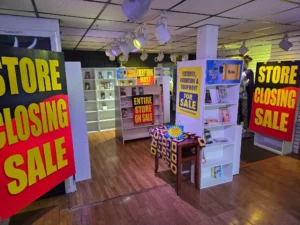
And then of course there were the video stores! The Meccas of any weirdo horror kids growing up back then, and boy was I weirdo horror kid.
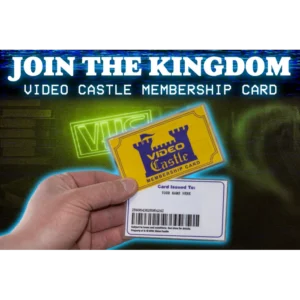
The video store was a place where you could find a piece of shit on video trash like Gore-Met Zombie Butcher Chef from Hell sharing shelf space with Alien and Eraserhead. Home video was a booming market, and it was the Wild West. Stores had shelves to fill, so they would buy anything with a cool cover to meet the demand of the renting public. I grew up on direct-to-video movies and stuff shot on camcorders in backyards, and it left a huge impact.
Big box computer games were the same boat as VHS tapes. There would be a massive studio title next to something made by a three-person team, and they would have equal footing on the same shelf. You really never knew what you were getting yourself into. There was so much more variety back then and people taking risks making weird shit that would never happen today.
All that rambling to say that I was fed a steady diet of oddball indie stuff as a kid, and it shaped my sensibilities quite a bit. The outsider voices were the ones I gravitated towards, and back then you really had to hunt for the stuff, which made it feel so much more subversive and special. You would hear about something in a magazine or in a chat room, and then you’d seek it out like a bizarre treasure hunt. I feel like that is lost today. Everything feels so much more disposable now because we have access to everything at the touch of a button with no effort at all.
It was a really cool time to come of age, and much like Kevin, the lead character in Dead Format, I think it’s really important to preserve history. It was the last era before everyone had a phone with a high def camera built in. Going forward, historians can literally see in real time what any random day was like thanks to smartphones, but pre early aughts we didn’t have that, so there’s a lot of things that will just be lost to time, and that is something that I think about a lot, and it makes me very sad. I’m hoping that with Dead Format, I can do my part to help save a small piece of the good ol’ days.
Question Two
RH: You’ve mentioned that the original short story was inspired by the loss of your father. How were you able to use that grief as a tool for creativity through writing the original story and then adapting the screenplay? How much of yourself do you see in the protagonist?
ML: Writing the original short story kicked my ass. It was supposed to be a goofy little throwaway that was poking fun at one of my favorite horror tropes: the haunted movie that comes to life, but as often happens when I sit down to write, my subconscious started kicking in all sorts of personal stuff, and things turned melancholy fast.
The tone of the whole story changed, and the initial joke that spawned the idea in the first place took a backseat as my pent-up feelings started to ooze onto the page. There is so much of me in the story and the film, I think moreso than in anything else I’ve ever made. Again, that wasn’t even on purpose. I would sit down to write, and shit that happened in my life that I hadn’t thought about in damn near two decades would just start coming out, and I would stare at the screen and be like, “Oh, so we’re going there…”
It was really rough sometimes, but honestly extremely cathartic. There were a lot of things and feelings that were swimming around in my head that I had been clearly avoiding for a long time, and this story and movie gave me an outlet to confront them.

As for the protagonist, a lot of my close friends, my girlfriend, and my mom have all just stared at me after watching clips and told me that if you combine the two lead characters into one person, it would be me, so I guess there’s a lot me in there, haha.
Question Three
RH: Audiences seem to be getting tired of the overuse of CGI and purely digital effects. Production even in the latest Hollywood horror films has been moving back in the direction of using more practical effects. As a director and SFX artist, what part of the process of creating these practical effects is most valuable and rewarding to you?
ML: Sitting in my kitchen covered in clay and ultra cal 30 is my happy place. Being able to make stuff and literally get my hands dirty is my favorite thing on the planet to do. I love writing and editing (when it’s going well, anyway), but sitting in front of a computer for hours at a time drives me nuts. I much prefer sculpting and painting and the smell of wet latex, which smells like cat piss for those who aren’t familiar. It’s disgusting but also a weirdly comforting scent. Out of all of it, though, I think lifecasting is my favorite part. Taking a mold of someone’s face or a body part and making a clay or plaster cast out of it is just the perfect representation of the movie magic I grew up loving. I would watch grainy behind-the-scenes VHS tapes of Tom Savini doing a headcast and fantasize about one day doing it myself. It’s funny because lifecasting is one of the most stressful parts of doing FX, and it causes me tremendous anxiety every time I do it, but it always makes me feel like I’m a real effects artist, and I’m really doing it, ya know? I did my first lifecast when I was 18, and it is still just as exciting to me now at 39 as it was back then.
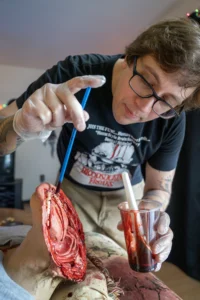
There’s also nothing like the excitement of going through the whole process of lifecasting, then pouring a clay positive and sculpting it, making your molds and finally pulling the final piece out and painting it, and then you’re on set and it’s go time. All that preparation and work lead up to that beautiful moment on set when you apply the prosthetic or set up the dummy head and you put fake blood on it and suddenly it comes to life and everyone on set is so excited. FX days are always such a blast with the crew. Everyone wants to see the bloody stuff and take pictures. It’s a ton of fun.

Question Four
RH: Did you face any unexpected challenges when adapting the original short story into a screenplay?
ML: Yes, haha. When I first wrote the screenplay, it was a short film, a really long short film, but a short film nonetheless. My good friends, Samatha Kolesnik and Nathan Ludwig (who became the first producers on the movie), read it and told me I was an idiot for thinking it was a short. We butted heads for MONTHS with me insisting there was no way to expand the story any further, and I was dead set on making a 25-minute short film for some stupid reason, but eventually I caved and heard them out.
Fun fact about me is that I don’t write in proper screenplay format. I’ve always directed my own scripts, so I write in a weird hybrid of screenplay and stage script with camera moves and edits baked in. Nathan came onboard and translated my nonsense into a proper script and had some really great ideas that helped expand the story in directions I wouldn’t have thought of.
Once the Candace character, who is Kevin’s sister, got added to the story, things just started clicking, and it was easy to run with and make it a feature. When I look back at it now, I can’t even comprehend how it could have been any other way than what it turned out to be. There was no way that it would have worked as a short film. There was so much more in there that needed to be explored, and I will be forever grateful to Sam and Nathan for sticking it out and fighting my stubborn ass for so long until I grew a brain.
Question Five
RH: Finally, what advice do you have for aspiring filmmakers who are looking to get into the indie horror industry, especially in light of your experience with Dead Format?
ML: My default advice every time I’m asked this question is, “Get a real job.” The first step to becoming an indie filmmaker is coming to terms with the fact that you will not make any money, in fact you will most likely end up in debt because of it, but that’s fine. You make things because creativity is a compulsion, not a choice. Always approach any creative endeavor with “Wouldn’t it be awesome if…” and not “(insert random fad) is really popular, how can I make money off of it?”
I’m telling you right now that if you break down the amount of hours you’ll end up sinking into making a movie over the course of a year (or four), you will realize that working part time at McDonald’s that same amount of hours would literally get you more cash. I don’t say any of this to be discouraging; I say it to be realistic.
If you work at McDonald’s, you can at least pay your rent and feed yourself. Having a dayjob and making your film on weekends is not failure, it’s smart. It’s a long and grueling journey to make a movie, and you need a stable base to live during it. And who knows, maybe your microbudget indie flick will blow up and become the next Terrifier (hopefully with a better script), and you’ll get whisked away to studioland, but more than likely you’ll be on the festival circuit and then self distro-ing through Kunaki and selling copies at horror cons, and THERE IS NOTHING WRONG WITH THAT. Again, I can’t stress enough that creativity is a compulsion, not a choice. You do this because you love it, not because you think you are going to get rich doing it.
The second piece of advice I would give is to volunteer and be on other people’s sets. Always remember that there is no job on set that is beneath anyone, be it running to the gas station to get ice for the fog machine or scrubbing fake blood out of the director’s mom’s living room carpet that accidently spilled, every single position on set is valuable.

Ask questions. Learn how to do as many different things as you can because chances are you’re going to be wearing a lot of hats, especially in the beginning. As you get more experience and your projects get bigger, you can give some of the hats to other folks and focus on directing, but having that experience wearing them will make you infinitely better equipped to handle the nonstop barrage of stupid shit that can go wrong every day on set, and it will go wrong, trust me. Learning how to roll with the punches and adapt on the fly is the key to surviving and finishing your movie.
Networking on set is also key. Meeting like-minded weirdos who also want to cover their friend’s apartments in fake blood is crucial and wonderful. On Dead Format, I was able to call on and surround myself with tons of incredibly talented folks who I met and worked in the trenches with over the years, and it made the film so much better than if I were trying to do everything myself. A good indie set is like a family, and Dead Format ended up being the most beautiful group of folks I have ever worked with. There are so many talented and passionate people out there just itching for a project to be a part of. You just need to find them.

But the most important piece of advice of all: DON’T GIVE UP! It’s going to be stressful, it’s going to be exhausting, you’re going to question every choice you ever made in your life that brought you to the point where you thought it would be a good idea to make an indie horror movie, but I promise you that MAKING SOMETHING is always worth it.
Thank you for the great questions and good luck with your next projects!

The answers were certainly worth waiting for, and I’m sure the movie is, too. I’ve been excited about this one for a long time! –L. Andrew Cooper
“Cluttered with the bygone that looks initially superficial–from the opening line about pubic hairstyles to VHS tapes, the story’s focus–this story is in some ways about nostalgia. As the specter of death enters, ready to slash its way through the protagonist (and some neighbors), the nostalgic becomes anything but superficial, and Lombardo beautifully delivers chills as well as a deeper understanding of why dead formats matter. Tied for my favorite tale in the book.”
–L. Andrew Cooper, comments on the short story version of “Dead Format” from 2022 review of Please Don’t Tap on the Glass and Other Tales of Melancholy and the Grotesque.