EXTREMELY WEIRD SPLATTER Written in Its Authors’ Guts: Group Interviews, Part Two
by L. Andrew Cooper
As I put together the table of contents for the forthcoming anthology Extremely Weird Splatter, I asked authors to answer three basic questions about why they and their stories fit with a project aiming to fuse extreme horror and splatterpunk with weird fiction. Not entirely randomly, I’ve sorted responses into three groups.
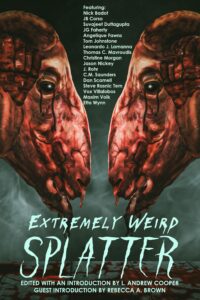
Extremely Weird Splatter: Contents

Nick Badot, “The Copper Merchant”
JB Corso, “Scenarios”
Suvajeet Duttagupta, “The Weight of the Dark”
JG Faherty, “The Fishhook Prophecy”
Angelique Fawns, “Highway to Hell Fan”
Tom Johnstone. “Debbie Does Delos...?”
Leonardo J. Lamanna, “How to Build a Meat Radio”
Thomas C Mavroudis, “Adoration of Evil”
Christine Morgan, “What They Deserve”
Jason Nickey, “Portal”
J. Rohr, “A Parent Sacrifices”
C.M. Saunders, “On the Fringes”
Dan Scamell, “MySkin EverFlesh”
Steve Rasnic Tem, “Dermis”
Vox Villalobos, “Soup”
Maxim Volk, “My Love, Like Moss, Envelops You”
Etta Wynn, “The Architect of the Soft Circuit”
Interview Group Two
GROUP MEMBERS: JB Corso, Angelique Fawns, Tom Johnstone, Leonardo J. Lamanna, Maxim Volk
By the way, I totally stole this “roundtable” format from author Sean Taylor, who does neat stuff all the time on his site Bad Girls, Good Guys, and Two-Fisted Action.
What aspect of your biography is most relevant to Extremely Weird Splatter?
JB Corso: Having both served overseas in the military, including a tour through a combat zone, and worked 20+ years in healthcare, I’ve witnessed humanity’s failings. Especially righteous people failing against those without agency and the most vulnerable. There is a real horror that few fantasy horror stories can actually match due to the realism. I’ve translated my pain and trauma to stories. And, there are a lot of them. My goal is to scare someone to the point of wetting themselves, though a month of nightmares would be a win.
Angelique Fawns: I’ve always looked for the side story in life… the Twilight Zone dimension. I think human existence is kind of like a chocolate cake with vanilla icing. Many people choose not to see past the frosting. But if you dig in past the shiny white sugar, there are so many dark delicious layers. That’s where extremely weird splatter lives. In the dark chocolate layers.

Tom Johnstone: That’s a bit personal, but just to be clear, the stuff about the psychological damage to the couple’s relationship due to infidelity is autobiographical, not the wet works…!

Leonardo J. Lamanna: My work as an archaeologist puts me in direct contact with the physical reality of past lives and past deaths. I study human remains marked by disease, trauma, malnutrition, and early mortality. It’s an archaeology of the body under stress, of flesh that records violence long after it’s gone. Across different periods, the patterns repeat: exploitation, coercion, suffering embedded in bone. Slavery, labor, power imposed on the body. These are not abstract ideas: they leave marks. That perspective shapes my writing. Horror, to me, is not invented. It’s inherited. The human body carries it, absorbs it, and sometimes transforms under it. Time doesn’t erase anything cleanly; it distorts, accumulates, and leaves us as unstable combinations of matter and thought, caught in cycles we mistake for meaning, moving toward an end that is always the same.
Maxim Volk: I grew up in a cult and left when I was seventeen, so much of my early life was definitely extremely weird and at times horrific. A lot of my writing is born out of those experiences, either explicitly, exploring the horrific aspects of religion, or implicitly, focusing on the inherent terribleness of the world around us. I’ve seen some weird shit in my lifetime, and my writing reflects that.
Which of your previous (or forthcoming, or planned) works makes you most qualified to participate in a project that fuses splatter with the weird?
JB Corso: My go-to genre is horror. I revel in the weird. I enjoy fusing Beetlejuice, Vivarium, and Mad God when considering plotlines. I reach for the literary jugular, hold tight, and thrust my thumbnail through the vein. Not a creative f*ck to give. Don’t like it, go read Harry Freaking Potter.
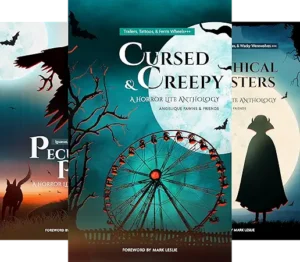
Angelique Fawns: A couple of years ago, I published a trio of anthologies called The Horror Lite series. Each book contains 13 stories, and some of those definitely dive into the splatter weird category. However, the majority of them end on an upbeat ending. It is my own personal belief that horror is a path to positivity.
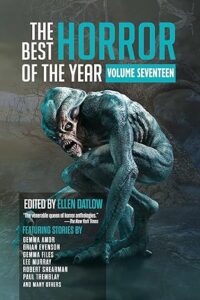
Tom Johnstone: Usually, my horror fiction is more on the quiet side, but “Debbie Does Delos…?” is almost a companion piece to my novelette “Body Worlds,” which appeared in the literary journal Body Shots, then Best Horror of the Year Vol. 17. The editor of Body Worlds said it was like Clive Barker and during the editorial process asked me to make it more so.
Leonardo J. Lamanna: Not all of my stories are strictly extreme or splatter, but they all focus on the body—what can be done to it, what it can endure, and how it changes under pressure. My short story “The Flesh Factory” is a good example. It’s set in a system where human beings are kept alive only to have their organs harvested over and over again. The violence isn’t sudden or chaotic—it’s routine. Procedural. Part of everyday life. What makes it weird is the logic behind it. Identity is annihilated, the body is treated as replaceable, and even the desire for death becomes a form of resistance that the system can anticipate and suppress. That’s where the horror sits: not just in the damage done to the flesh, but in how normal—almost clinical—it all becomes.
Maxim Volk: I have several works that fall into the splatter category, like my story “The Canvas” for Horrific Scribes and my upcoming book, Deadbeat, and I’ve explored the new weird in some stories that will be coming out soon, but this is the first time I’ve experimented with fusing them together. Writing this story inspired me to keep delving deeper into this genre, so hopefully there will be many more to come.

Without giving away ANYTHING—what about your story for Extremely Weird Splatter is most transgressive?
JB Corso: What you see isn’t what you know. What you feel isn’t someone or something else’s concern. The hardest death to see is the one we watch on repeat.
Angelique Fawns: “Highway to Hell Fan” is one in a series of short stories that feature a character called Mia. I’ve always been interested in how a soul can descend into corruption. Where is that gray area between good and evil? How far can you travel between the two before someone is beyond hope? We explore these boundaries with Mia, and when she becomes excited by violence and gore, we are firmly in the transgressive category.

Tom Johnstone: The most transgressive thing about the story for me is the idea of dissociation and the uncanny making someone do really horrific things.
Leonardo J. Lamanna: At its core, “How to Build a Meat Radio” pushes the idea that the search for the divine has always been tied to the body, and to what can be done to it. Across cultures and time, religious experience has often involved blood, sacrifice, dismemberment, and ritualized violence. Not as aberrations, but as structured, meaningful acts meant to bridge the gap between human and divine. The story takes that underlying logic seriously and refuses to soften it. It follows a character who interprets faith in the most literal way possible, turning devotion into something obsessive, physical, and increasingly destructive (both to himself and to others). The transgression lies there: not just in the violence itself, but in treating it as a legitimate path to transcendence, and in suggesting that this impulse is not alien to religion but rooted within it.
Maxim Volk: A lot of my works, including this one, explore the intersection of love, sex, and violence. This story is an attempt to demonstrate the ways that violence can sometimes be erotic, and that eroticism—love, sex, lust—can sometimes be violent, not necessarily in a way that violates consent (at least in this story), but in a way that shows that sometimes the best way a person can show you that they love you is by hurting you.