Queer Horror: from subtext to main text
by Lilly Shanan
…with guest commentary from David-Jack Fletcher!
In horror stories, a force of otherness usually terrorises both the story’s characters and the audience. In Mary Shelley’s Frankenstein, the Creature kills and hunts for vengeance after his creator denies him a bride. J.S. Le Fanu’s Carmilla features the vampiric Carmilla, who feeds upon Laura and lulls her under a spell. Despite and even because of their apparent monstrosity, these figures have earned special status within the queer community. Ardel Haefele-Thomas writes about an overlap between queerness and the monstrous, arguing that ‘these texts transgress monstrosity in the sense that they help interrogate the very idea of what is monstrous, opening up spaces where we can read sympathy for others who are queer’ (17).
In Frankenstein, the Creature’s internalised disgust mirrors internalised homophobia. Treated as a horrific ‘other,’ even by his own creator, the Creature speaks of himself with the same loathing he feels from his society: ‘my form is a filthy type of yours, more horrid even from the very resemblance’. The Creature’s grief over resembling humanity yet being cast out as a horrific, distorted version of it has struck a chord with the queer community. Harry Benshoff suggests that queer audiences are more likely to experience the monster’s plight on personal terms due to how they are marginalised; like the monster, they are ‘permanent residents of shadowy spaces’ (230). Even though we as the queer community know we are human and have the same basic needs and feelings as any cisgender heterosexual member of society, we are shunned and seen as an ‘other’ in society for wanting to pursue human desires that have slightly different forms. Facing such treatment, the queer community can easily identify with the Creature in Frankenstein.
Le Fanu’s Carmilla depicts queerness through Carmilla and Laura’s relationship in a manner that at least today seems overt in its eroticism and in its metaphorical potential for representing queer experience. Carmilla’s pursuit of Laura can be read as a vampiric predator securing its prey, a literal monster story, as Carmilla uses their relationship to feed off of Laura. But a modern queer audience tends to sympathise with Carmilla due to her position as the ‘other’; for example, in 1950 the story was praised by Daughters of Biltis, a group dedicated to empowering lesbians through political and civil rights (Haefele-Thomas 114). Haefle-Thomas argues that the status of the vampire has a strong overlap with queer identity due to both connoting liminal existences, both physically resembling any other person but containing this element of otherness that entails that they live their lives differently within a heteronormative society and thus disturb the ‘natural’ order (108). This perspective enables queer readers to view Carmilla and Laura’s relationship as metaphorical for the queer experience, with the ambiguity of Laura potentially being a vampire at the end of the novel symbolising her transgression into the otherness of lesbianism.
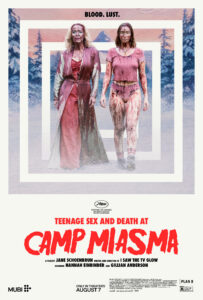
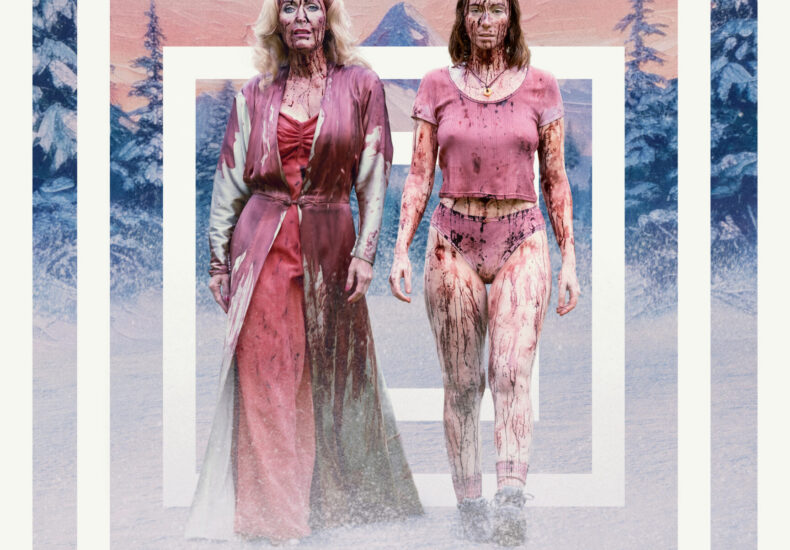
As valid as the queer readings are, they require comparative perspectives and close attention to details in the novels. However, the growing popularity of queer readings of horror, along with the improvement of queer rights in general, has helped queer horror to become far more overt and accessible. Queer people no longer have to read between the lines to argue for representation of themselves. Though it strays from my focus on prose fiction, I would be remiss not to mention Jane Schoenbrun’s recent film Teenage Sex and Death at Camp Miasma, which is essentially a love letter to horror and how queer people have identified with it. As of 2026, plenty of horror novels feature queer narratives as the main text, and it has become increasingly common to feature the ‘monster’ in a positive light. Queer horror has become such a staple in 21st-century horror that entire publishing presses are dedicated to it and to amplifying queer voices.
Going twenty-five years strong, Lethe Press is one of the oldest presses publishing eerie and queer fiction. They generally look to publish historical speculative fiction and horror and have a section dedicated to their queer publications, which is split into the following subcategories: gay fiction, lesbian fiction, transgender/genderqueer fiction and bisexual fiction. They have even re-issued out-of-print queer books, stating their mission is to ‘rescue many books from obscurity’ and give a home to the work of writers whom larger presses might not accept due to it being too queer-focused (Mandelo).
Founded in 2021, Shirley Jackson Award-winning press Cursed Morsels proudly advertises itself with the tagline ‘publisher of short horror and weird fiction. Anti-fascist, anti-capitalist, and pro-queer’. Back in June this year, they appeared on the podcast Workers’ Lit to discuss queer horror, why members of the LGBTQ+ community are drawn to the genre, and how anti-fascist art tends to overlap with the queer:
While not specifically dedicated to queer horror, Divination Hollow Reviews publishes blog posts and short stories, promoting literacy, equality and creativity through horror and its related subgenres through a diverse group of contributors and consequently amplifying these voices within the literary sphere.
They are a queer woman-run platform, and their website has a section for queer events and resources. It includes Queer Your eReader, a book blast event lasting 24 hours in which authors share their books with readers for free (the next event will be on the 27th of March 2027!); Queer History, a page documenting overlooked queer history; and Pride in Horror Month, an annual event hosted in June that calls for submissions for horror-related pieces by and about queer voices.
Last but not least, Slashic Horror Press is an independent queer horror press, founded in 2023, that aims to deliver queer stories within the horror genre. They are adamant about centring queer voices within their works and ask that all submissions feature queerness as a key component within their narratives. This dedication to queer narratives is further highlighted through their Outwrite Scary Awards, an awards system that makes LGBTQ+ works the main category rather than a subcategory. The fact that the 2025 publishing sphere can hold an awards event dedicated specifically to queer-centric horror shows both how recognised the subgenre has become and how important horror is to the queer community.
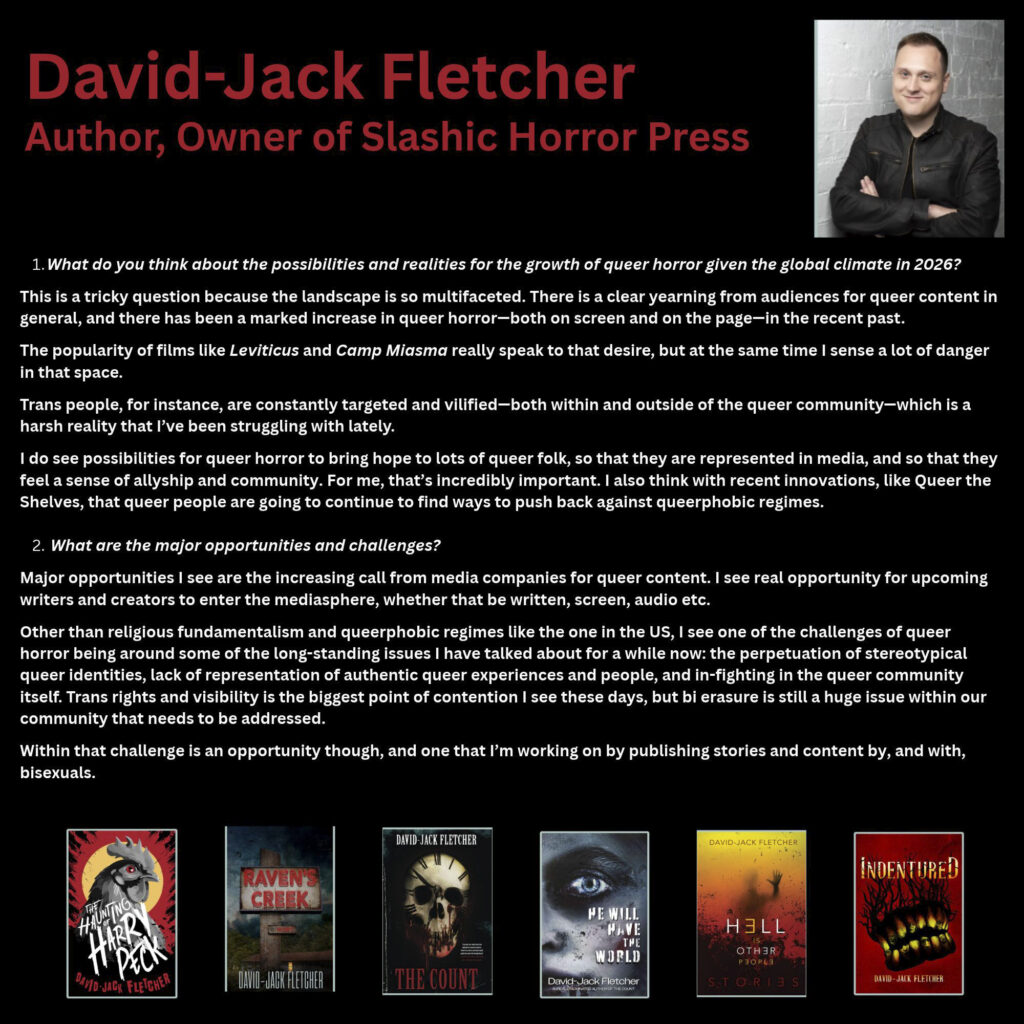
David-Jack Fletcher, founder of Slashic Horror Press, had this to say about queer horror within 2026:
We at Horrific Scribblings are also passionate about publishing queer horror. I identify as an asexual lesbian, and exploring queer horror in greater depth was one of the main reasons I came to work with Horrific Scribblings, which has led to the article you are reading now. L. Andrew Cooper, the press’s owner (and the publisher and lead editor), identifies as gay/queer. Extremely Weird Splatter, our biggest publication yet, includes several stories from queer authors and stories featuring queer characters, demonstrating how weird horror can twist the queer experience beyond the mundane. In Maxim Volk’s “My Love, Like Moss, Envelops You,” a serial killer turns a new leaf in love via his husband’s resurrected form. JB Corso’s “Scenarios” details the never-ending slaughter of Gretchen’s family, in which she is forced to endure scenario after scenario of her wife and kids’ gory demises. Outside of EWS, our archives contain many queer narratives. We have a category dedicated to LGBTQ+ stories that showcases the many ways in which horror, the weird, and the queer intersect, ranging from vegan vampires to erotic tattoo practices. Our stories show that, within horror, there is no single definition for what the queer experience should be.
The queer community’s sympathy for, and identification with horror and all of its monsters has been crucial in shaping today’s queer horror scene. In 2026, we can proudly say that we have dedicated spaces to amplify queer voices in horror, resulting in subtext becoming main text on a wider scale.
Sources
Benshoff, Harry, “The Monster And The Homosexual,” The Monster Theory Reader
Haefele-Thomas, Ardel, Queer Others in Victorian Gothic: Transgressing Monstrosity
Mandelo, Lee, “An Interview with Steve Berman,” Reactor Magazine
Leave a Reply