
Women at Horror’s Extremes
by Camille McCullough
Extreme horror and splatterpunk have long left women in the margins, using violence and sexual assault against female characters for shock value. David J. Schow coined “splatterpunk” in 1986 to describe an extreme subgenre marked by graphic gore and countercultural themes, reacting in part to works from splatterpunk’s first wave in the 1980s that fetishize misogyny. In Jack Ketchum’s Off Season (1980), women endure prolonged, graphic torture; Richard Laymon’s The Cellar (1980) focuses on victimized female bodies while blending sexual arousal with extreme violence; and John Skipp and Craig Spector’s The Light at the End (1986) portrays women as helpless victims or disposable objects.
Contemporary women and queer creators are confronting this legacy, using visceral horror to explore systemic abuse, oppressive societal expectations, and threats to bodily autonomy. Recently, “femgore” has emerged as a term for female-centered splatterpunk and extreme horror. Femgore differs from splatterpunk in key ways: body horror is centered on things such as menstruation and childbirth, and the violence leans toward a gendered or feminist purpose. Women writing splatterpunk, extreme horror, or femgore write from a perspective that answers the question “what does it mean to inhabit a body that society fears or controls?”
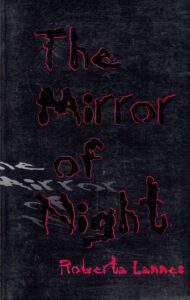
Accounts of women in splatterpunk and extreme horror should recognize pioneers such as Roberta Lannes, author of The Mirror of the Night (1997), who challenged the social status quo by entering a traditionally male-dominated space and helping create room for women in the genre. Women writing splatterpunk and extreme horror today address real-world trauma, survival, agency, and the expansion of previously established boundaries. Horrific Scribblings is fortunate to include many of these women in its Horrific Scribes archives and in our anthology Extremely Weird Splatter. Their work questions conventional assumptions about women and gender roles while reflecting the horrors of lived experience.
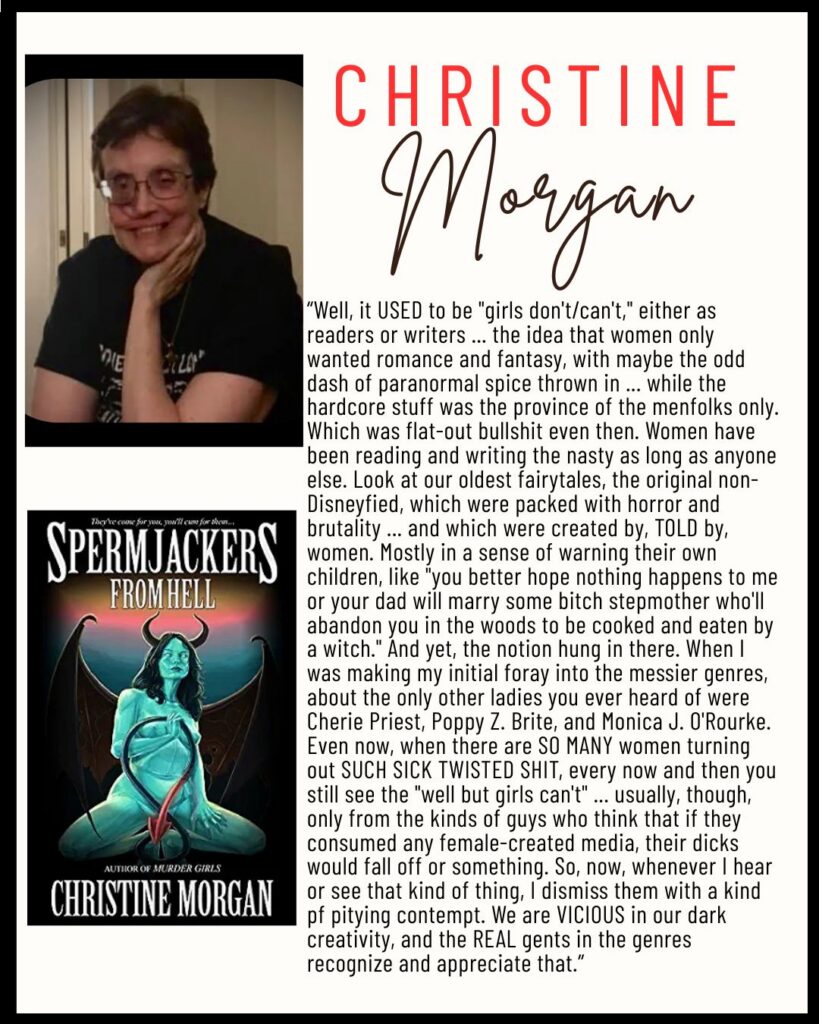
I asked women who write splatterpunk and extreme horror to discuss the most common misconception about women who read and write these genres. Reading these comments, I realize that, contrary to the history of splatterpunk and what a lot of people still think, women do have places at horror’s extremes, and they’re doing important work. Here’s what they have to say:
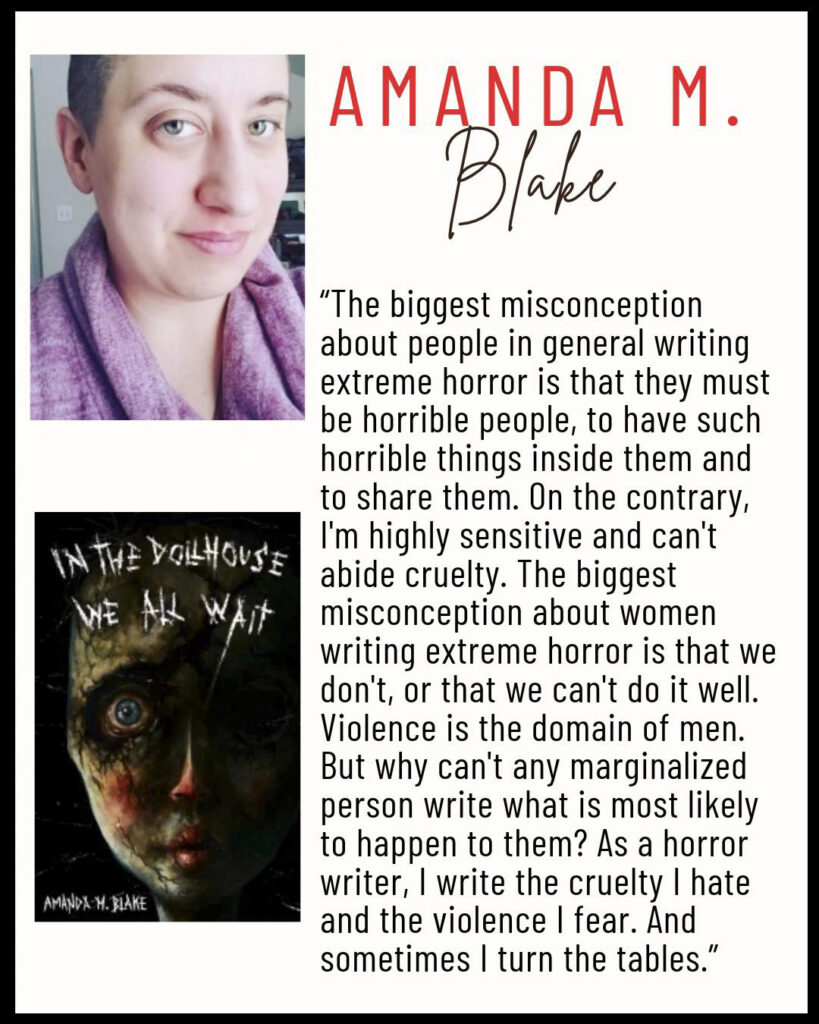
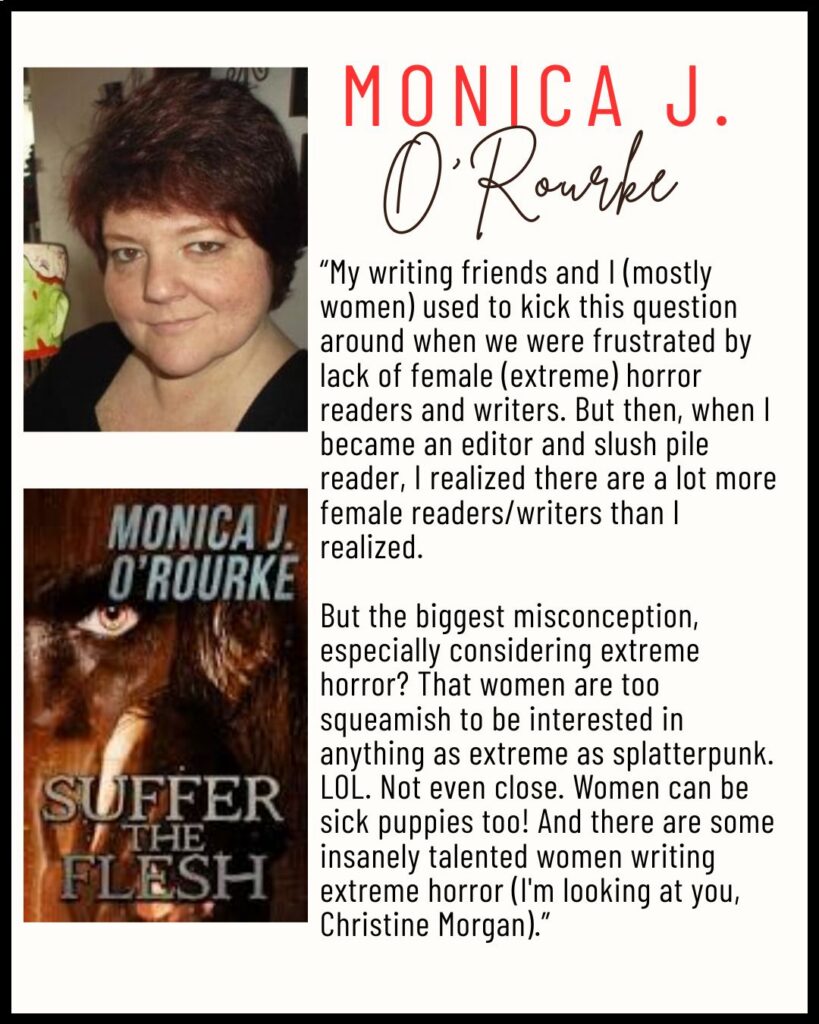
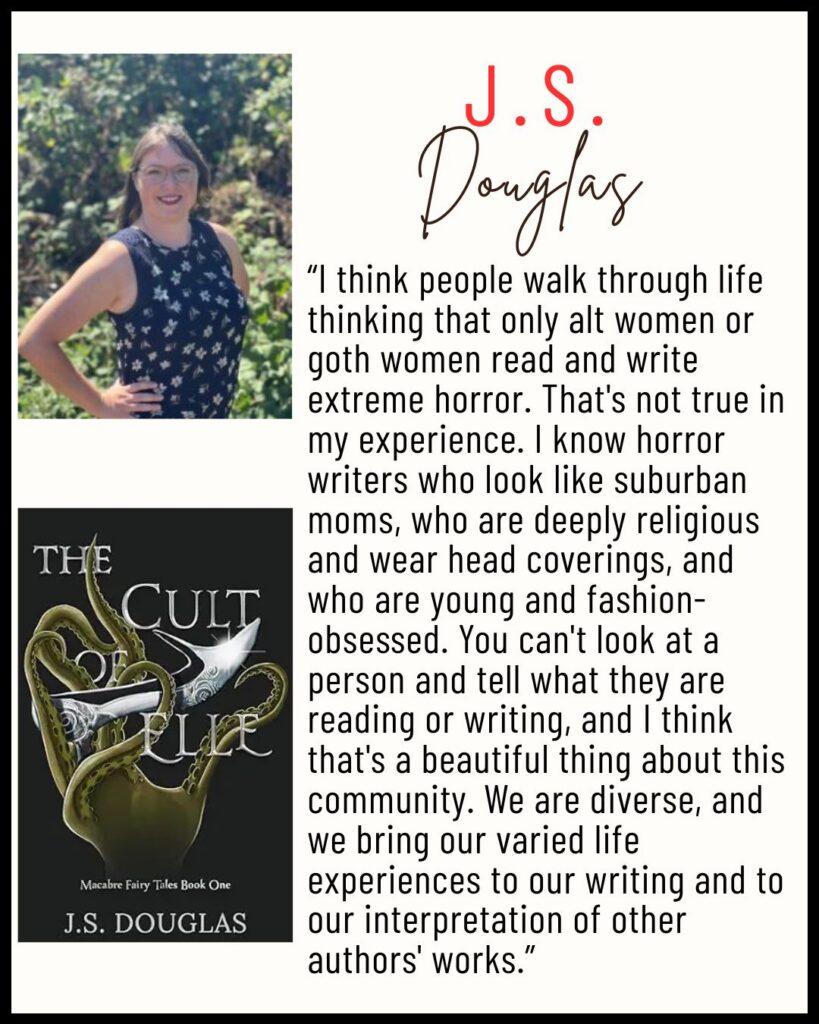
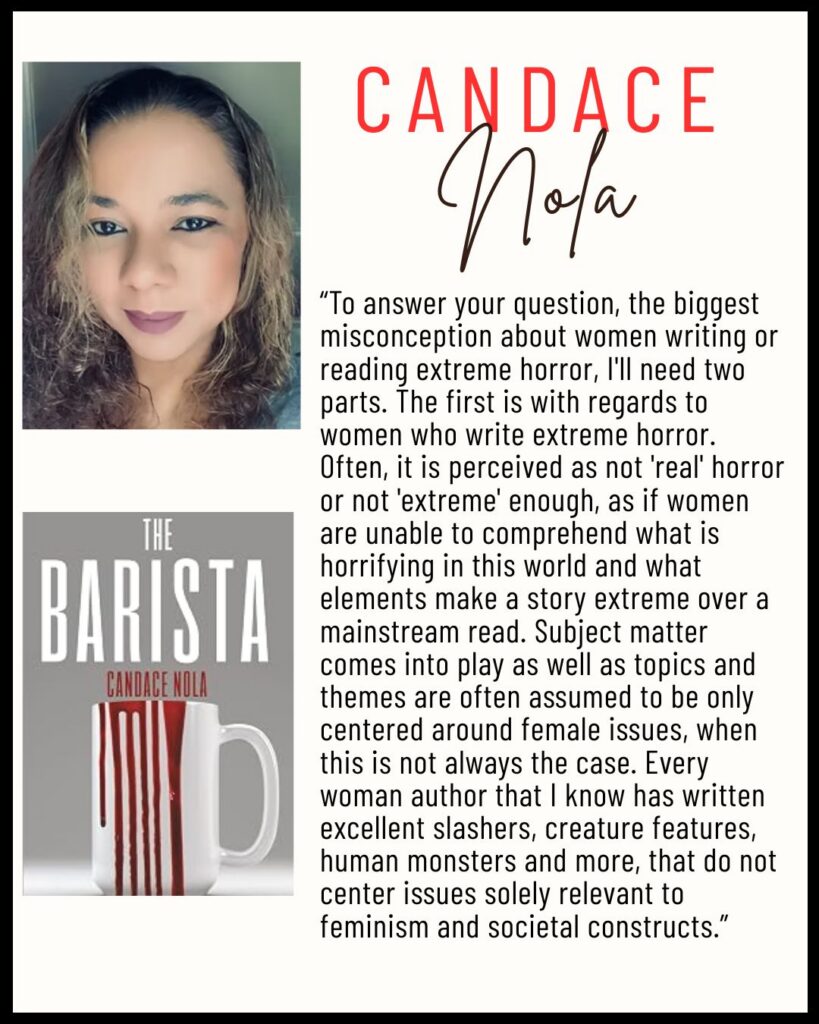
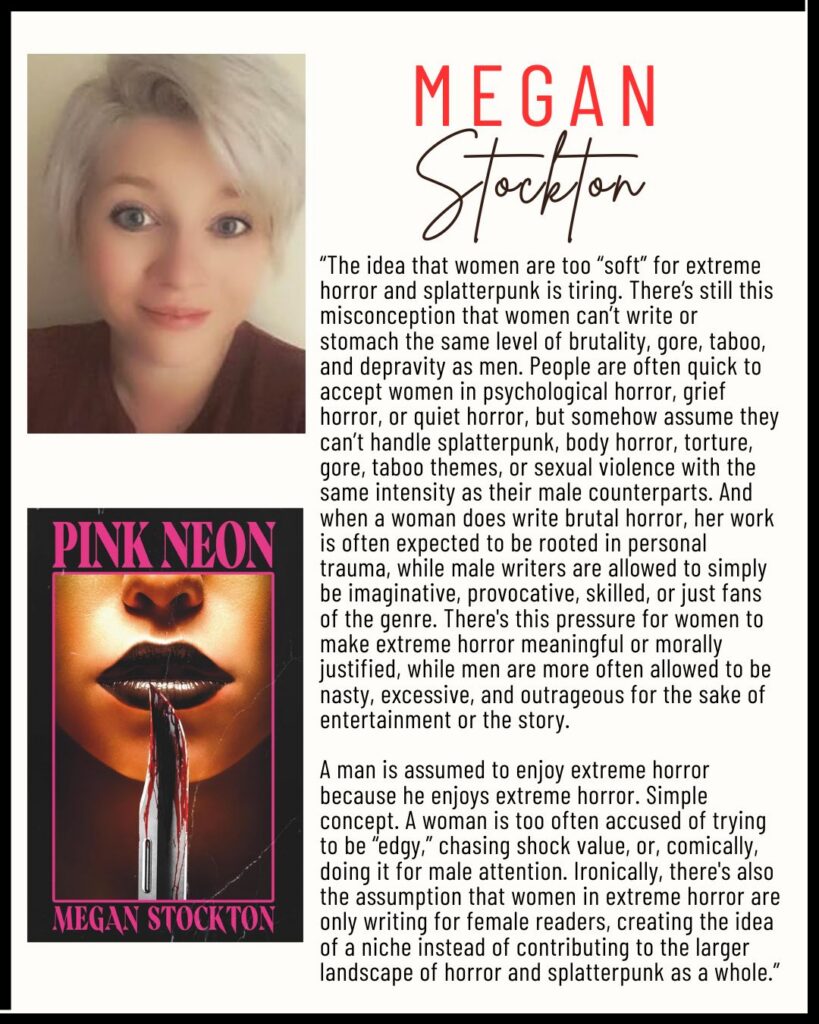
Read Amanda M. Blake and J.S. Douglas in Horrific Scribes…
Read Blake’s short story “Weed Killer” in Horrific Scribes February 2025.
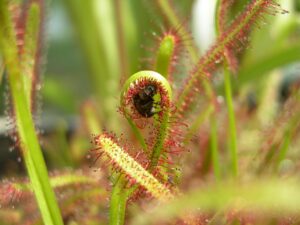
Description: A large persistent weed grows outside a historical downtown donut shop.

Read Blake’s short story “Nest/Infest” in Horrific Scribes May 2026.
Description: A one-night stand gone horribly wrong just a little after COVID lockdown ends.

Read Douglas’s short story “Dysmenorrhea” in Horrific Scribes November 2025.
Description: Dysmenorrhea, a.k.a. period pain. It can be brutal. Disgusting. Agonizing. Horrific. When it hits, the only thing you can think about is escaping it. Your job doesn’t matter. Heck, the place where you curl up into the fetal position and pray for unconsciousness doesn’t matter. The only thing you can focus on is the pain. In “Dysmenorrhea,” a woman crawls into the break room closet to drown in her agony. When she finally climbs out of her coworkers’ shoes and coats, she discovers the world has undergone an apocalyptic change.

Read Douglas’s short story “Like and Subscribe” in Horrific Scribes March 2026.
Description: The Humbart Family channel features “wacky pranks and funny antics,” bringing in followers from across the internet. After years under the unblinking eye of the camera, the Humbart children have reached their breaking point. This Christmas, it’s time for revenge.
Read Douglas’s selection of poems “Four Poems of Violence and Revenge” in Horrific Scribes September 2026.
Description: Poems that plumb the depths of violence found in modern times and in accounts throughout history. These pieces address everything from social media’s effect on families to bloody revenge to spontaneous human combustion.
AND read Christine Morgan and Monica J. O’Rourke in Extremely Weird Splatter…

Morgan contributed the story “What They Deserve” to Extremely Weird Splatter.
The narrator won’t tell us where they are or why. But, based on the reek of blood and vomit, we know things for them are about to get a lot worse.
“Oh, we humans are, by far and always, the worst monsters.”–Christine Morgan
O’Rourke contributed the story “Symmetry” to Extremely Weird Splatter.
A man who kills in search of order plans to subject his next victim to a historically brutal form of torture.
“To be honest, the only technique I use is to keep writing… and see if it gets under my skin.”–Monica J. O’Rourke
References:
“Splatterpunk! Extreme Horror! Oh My!” Klipsun Magazine, 3 Oct. 2025, https://www.klipsunmagazine.com/fall2025veridisquo/homepage/splatterpunk-extreme-horror-oh-my.
“The 4 Forgotten Women That Built Horror.” FYEAH History, 21 Oct. 2017, https://fyeahhistory.wordpress.com/2017/10/21/the-4-forgotten-women-that-built-horror/.
Vergara, Vernieda. “A Beginner’s Guide to the Splatterpunk Horror Genre.” Book Riot, 22 Oct. 2018, https://bookriot.com/splatterpunk-horror/.
“Women Who Built Horror.” Zócalo Public Square, https://www.zocalopublicsquare.org/women-who-built-horror/.
“Roberta Lannes.” Wikipedia, https://en.wikipedia.org/wiki/Roberta_Lannes. Accessed 25 Oct. 2026.
Leave a Reply