
Women in Horror: Gaining Recognition for Exploring Sexual Diversity and Taboo
by Reese Hurd
Women who write horror often have an affinity for taboo sexuality. They explore it in ways male writers usually don’t, maybe because they haven’t had to. Through violence and horror, women writers ask the questions about sex and sexuality that really matter.

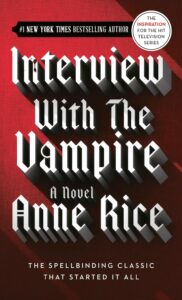
A prime example of a work of horror by a woman that raises important questions about taboo sexuality is Anne Rice’s debut novel, Interview with the Vampire. Rice wrote the book in 1973 to make sense of her grief following the tragic loss of her daughter, and critics and publishers relentlessly rejected her for years. In 1976, she was finally recognized–only after she stood on street corners handing out copies for free (a humiliation even the most incompetent male authors likely wouldn’t face). Throughout the novel, Rice emphasizes the sexual fluidity of vampires through shifting gender roles and homoeroticism, particularly in the relationship between the main characters, vampires Louis and Lestat. They behave like toxic and passionate lovers, blurring the lines between cruelty and tenderness. Rice also brilliantly demonstrates a perversion of the heteronormative family unit. Louis and Lestat serve as “co-parents” to Claudia, a five-year-old girl turned into a vampire by Lestat in order to please Louis. This taboo vision of sex, gender, and family continues to make the novel’s genius clear fifty years later, when some people still find the idea of a family with two male parents shocking.
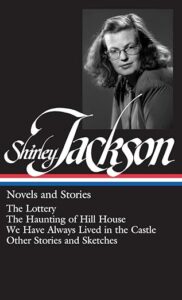
Shirley Jackson took a similar trajectory through her career. She was relatively well-known as a commercial author in her lifetime. However, critics didn’t recognize the wide-ranging brilliance of her work until after her death. Jackson now holds a legacy as one of the greats of the American Gothic. Most U.S. middle school kids study her short story “The Lottery” in American Lit courses. Her novel The Haunting of Hill House (1959) received a classic film adaptation by Robert Wise titled The Haunting in 1963, another very poor (but major) film adaptation by Jan de Bont titled The Haunting in 1999, and more recently the 2018 Netflix limited series adaptation by Mike Flanagan, with the original title The Haunting of Hill House, which is one of the most adored series on the entire platform. In the original novel, the character of Theodora acts as an embodiment of resistance to the ideals of womanhood in post-war America. She arrives at Hill House completely alone and very clearly admits to committing one of America’s most shameful crimes: being disinterested in a husband. Jackson beautifully develops the ambiguous relationship between Theo and the main character, Eleanor, throughout the novel as their interactions in the terrifying Hill House take place in the gray area between platonic and romantic. The sexually transgressive nature of Jackson’s work, which may seem obvious today, went largely unnoticed in her time, and between her death in 1965 and 2010, most of her works other than The Haunting of Hill House, We Have Always Lived in the Castle (1962), and some short stories became unavailable. A revival in the 2010s finally brought fuller recognition to the importance of her complete body of work and to its more daring dimensions.
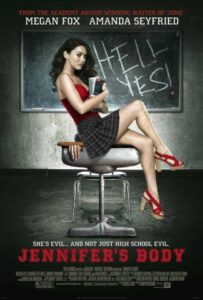
A more contemporary example of taboo-breaking women’s horror writing appears in the film Jennifer’s Body (2009), written by Diablo Cody and directed by Karyn Kusama. The film completely tanked at the box office upon release and sits at a whopping score of 47% on Rotten Tomatoes. False marketing led the horny incels and older brothers of the late 2000s to believe that star Megan Fox would give them a performance similar to the alluring one she gives in Transformers (2007), and they were thoroughly disappointed and incapable of conceiving that not every piece of media caters to them. Audiences were also unfamiliar with the notion of a film focused entirely on the relationship between two young women, in this case characters Needy Lesnicki and Jennifer Check. In Jennifer’s Body, men are simply pawns that move the story forward or, more often, demon food. The film also explores bisexuality. Needy asks why Jennifer is going to kill her–she only murders boys! Jennifer provides an iconic response: “I go both ways.” The film is now widely recognized as a cult classic, and its engagement with the unfamiliar and taboo deserves much of the credit.
And there we have it—a brief history of women writers whose sexually transgressive works were not immediately accepted or understood by the public but eventually achieved widespread appreciation for their bloody efforts to address cultural taboos. Rice, Jackson, Cody, and Kusama all dare to talk about the things that we often don’t want to, but because they do, we’re not likely to stop talking about them.