Five Tales of Aquatic Creepy Crawlies
by H.J. Dutton
This article builds on two previous articles, “Five Stories about Bugs and Creepy Crawlies” and “Four Stories Set Underwater.” Although reading those articles is not necessary for understanding this one, understandings of creep-factors and specific underwater frights are related… and you can also get similar thrills from those articles’ recommendations.
So, like insects, underwater, creepy crawly invertebrates have a penchant for unnerving us on a primal level. And like our aversion to insects, our deep-seated revulsion at the deep-sea squirmies stems from a few key factors, such as their alien anatomies, lack of identifiable expressions, and associations with parasitism. Though our fear of tentacled terrors from beneath the waves stretches back much further than history, it is perhaps clearest in our relatively recent encounters with a legendary deep-sea predator. Early glimpses of the “kraken” – a creature we now know as architeuthis dux, the giant squid – fueled sailors’ nightmares for millennia, but our first documented encounter with the beast occurred in 1873 when one attacked a Newfoundland fishing boat, turning seafaring folklore into verifiable fact overnight. Video evidence of the creature wasn’t captured until 2012, over a century later. To this day we know next to nothing about its kind, and even less about its equally massive cousin mesonychoteuthis hamiltoni. This continued lack of knowledge, combined with the creature’s absurd scale, summons deep dread and obsessive awe. That fascination wars – and often overrides – our primal fear, a feeling that ultimately applies to all aquatic invertebrates.
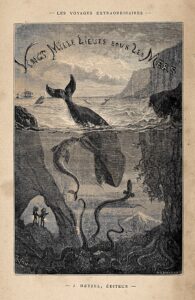
Jules Verne famously taps into this dynamic in his 1870 adventure novel 20,000 Leagues Under the Sea, in which Captain Nemo and his crew must fend off a giant squid when it attacks the Nautilus vessel. In 1991, author Peter Benchley published Beast, a novel that essentially replaces the great white shark in his magnum opus Jaws (1974) with a giant squid in an attempt to elevate the invertebrate once again to the level of canonical terror.
The short stories below reflect the dynamic of awe and terror inspired by the underwater invertebrate, arguably to an even greater degree of success thanks to their brevity and perhaps to their more concentrated skill.

“The Derelict” – William Hope Hodgson (1912)
A ship doctor recounts his former crew’s run-in with an abandoned vessel they discovered in uncharted waters. Upon boarding, they discover the abandoned vessel has an occupant – just not a human one. Not as iconic as Hodgson’s “The Voice in the Night” but arguably far more frightening.
“The Inhabitant of the Lake” – Ramsey Campbell (1964)
Seeking seclusion for his next project, painter Thomas Cartwright rents a lakehouse in the English countryside. He begins having nightmares shortly after moving in, ones that suggest the decrepit lake outside isn’t as empty as it looks. Of Campbell’s many contributions to the Cthulhu Mythos, this is one of his most imaginative.
“Copping Squid” – Michael Shea (2009)
A clerk stuck on the night shift kicks out a regular nuisance named Andre out of the liquor store – but rather than call the police, he takes pity on the man and offers to drive him out of the rough neighborhood. This act of kindness proves to be a catastrophic, life-changing mistake. A shining example of a modernized Cthulhu Mythos tale.
“The Thing that Drifted Ashore” – Junji Ito (2017)
Another manga entry from the master himself. In it, a mob of beachgoers and researchers flock to the Japanese coastline when a worm-like behemoth washes ashore. Upon closer inspection, the crowd discovers that the creature’s stomach is full of human bodies – ones that are still very much alive.
“He Sings of Salt and Wormwood” – Brian Hodge (2018)
Marine worms are among the most diverse groups of invertebrates on the planet, and one that seldom appears in fiction. In this tale, a retired surfer discovers a number of strange wood-carved sculptures outside his shorefront home. Things go downhill for him and his wife when – while free-diving – he stumbles upon the source of the sculptures.
For more tales of creepy crawlies, consider the following stories in our archive:

Read Alistair Rey’s short story “Snails” in Horrific Scribes November 2025.
Description: When a medical examiner is called to inspect a strange creature found beneath the city, he uncovers a discovery that defies anatomy… and sanity. In the flicker of fluorescent light, the walls seem to breathe, and what’s dead refuses to stay still. A story of decay, obsession, and the slow horror of what hides beneath the shell.

Read Amanda M. Blake’s short story “Nest/Infest” in Horrific Scribes May 2026.
Description: A one-night stand gone horribly wrong just a little after COVID lockdown ends.

Read Steve Toase’s short story “Húsið Mitt” in Horrific Scribes October 2025.
Description: Thomas Stape meets regularly with old friends to eat out. Over the years they have eaten in Michelin-starred restaurants and kneeling down on carpets by the gutter. Sometimes they’ve feasted like kings in hidden country pubs. Other times they’ve sat in rooms more sterile than any operation theatre. Tonight, Thomas has found somewhere special, unlike anywhere they’ve eaten before.