I Am Publishing Noir Falling Because I Hate Anti-Intellectualism (And It’s a Fun Read, Too)
by L. Andrew Cooper
American anti-intellectualism is stupid.
Anti-intellectualism doesn’t have to be American to raise questions about the, um, intellects of the people who support it. Anti-smart isn’t smart. We’re at the level of the definitional, the self-reflexive.
Not that self-reflection is a strength of the anti-intellectual. Self-reflection is an intellectual activity and generally on the naughty list for those who abhor the life of the mind.
Anti-intellectualism fares better in the U.S. of A. than in many, probably most, technologically advanced (or at least technologically dependent) societies, and it has a sad, ironic history because it grew up hand in hand with American Democracy.
The proper function of democracy depends on people being educated enough to use their power and to keep people with criminal intent from abusing the system to increase inequities and take that power away. Criminals, powermongers, bullies, and other ne’er-do-wells, then, have always had an incentive to make being smart—being educated enough to keep a democratic-republic functioning fairly—seem bad. Anti-intellectualism was an invisible “check” on democracy letting the lower classes get out of hand from the time of the American Founding Fathers, and unfortunately, it has been successful.
People might rightly criticize the hoarding of educational resources by the rich and the exclusion of the poor and minorities from elite institutions overtly through most of history and some would say covertly today. But clever, bad people—themselves educated—have managed to confuse problems of the cultures surrounding education and regulating access to it with problems of being educated. Problems with the educational system do not make being educated or, not to put too fine a point on it, having a greater capacity for being educated a bad thing. Unless a smart, educated person is a threat to your own wealth and power.
Thus, people vested in keeping democracy from getting out of hand invented the “quintessential American,” from the “Average Joe” to the High School Hero to the American War Hero, as someone quite opposite from the person applying intellectual skills to solve problems. The intellectual problem-solver, nowadays, has gotten an education despite likely having faced physical and emotional abuse for being a “nerd” or despite otherwise dealing with lower social and sexual status as a result of being smart, which “regular” people see as problematically abnormal (as opposed to attractively abnormal, like being unusually athletic). The intellectual, whose “success” depends on being able to do mentally focused work in conjunction with others, isn’t the gruff, “self-reliant” American ideal of the man of few words who comes from harsh “real-world” experience rather than suspicious “book-learnin’.” The intellectual might have spent time in a library that he (or, perish the thought, she, or even they) would have been better spending scoring touchdowns or otherwise scoring—heh heh—with a hot girl.
I was a scholarship kid. I went to a public high school living in an apartment with my single mom. Nevertheless, I must be very, very careful mentioning where I went to college, that I even went to grad school, and where I got my PhD (even when talking to people who have PhDs). Some people react very badly, even if they’ve asked, when they hear “Harvard” and “Princeton.” Like telling them is attacking them. And those are just the people who react openly… many more people dislike me in silence.
What I am writing here is not a fresh revelation. Why mention it now?
When a man, a felon, who says he’s a genius but talks like an idiot and devotes substantial resources to dismantling fact-checked media as well as educational and democratic opportunities for the majority of the population is President, American anti-intellectualism has become an epidemic to eradicate.
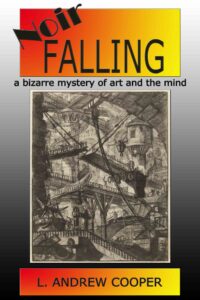
But on a personal note, I’m also republishing my novel Noir Falling, no doubt the brainiest thing I’ve ever published, maybe the brainiest thing I’ve ever written, and I just read a review of my anthology Worlds Collide that quoted a line I’d written that referred to empiricism and phenomenology and dismissed me as someone who “just likes to hear themselves talk.” I’ll admit what I wrote might have erred on the side of weighty, but I won’t admit it was gasbagging… rather, I think it went over this reviewer’s head, and in fine American style, the reviewer felt comfortable blaming me for being too smart/educated rather than blaming themselves for not being smart/educated enough. Certain people believe smart/educated is out of place in horror and other speculative, bizarre fiction. Part of my mission in life is to oppose this view.
The anti-intellectual reviewer I’ve mentioned would not enjoy Noir Falling, which I decided to write without intellectual inhibition, something I don’t often allow myself to do. Though I encourage readers to skip over anything they don’t “get”—the book is not written for everything to make sense anyway—it’s full of big words and bigger concepts and unexplained references that you won’t get even if you do read this new edition’s special introduction and guide. I’m not even sure I remember what everything in it is about anymore. Brain cells die, you know.
But while they’re alive, we should let them thrive. Most of what I write is a fuck you to something. I have trouble getting invested in a project that isn’t in some way transgressive. Well, okay, Noir Falling is transgressive in ways beyond daring to be intellectual. But these days, daring to be smart—daring to say, “It’s okay if not everyone gets everything”—challenges an America, even a world, willing to elect morons as leaders, willing to treat its best and brightest (those words often do go together) like total shit.
Celebrate intellectualism. Make your reading make you think.
All stories in Horrific Scribes are smart in one way or another, but here are some recommendations for stories from the archive I think have a particularly intellectual edge. Calling them intellectual doesn’t mean they’re not emotional. Some of them are more emotionally powerful because of their intellectual intrepidity.

Read Raymond Brunell‘s short story “We Have Not Died Yet” in Horrific Scribes October 2025.
Description: An archaeologist excavating a tar pit discovers impossibly preserved remains—human bodies from eight hundred years in the future, all frozen mid-run, fleeing something. When she recognizes her daughter’s dental work in one of the skulls, she realizes the pit doesn’t just preserve the future-dead: it’s already claiming them. This is a story about temporal paradox, the futility of warnings, and what it means to see your child’s corpse before she’s born.

Read Emmie Christie‘s short story “Chrysalis” in Horrific Scribes August 2025.
Description: The air stagnated in the streets, and the stars were fading from the sky. Siran knew only one thing: she had to keep moving.
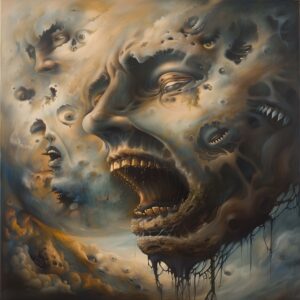
Read Joseph Hirsch‘s short story “The Look on Your Face” in Horrific Scribes July 2026.
Description: A wizened and eccentric billionaire in Las Vegas has taken up painting portraits of subjects wearing horrified expressions on their faces. His method for coaxing such reactions from models is both memorable and more than a little unsettling.

Read Samuel Kozah‘s short story “The Cattle That Came Back” in Horrific Scribes March 2026.
Description: When Zugwai’s cattle vanish in the night, the loss settles into his household like a slow reckoning. Then, before first light, they return, every animal, whole and unmarked, standing in the compound as if they never left. His wife sees answered prayer. His neighbors see evidence of God’s faithfulness. Zugwai sees something else, something older, and he quietly begins to work out what the return will cost.
COOPER’S NOTE: This story is one of my favorites in the archive, and on the surface, very little happens in it. The horror requires an intellectual process that leads to an emotionally devastating conclusion.
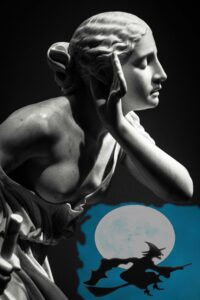
Read Christine Lajewski‘s story “Mother’s Milk” in Horrific Scribes March 2026.
Description: A goddess got displaced and demoted. Then she got mad.

Read Thomas C. Mavroudis‘s short story “Revelations of a Shadow Person” in Horrific Scribes, December 2025.
Description: Everything you really didn’t want to know about shadow people because you were too afraid to ask, straight from the source.

Read E.W.H. Thornton‘s short story “The Slide” in Horrific Scribes July 2025.
Description: The refuge of beauty and truth becomes a trap as the creatures lurking within the lies we tell ourselves emerge to feed.
[Silas adds: On a more literal level, a college professor lectures about photography and death, but what she reveals through a series of dark images is far more than academic.]