More Internet Horror
by H.J. Dutton
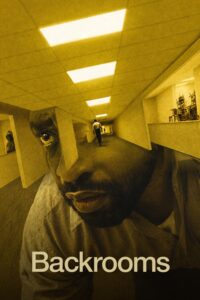
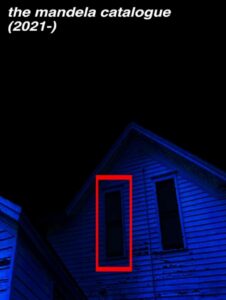
The internet democratizes access for artists, writers, and other creatives: anyone, regardless of experience or connections, can post a project on the web and gain a following. Kane Parsons, director of A24’s The Backrooms (2026), is a famous example of someone who took advantage of this access, having started his career in his bedroom with nothing but Blender software. Artist Trevor Henderson, once a niche illustrator on Instagram, recently sold the feature film rights to two of his characters to Warner Bros. and TriStar Pictures. Likewise, Alex Kister, creator of the Mandela Catalogue YouTube series, is now working with none other than Steven Spielberg to produce a film adaptation of his work. Granted, today’s attention economy makes the odds of fame much lower than they were twenty years ago, when YouTube and other now major platforms were in their infancies. Nevertheless, the internet has made possibilities for creative success exponentially greater than they were before the digital age.
Six months ago, I wrote a post about analog horror in digital media and included five of my favorite examples. While I think the post successfully defined analog horror and distinguished it from similar modes such as found footage, its list of examples was rather short. Many other examples of readily available analog horror deserve attention, and limiting discussion of internet horror to analog alone would be a mistake. Internet storytelling is diverse, including formats and media you likely wouldn’t have thought could deliver compelling horror. Below, I’ve selected examples that demonstrate this diversity, going beyond analog. Alongside the analog examples are webpages, mockumentaries, computer games, vlogs, and more. As in the analog horror blogpost, all the examples are free to view on their respective platforms. No subscriptions needed.

Marble Hornets – Troy Wagner, Joseph DeLage (2009)
Over a decade before the first analog series hit the web, Wagner and DeLage set the gold standard for internet horror with their nine-hour YouTube series. It’s not the first ever horror series ever to grace the internet, but it’s by far the most foundational, establishing the definitive Slenderman mythos that would dominate mainstream internet horror for years to come. The narrative follows a team of amateur filmmakers as they struggle through a script and become increasingly aware that something otherworldly has taken notice of them.
Gemini Home Entertainment – Remy Abode (2019)
Framed as a collection of 70s era home videos, Gemini delivers a series of seemingly disconnected documentary clips, infomercials, PSAs, and video game clips. Beneath that disconnected surface, though, the program is desperately preparing viewers for a threat they likely have no hope of surviving.
Mystery Flesh Pit National Park – Trevor Roberts (2019)
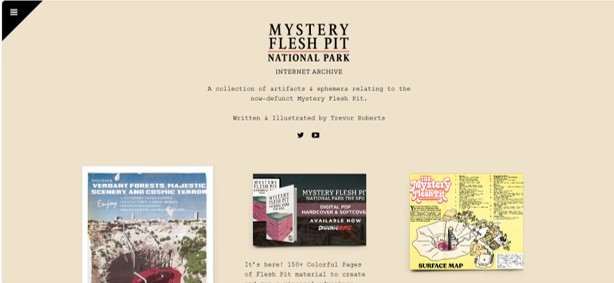
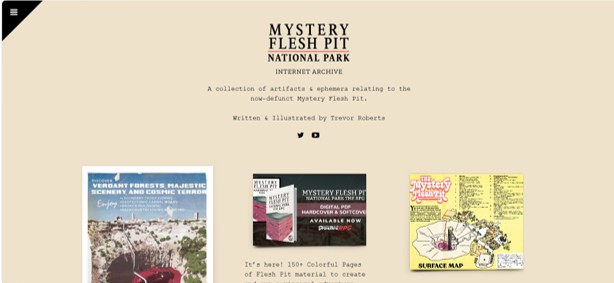
Written and illustrated by one man, this archive at https://www.mysteryfleshpitnationalpark.com describes the history, geology, and ecosystems of a national park that doesn’t exist. Attention to detail is an understatement. Roberts fleshes out his ingenious ideas to their fullest extent, covering cross-sections, maps, merchandise, ads, blueprints, biology, and much more.
Monument Mythos – Alex Casanas (2020)
Like Roberts in Flesh Pit, Casanas tells the story of an alternate-history America rife with nightmarish anomalies. Landmarks such as the Statue of Liberty and Washington Monument are reimagined as eldritch monoliths masking terrible truths behind their exteriors. But where the Flesh Pit is intensely detailed in its horror, the Monument Mythos relies much more on implication and the unknown.
Fake Documentary Q – Daichi Minaguchi (2021)
Where the prior entries entail long-form narratives, this mockumentary presents itself as an anthology of loosely connected evidence of the supernatural. It’s a veritable cornucopia of the best horror tropes, including cursed media, found footage, folklore, cults, spatial anomalies, descents into Hell, and more. Its entries Film Inferno and Basement are arguably the scariest pieces of media on this list.
Chezzkids Archive – Other Videos (2022)
Framed as an early-2000s educational site for children, Chezzkids functions like a narrative onion. Each entry peels back increasingly rotten layers toward the truth behind its fictional creator. It’s a slow burn but one with tragic secrets that are worth the wait.
Lacey’s Wardrobe – Ghosttundra (2023)
Those of you who played internet flash games in your childhood will instantly recognize this short film’s aesthetic. It’s that nostalgic groundwork that makes the inevitable shift in tone so effective. Lacey’s Wardrobe is one entry in a small series of videos, though I think its first is by far the best for the aforementioned reason.
The Glendale Archives (2026)
A vlog, short for “video blog,” is exactly what it sounds like. It’s a form of blogpost in which the cameraperson uses video to document their daily life, a type of web content that’s still popular today. In a stroke of genius, The Glendale Archive merges the blog format with an I Am Legend-esque post-apocalypse narrative. However, compared to the competent monster hunter of Matheson’s 1954 novella, The Glendale Archive’s anonymous protagonist is far more vulnerable.
(Channel name matches series name)
For more media-driven horror, consult Horrific Scribes…
Painting and Photography
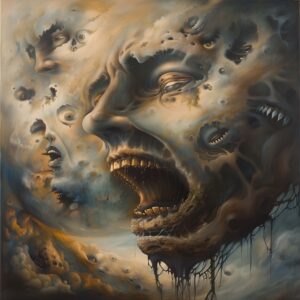
Read Joseph Hirsch‘s short story “The Look on Your Face” in Horrific Scribes July 2026.
Description: A wizened and eccentric billionaire in Las Vegas has taken up painting portraits of subjects wearing horrified expressions on their faces. His method for coaxing such reactions from models is both memorable and more than a little unsettling.
Photography

Read E.W.H. Thornton‘s short story “The Slide” in Horrific Scribes July 2025.
Description: The refuge of beauty and truth becomes a trap as the creatures lurking within the lies we tell ourselves emerge to feed.
[Silas adds: On a more literal level, a college professor lectures about photography and death, but what she reveals through a series of dark images is far more than academic.]
Film

Read Jeffery Sims‘s short story “The Artistry of Poteauje” in Horrific Scribes October 2025.
Description: Mysterious foreign director Poteauje comes to Hollywood. His first picture involves murder. Poteauje demands realism, but in his business, what is real?
Home Video

Read Paul Edmonds‘s short story “Grand Guignol” in Horrific Scribes, February 2026.
Description: A guys’ poker night gone wrong; smut, friendship, and a cursed videotape spiral into carnage.
Internet Video

Read Thomas C. Mavroudis’s short story “From a Trail Cam Pointed at Our House” in Horrific Scribes, June 2025.
Description: A frustrated father gets tricked into watching a very unnerving “suggested for you” video online.