
Interview with Maxim Volk, Author of Deadbeat and “My Love, Like Moss, Envelops You”
by L. Andrew Cooper
I caught up with Maxim Volk, author of the story “My Love, Like Moss, Envelops You” in the anthology Extremely Weird Splatter forthcoming from Horrific Scribblings, to talk about their book Deadbeat just in time for its release.
About the Author
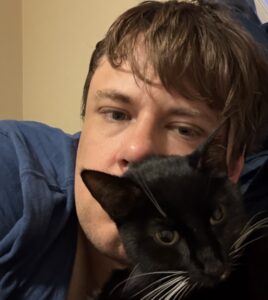
Maxim Volk (they/he) is not in a cult anymore. Now they write things. Horrible things. Terrible things. Things that are sure to make God regret dropping Adam and Eve in that garden with no pants on. Their work has appeared in Carnage House, Macabre Magazine, Horrific Scribes, and more. Their first book, Deadbeat is from Slashic Horror Press, https://www.slashichorrorpress.com, with a June 15, 2026 release.
Deadbeat

Welp, you’re dead. Weird, right? That’s usually how these books end, but here you are, at the beginning, dead as a doornail. Good news? There’s a magical cult ready and willing to resurrect you. Bad news? You’ve reawakened with an insatiable hunger for human flesh. You’ve always had a penchant for eating ass, but this is ridiculous. Who should you eat first? The choice is up to you. There’s a lot of tasty guys out there just waiting to be eaten.
The Interview
Extreme Queer Nostalgia: Choosing Your Own You.
LAC: Your novella Deadbeat is #1 in the Extremities series from Slashic Horror Press, and it’s built like a Rated X (for sex and violence) reboot of adventure-themed books from my 1980s childhood that were written in the second person and prompted readers to make choices that shaped the story. Only… I think you’re a good deal younger than I am. What’s your attraction to this type of book? Second-person narration has become a more common literary choice in the last couple of decades—is your choice of second person passing a literary agenda in pulp disguise? I think those books might have been part of my early childhood queerness. While other boys were off doing… typical boy… things… I was inside reading books that made me the hero in worlds totally unlike the one I was stuck in. I got to experience identities other than the one I had to pretend was me. What do you think—is there something queer and/or queerly liberating about becoming another “you,” trying on a new identity, and shaping your story as you read? Why or why not?
MV: Growing up, even long before I knew or accepted that I was gay, it was drilled into my head that there was really only one path for gay guys, and it was death. One of the beauties of this genre is that we get to pick our own path. There is not just one ending, but many, some horrific, others less-so (though it may be difficult to find a happy ending in Deadbeat). On a less queer, but still personal note, I liken this style to a video game, where you might find Easter eggs and alternate endings, some more difficult to discover than others. I can spend hours lost in Red Dead Redemption or Cyberpunk 2077 exploring every little corner. This genre feels similar.
As far as second-person narratives are concerned, I love experimenting with different styles. My next book is a first-person narrative, though certainly not one that is traditional, and the one after that is a third-person narrative. I also recently had another second-person story titled “The Flowers on Your Unmarked Grave” published through Trashlight Press, though this one is a bit more literary, and it was fun to explore a different style of second-person narrative there as well. For Deadbeat, the second-person narrative helps with the sardonic tone, I feel. I tried to make it seem like the narrator is judging you, the reader, for choices that you make.

Extreme Queer Zombies: George Romero vs. Bruce LaBruce.
LAC: When George Romero’s Night of the Living Dead defined the modern zombie (without ever using that word) in 1968, it did so with a story that put a member of an oppressed minority, a black man, in the role of main protagonist, and it made his blackness central to the outcome’s horror. Does Romero’s trailblazing association of the modern zombie with minority politics relate to your decision to explore queer zombie horror in Deadbeat? How so and/or how not? If you haven’t seen Bruce LaBruce’s extreme queer zombie films, look them up. What do you think? If you have, how specifically have they influenced you? At one point in Deadbeat, your protagonist wonders about the… unfamiliar… erotics of being a zombie. Does queer eroticism have a special relationship with zombie eroticism? Why or why not?
MV: I am not a huge movie aficionado (my ADHD does not allow me to sit and watch a 2-hour program), so I’ll be honest and sheepishly admit I know Night of the Living Dead in name only. However, I did consciously think about the overlap of queerness and zombie stories (or the lack thereof) while writing this book. The Walking Dead always felt to me like it treated queer characters poorly (all characters poorly, to be honest), and even campy, trashy horror that feels like it should be inclusive, like the CW’s iZombie failed its queer characters. (There was a character in iZombie whose only reference to being queer was in a deleted scene, and then he was written out with little comment in the next season.) I wanted my story to feel like it could not be separated from its queerness any more than it could be separated from its zombie elements. Both are equally integral to the story, and, as I’ll mention later, fully intertwined.
Which brings me to the second question. The only queer zombie story that immediately came to mind when I was writing this story was Otto: Or up with Dead People, which I was going to reference in response to this question, and, lo and behold, when I looked it up to be sure I had the name right, I discovered was directed by Bruce LaBruce. So, while I was familiar with LaBruce’s name from some of his less-gory (though not any less transgressive) movies, I suppose he did influence my writing of this book. There is a scene in Otto specifically that comes to mind, zombie sex that is so transgressive, the first time I saw it, my thought was “Can they show that on screen?” There were a few times while writing this book where I asked myself the same question, only for the page instead of the screen.

I think the connection between zombie and queer eroticism lies in exploration. Unless one is lucky enough to have gone to a school with inclusive sex education—I certainly was not—queer kids’ (and adults’) sexual exploration often either comes from watching porn or from a “working things out.” There is no roadmap for queer sex for many, just like there is no roadmap for our zombie friends who are navigating sexuality in a new body.
Extreme Queer Horror Comedy: “The Tone of Pettiness and Spite.”
LAC: In your afterword, you refer to Deadbeat having a “tone of pettiness and spite,” but it’s not a harsh tone—it’s bitchy but also funny, at least sometimes. Do you intend Deadbeat as horror comedy? Why or why not? Am I twisted for finding some of the extremely graphic descriptions of eating people rather amusing? Why or why not? How do you feel about words such as “camp” and “campy,” and do they apply here? How much? Must spite with a sense of dark, gruesome humor be petty? Might it not be exactly what certain people deserve?
MV: I did intend Deadbeat to be a horror comedy. I find that “zombie” as a genre has been done to death, no pun intended. I almost decided against writing this story for fear that I wouldn’t be able to make it feel original. For me, a zombie story needs to have a unique spin. I was uninterested in rehashing The Walking Dead or Day of the Dead; there’s also a bleakness about both of those that I don’t like. Deadbeat is by no means a happy-go-lucky story, but the comedy helps keep the tone from being defeatist.
I’ve always viewed camp as a label that needs to be applied by an audience and not an author. I did intend it to be campy, and I hope it comes across that way, but I don’t want to be the one to label it like that and then have it fall flat. Nothing worse than picking up a piece of media self-described as campy and then find that, in trying to be “so bad it’s good,” it circled back around to bad again.
And yes, I meant the descriptions of dismemberment to elicit a horrified laugh. Death in real life is rarely funny, but knowing that these characters are fictional allows me to play with the inherent hilarity of being dismembered and eaten. I wanted it to feel like a Garth Ennis comic book or the car accident scene in Meet Joe Black, horrific, but in a way that invites the audience to laugh and then feel bad about laughing. Tied to that hilarity, I think spite can sometimes be gleeful and petty, a big “fuck you” to the people who hurt you. I recently read Bunny by Mona Awad and found a similar tone. There’s a blackness to the comedy that feels simultaneously petty and spiteful, like the antagonists were straight out of her own life, and she delighted in torturing them.

Extreme Queer Appetites: Sex, Eating People, Sex.
LAC: One of extreme horror’s extremes is often graphic sex, but even though I’m gay, since I spend most of my time reading straight fiction, I still get an extra shock from graphic queer sex. Depending on your (the reader’s) choices in Deadbeat, you could be getting rammed in the ass very early on, and in your (Maxim Volk’s) story for the forthcoming anthology Extremely Weird Splatter, “My Love, Like Moss, Envelops You,” you allude bluntly to anal sex in the second paragraph and get much more graphic from there. Do you see yourself as using queer sex in horror as way to up the ante—more than straight sex would—on extremity? Why or why not?
MV: To me, the word “queer” itself in the context of “queer sex” implies transgressiveness. Sometimes I wish that was not the world we live in, but it is. I think of a recent rejection that I got for a queer novella that I wrote (that was accepted elsewhere and I signed the contract for about twenty minutes ago as of the time of this interview) where I was told that the story “seemed to be erotica” and that they do not publish erotica. In the entire thirty-thousand-word novella, there were two sex scenes that totaled less than 3% of the story. I can’t help but wonder if the novella would have been accepted (or at least not described that way) if it had been straight sex scenes, or perhaps gay sex scenes that were packaged for a straight audience—straight people are so afraid of depictions of rimming, it’s almost comical. So yes, I think for most audiences, even queer ones, queer sex can be a way of eliciting a strong emotion. I recently finished reading The Sluts by Dennis Cooper, and I felt a lot of similarities to the tone that I go for in my writing. Queer sex is inherently transgressive in the world that we live in, so why not force the audience to sit with that discomfort?

LAC: In Deadbeat, the main character transitions pretty easily from trying to satisfy an appetite for queer sex to satisfying an appetite for eating human flesh. The character even sees the desires as overlapping at one point. What’s the relationship between queer sex and eating people? In “My Love, Like Moss, Envelops You,” queer sex becomes… inhuman. Do this story and Deadbeat suggest that there’s something not only deviant but potentially monstrous about queer sex? If so, what is it? If not, why do the stories connect queer sex with such horrors?
MV: Many of my works, including these two as well as “The Canvas,” published through Horrific Scribes, and “The Consummation,” a story that appears in issue two of Bloodlust Magazine, focus on the overlap of sex and violence, though I think these stories are somewhat unique in the extreme horror/splatter genre in that they do not explore sexual violence so much as sex in which violence plays a key role. It’s not that I am someone who is opposed to depictions of sexual violence—it happens in real life, so it should be allowed to be explored in fiction—but I find that this exploration of eroticized violence can almost be more transgressive in the way that it forces the audience to recognize that not everything that they view as violent in the context of sex is necessarily bad.

I read an interview last year from a bisexual+ person who talked about how they generally only find themselves having sex with queer men because they need a roughness to their sex that is not present in heterosexual sex. There were many people in the comments of that interview on social media who were not queer men/mascs who were viewing the interviewee with contempt, as if the roughness that they craved and received consensually with their male partners was some aspect of rape culture. It got me thinking about how queer people’s sex is often viewed that way, even when fully consensual, agreed-upon beforehand, and mutually enjoyed. Similarly, I recently read what was described as a “feminist critique of gay [male] sex,” and I found myself getting increasingly frustrated with the lack of understanding of how different queer guys’ sexuality is from heterosexual sex, and how, so often, it’s considered not only deviant, but horrific, obviously not for the people having the sex, but for the prudish voyeurs looking in.

Extreme Queer Wish Fulfillment: Cops, Culprits, and Cults.
LAC: In Deadbeat, you (the reader) get to have hot sex (infidelity in particular) and go on a killing spree that, depending on your choices, could include random people, cops, people who have wronged you such as bullies and bureaucrats, and/or bad people who just plain deserve killing. To what extent is Deadbeat about giving readers an opportunity to experience extreme transgression in the driver’s seat—a narrative of twisted wish fulfillment from their point of view? Speaking of which, your bio and notes in the book refer to your (the author’s) history in and emancipation from a cult, and a central scene in the book happens to involve a cult that the reader has the opportunity to slaughter. Do you see that moment as a particularly personal bit of wish fulfillment? How about “My Love, Like Moss, Envelops You”—any wish fulfillment in that very weird tale of sex and slaughter? Given that your background involves being in a community that didn’t accept queerness, to what extent is each act of writing extreme queer horror an extreme transgression in itself? If you see writing extreme queer horror as transgression, how is it effective? If you don’t see it that way, why not?
MV: I did try to allow a bit of wish fulfillment in this book, though there’s also an element of “okay, maybe you’re the real asshole in this situation” in quite a few different paths, a dig at those people who always think they’re the victim of every situation.

Interestingly enough, I did not necessarily view the cult in this book as being reflective of my own experience in a cult. They’re pathetic, sure, but not evil. People with similar experiences to me may get a bit of thrill out of a buffet of cult members, but I got more of the wish fulfillment aspect in some of the power-abusing assholes who get eaten elsewhere. “My Love, Like Moss, Envelops You,” on the other hand, is less wish fulfillment and more a promise, though not because of sex and slaughter, but because of love. I don’t know if I can really explain why without spoiling it, so I will allow the reader to draw their own conclusions.
I view writing anything queer as transgression itself. I mentioned earlier that queer sex is inherently transgressive in the society in which we live. I want my readers to have to sit with the discomfort of reading a queer sex scene that is authentically queer, and not a sanitized, cutesy way, written for heterosexuals, like certain recent uber-popular homosexual (note the intentional lack of using the word “queer” here) stories that will remain unnamed. I also have books that are in the early stages of the publishing process that are not horror at all but are still very transgressive because of their approach to queerness and sex. When it comes to extreme horror, I sometimes think that the genre falls into the trap of just trying to be as gross as possible, which ends up doing the opposite of what was intended. It ends up coming across as more cringe than anything else. There is some gross-out imagery in Deadbeat, and maybe a little in “My Love, Like Moss,” but when I write horror, I try to elicit terror in a different way than just gross-out imagery. My less-extreme horror focuses on leaving the audience unsettled rather than on the verge of vomiting. For my extreme horror, I want my audience to be extremely unsettled, walking away from it with a sense of unease that will last for days.
Extreme Queer Morality: Cheaters and Superheroes.
LAC: Okay, so maybe that wish fulfillment question betrays some of my own bias, as I went into the book planning to be naughty. I (as the book’s “you”) cheated on my husband immediately, killed everyone in my path, and reached THE END very soon. I then went back and explored all the possibilities, of course, and learned that, although you (the reader) die no matter what so you can become a zombie (the book description reveals that point), you actually last longer—and get the reward of more adventure—if you choose to be, um, less naughty than I was. Do the results of choices in Deadbeat suggest underlying morals? If so, what are they? Does the book have a position on fidelity in relationships? Does it encourage readers to choose to be a “good,” heroic zombie rather than a “bad,” monstrous zombie? Why or why not? “My Love, Like Moss, Envelops You” also involves a character with fidelity issues. Why are you drawn back to issues of fidelity and infidelity in same-sex relationships (or at least relationships involving more than one phallus)? In both Deadbeat and “My Love, Like Moss, Envelops You,” marriage might seem like a horror. Is it? Why or why not?
MV: I wanted Deadbeat to be about the choices, good vs. bad vs. monstrous, as the genre lends itself to. I don’t necessarily know if it was intended to be a fable with a hard line between good and evil, though I did want to have a message that actions have consequences. Certain choices we make may come back to fuck us in the ass later, pun definitely intended this time. If you were an asshole a week ago, that might have consequences now. If you make an asshole move on page 20-something, that might affect your ending a hundred pages later.
On relationships, I wrote Deadbeat a few months after a bad breakup during which I was cheated on, so there may have been a bit of pettiness involved in the portrayal of fidelity and cheating in the story. Similarly, “My Love, Like Moss, Envelops You” was written at another juncture in a relationship, one in which it felt important to emphasize that sometimes no amount of careless or even intentional infliction of pain will make certain love go away. The themes are almost juxtaposed in these stories. Deadbeat is about how casually cruel one can be to throw away a long-term relationship, and “My Love, Like Moss,” for all its horrific imagery and stomach-wrenching (literally!) violence, is a love story about how love isn’t something that can be easily discarded.
Deadbeat, Before and After: Queerness as Rot.
LAC: The title “Deadbeat” is a double entendre because the main character, before he dies, is a deadbeat in the sense that he is generally lazy and self-indulgent, sponging off his husband, and after he dies, he’s still the same deadbeat only… dead, his deadbeat-ness now manifesting as the putrefaction of his pretty flesh. His deadbeat decadence becomes literal decay. Linking queerness, decadence, and decay isn’t new in horror; most famously, literary Decadent Oscar Wilde does it in The Picture of Dorian Gray (1891). In 2026, what’s decadent (or Decadent) about queerness?
MV: To me, queerness and decadence are intertwined. There’s something liberating about queer sex being explicitly a breaking of rules and social norms, no need to conform to what others think. Although the protagonist of Deadbeat may be too lazy to really take full control of that. Queerness also feels decadent in the wake of spending most of one’s childhood hearing that sex is for procreation, and everything that isn’t that is just pleasure for which one should feel guilty. So is mutual masturbation or giving a rimjob decadent? Maybe not, but many straight people view it that way.
LAC: Something special enables the main character to become a zombie. The book doesn’t reveal what it is. Will you speculate or, if you know what it is, give us hints?
MV: I actually don’t think there’s anything special that enables the reader to become a zombie. One of the themes I wanted to explore in this book is randomness. No spoilers, but the first few paths that the reader can take in the beginning of the book help emphasize that violence is often random. Likewise, positive events (as much as becoming a zombie can be positive) can also just be left up to the whim of the universe. Sometimes what seems like providence can just be entirely coincidental.
LAC: Does the main character’s rotting body have anything to do with queerness? Why or why not? “My Love, Like Moss, Envelops You” doesn’t involve decay in the way of Deadbeat, but it does involve grotesque, unnatural transformation related to a queer relationship. Would you say grotesque transformation is a prime way for you to explore your experience of queerness? Why or why not?
MV: Sometimes, in relation to the rest of the world, queerness itself feels like rot and grotesquerie. For a repressed, self-loathing young queer person, it’s easy to view ourselves as monsters or as having some deep evil growing inside us. Even somewhat recently, I was told by someone who had no business talking to me this way that being queer was a “sickness” seeping into our souls. Ultimately, it’s not true, but living with it so long allows me to play into the horror I felt.
Current and Future Works, Weird, Extreme, Queer, and Otherwise?
LAC: We’ve been talking about an extreme queer zombie novel of forking paths and a short story that, like all the stories in Extremely Weird Splatter, fuses elements of extreme horror and weird horror (and is also queer). Your growing list of accomplishments is an atypical résumé, to say the least. How do you plan to build it? What, if anything right now, is in the publication pipeline? What projects are you cooking? If you could write and publish anything, absolutely no limits, what would it be?
MV: I have quite a few things coming soon (and less soon), all pretty diverse in terms of genre. My next book A Glass Darkly is coming in 2027 from Laughing Man Publishing House. It’s a psychological thriller through the lens of a deeply-closeted Bible college student. This one borders on autofiction, deeply personal and reflective of a lot of my own personal experiences. Then there’s Glimmer, a sci-fi noir detective novella coming in the next year or so from Whumpy Printing Press about an alien prostitute dragged into an investigation into a trafficking ring. Finally, I have a novel in the sword and sorcery genre that I can’t go into many details about as it hasn’t been announced yet. All three of these books are very queer, very sexy, and very transgressive, as most of what I write is. I also have a cosmic horror story in Tenebrous Press’s Your Body is a Fever Dream anthology, as well as a memoir piece, a couple stories that are more literary in style, and a very short poem about the Mothman, all being published in anthologies by the end of the year. (In case you can’t tell, I’m just writing whatever the fuck I want, genre and branding be damned. I’m sure I’ll settle into one genre eventually, but for now, I just close my eyes and let the stories come to me.)
My in-progress work is a bit more intentional. Right now, I’m almost finished with something that combines the New Weird with splatter once again, a queer novel set in 1980 New York that is full of serial killers, eldritch abominations, extra-dimensional apparitions, and lesbian sex cults. I also plan on finishing an “Up North” gothic novel over the summer (combining elements of gothic fiction with the ennui of living in the “up North” region of the Midwest). I’m going to try to find traditional representation for one or both, so that’s my task for the summer.
My dream is to write and publish a pulpy, queer Weird Western novella series. Think X-Files meets Red Dead Redemption meets Brokeback Mountain. While I’m dreaming, I’d also like it to be optioned for a television show. It’s a longshot, I know, but a year ago, I would have never dreamed of having a book published, and now I have four on the way, so I’m in the “never say never” stage of my career.
LAC: Thank you!